
Authors Alvarado Rodríguez, Santiago Sainz | Date August 2026
License CC BY-NC 4.0 | DOI 10.5281/zenodo.21970306 | Language English
Six months into 2026, maritime geopolitics has moved faster than at any point in the past decade. On February 28, the United States and Israel struck Iranian military targets; within days, Iran declared the Strait of Hormuz closed to what it called unfriendly shipping, laid mines, and began attacking tankers. For the first time in modern shipping history, Hormuz and the Red Sea were disrupted. They are the two corridors connecting the Middle East to world markets, and were disrupted at the same time.
This report is ISDO’s full account of what came next. It is the fullest study of strait geopolitics the observatory has produced to date. It tracks the Strait of Hormuz crisis from its outbreak through two failed ceasefires, quantifies its effect on oil prices, shipping insurance, and global trade, and follows Iran’s creation of a unilateral toll authority over the strait, a governance question this report treats as the clearest test of how 2026 actually ends.
The disruption did not stay contained to the Persian Gulf. Nine other corridors grew more strategically salient across the same six months. The Strait of Gibraltar became an active theater of naval interdiction against Russia’s sanctions-evading shadow fleet. Piracy in the Strait of Malacca rose sharply as displaced Middle East-bound traffic sought alternate routes. The Bosphorus, the Taiwan Strait, the Danish Straits, and five further choke-points examined in this report each absorbed a share of the same underlying strain, for reasons this report traces corridor by corridor rather than treats as unconnected news.
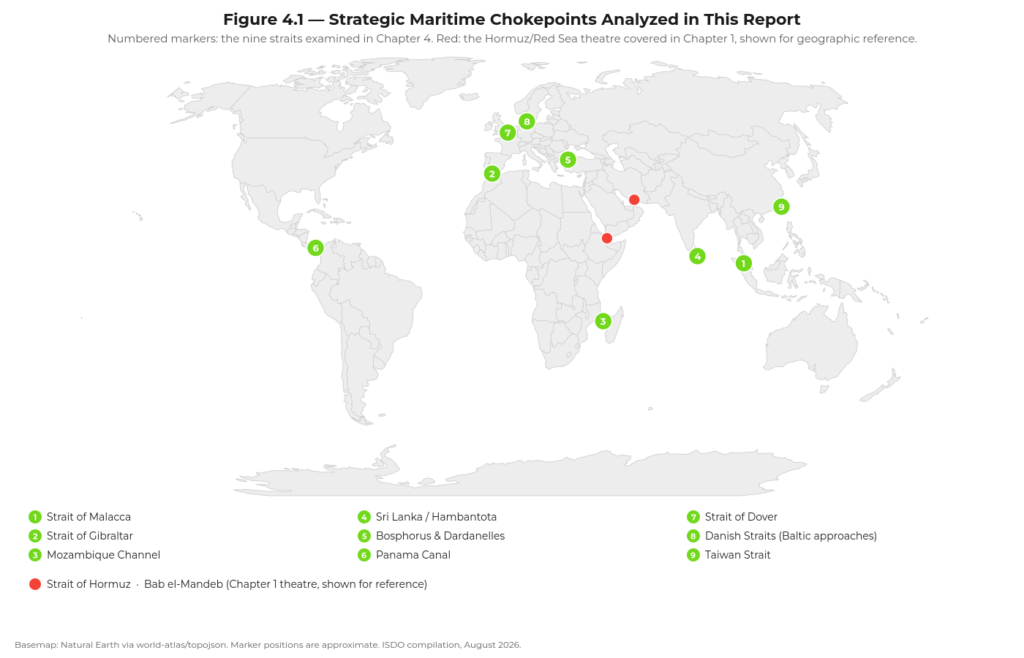
The report’s central finding is that 2026 did not produce a single choke-point crisis. It produced a multiplication of them, and its own scope reflects that: what began as a four-strait analysis grew to nine over a single revision cycle. A four-scenario forecast projects how the compound crisis is likely to evolve through the close of the year, and a closing chapter sets out concrete policy recommendations for governments, shipping companies, and multilateral institutions navigating the new geography of maritime geopolitics this report documents.
The full report, methodology, and complete bibliography are available in the PDF above.