
DOI: 10.5281
| INTERNATIONAL SUSTAINABLE DEVELOPMENT OBSERVATORY | ECONOMICS & SOCIAL AFFAIRS DEPARTMENT |
| AUTHOR Santiago Sainz | PUBLISHED BY International Sustainable Development Observatory (ISDO) · Economics & Social Affairs Department | isdo.ch |
| DOMAIN Human Rights & Social Policy | DATE June 18, 2026 |
| ABSTRACT This report provides a systematic, academically neutral assessment of the documented treatment of four population groups: asylum seekers and recognized refugees, undocumented economic migrants, established ethnic minorities (Roma and Afro-European communities), and second and third-generation citizens of migrant origin, across the 46 member states of the Council of Europe. Drawing exclusively on institutional monitoring sources, including the EU Fundamental Rights Agency (FRA), the EU Agency for Asylum (EUAA), the European Commission against Racism and Intolerance (ECRI), the Committee for the Prevention of Torture (CPT), the European Court of Human Rights (ECtHR), UNHCR, OSCE/ODIHR, and Eurostat, the analysis maps documented practices against the specific legal obligations each state has voluntarily accepted through ratification of the European Convention on Human Rights, the EU asylum directives, and the Race Equality Directive. The report introduces the Country Discrimination Index (CDI), a composite score for 20 Council of Europe states across five analytical dimensions: access to legal procedures, administrative treatment, labor market access, housing and education, and physical safety. Key findings include: systematic non-compliance with the EU Asylum Procedures Directive’s processing time requirements in at least six member states; documented pushback practices in violation of Article 3 ECHR at five major border zones; persistent Roma school segregation at 45% despite legal prohibition for nearly two decades; and no measurable improvement in racial harassment rates against Afro-European communities between 2018 and 2023. The report concludes with a strategic posture grid and policy recommendations for EU institutions, Council of Europe bodies, and member state governments. Published by ISDO Economics & Social Affairs Department. CC BY-NC 4.0. Keywords: asylum seekers; ethnic minorities; Roma; Afro-European; racial discrimination; pushbacks; non-refoulement; ECHR; EU Race Equality Directive; Country Discrimination Index; migration; human rights; Council of Europe Author: Santiago Sainz | Publisher: ISDO – International Sustainable Development Observatory | isdo.ch | CC BY-NC 4.0 | June 18, 2026 |
| TABLE OF CONTENTS Sections · Subsections · Case Studies · Annexes |
| 1. Introduction: The Evidence Gap 1.1 The Central Question 1.2 Four Population Groups and Why Each Matters 1.3 Research Questions and Report Structure 1.4 Structure of the Report and Chapter Outline 2. Conceptual Framework 2.1 The Legal Standards Benchmark Approach 2.2 The Five-Dimension Assessment Framework 2.3 The Four Strategic Postures 3. Methodology 3.1 Research Design and Approach 3.2 Primary Data Sources 3.3 The Country Discrimination Index (CDI) 3.4 CDI Data Adjustments and Intersectional Framework 4. Asylum Processing: Delays, Backlogs, and Procedural Barriers 4.1 The Scale of the Processing Challenge 4.2 Recognition Rate Divergence and the Dublin III Dimension 4.3 Unaccompanied Minors: The Most Vulnerable Applicants 4.4 Landmark Cases Shaping European Asylum Law Case Study: MSS v. Belgium and Greece (ECtHR Grand Chamber, 2011) Case Study: Tarakhel v. Switzerland (ECtHR Grand Chamber, 2014) Current Data: EUAA 2024–2025 Asylum Statistics Update 5. Pushbacks, Border Violence, and Non-Refoulement 5.1 Defining Pushbacks in International Law 5.2 Frontex and Accountability 5.3 Case Studies: Landmark Pushback Rulings Case Study: ND and NT v. Spain (ECtHR Grand Chamber, 2020) Case Study: MH and Others v. Croatia (ECtHR, 2021) Case Study: DA and Others v. Poland (ECtHR, 2023) 2024–2025 Update: Frontex Accountability and Fundamental Rights 6. Reception Conditions and Immigration Detention 6.1 The Legal Standard for Reception Conditions 6.2 Immigration Detention: Standards and Documented Violations 6.3 Case Study: The Moria Fire and the Limits of Minimum Standards 6.4 The CIE System in Spain and the 2024 Canary Islands Context 7. Roma Populations: Systemic Exclusion in Europe’s Largest Ethnic Minority 7.1 The Roma Population in Europe: Scale and Diversity 7.2 School Segregation: The Mechanism of Intergenerational Exclusion 7.3 Forced Evictions and Housing Discrimination 7.4 National Roma Integration Strategies: Assessment 7.5 Case Study: DH and Others v. Czech Republic (ECtHR Grand Chamber, 2007) Case Study: Oršuš and Others v. Croatia (ECtHR Grand Chamber, 2010) 7.6 Case Study: Pata Rat (Forced Eviction and Relocation in Romania) 7.7 2024 Update: EU Roma Strategic Framework Mid-Term Review 8. Afro-European Communities: Racial Discrimination and Structural Barriers 8.1 The Afro-European Population in Europe 8.2 Police Profiling and the Effectiveness of Legal Remedies 8.3 The EU Anti-Racism Action Plan and Implementation Gaps 8.4 Case Study: The Death of Adama Traoré, France (2016–2026) 8.5 Case Study: The NSU Complex, Germany (2000–2018) 8.6 2024–2025 Update: FRA Being Black in the EU (New Findings) 9. Second and Third-Generation Citizens: Discrimination Despite Legal Status 9.1 The Persistence of Disadvantage Across Generations 9.2 Ethnic Profiling by Law Enforcement 9.3 Case Study: The ISM/CORUM Experiment, France (2022) 9.4 Case Study: Name Change and Labor Market Outcomes, Sweden (IFAU 2021) 10. Legal and Institutional Architecture: Gaps Between Commitment and Practice 10.1 The European Court of Human Rights: Enforcement Record 10.2 National Equality Bodies: Resources, Independence, and Effectiveness 10.3 The Race Equality Directive: Transposition Quality and Enforcement Gaps 10.4 Case Study: FMS and Others v. Hungary (CJEU, 2020) 10.5 2024–2025 Update: ECHR Execution Statistics and Emerging Trends 11. Strategic Conclusions: CDI, Policy Recommendations, and Governance Roadmap 11.1 The Country Discrimination Index: Summary Results 11.2 Five Cross-Cutting Findings 11.3 Policy Recommendations: Closing the Legal-Practice Gap Balancing Legal Pressure with Institutional Incentives: A Governance Roadmap 11.4 The 2024–2025 Data Picture: A Snapshot of Current Conditions 11.5 Synthesis: The Fifteen Cases (Patterns and Lessons) 11.6 Policy Innovation Proposals: From Diagnostic to Binding Mechanism 11.6.1 The Early Warning Mechanism (EWM): Three-Level Design 11.6.2 CDI-Linked Structural Funds Conditionality: Legal Proposal 11.6.3 Proposed European Directive on Equality Body Standards 11.6.4 Proposed Pan-European Correspondence Study Protocol 11.7 Intersectional Emergency Governance: Gender in Asylum and Stateless Persons 11.7.1 Gender and Asylum: Procedural Barriers Affecting Women 11.7.2 Stateless Persons: The Population the CDI Cannot See 11.8 The CDI at a Glance: Numerical Scorecard for Key Country Contrasts 11.9 Data Bridges: Connecting Legal Standards to Measured Outcomes 11.10 The Motor of Impunity: Why States Choose Non-Compliance 11.11 The Continuum of Exclusion: From the Border Fence to the City Street References and Principal Sources Annex A: Country Profiles (20 States) Annex B: Glossary of Key Terms (13 definitions) Annex C (Revised): Country Discrimination Index (Full Open-Data Methodology) C.1 The CDI Formula C.2 Dimension Weights and Sub-Indicator Structure C.3 Reporting Capacity Adjustment Factor (RC) C.4 Sensitivity Analysis C.5 Demographic Pressure and Asylum Volume Control Variables C.6 Harmonized Proxy Indicator Framework Annex D: Case Register (15 Cases) Supplementary Analysis: Intersectional Discrimination (Tables S1–S3) LIST OF TABLES (19 analytical tables + 6 supplementary tables) Table 1. Legal Architecture: Principal Instruments, Ratifying States, Primary Obligations, and Monitoring Bodies Table 2. Five-Dimension Discrimination Assessment Framework Table 3. Four Strategic Postures: Definitions, Indicators, and Country Examples Table 4. Primary Data Sources: Institution, Instrument, Coverage, and Known Limitations Table 5. Asylum Processing Times, APD Compliance, Recognition Rates, and Legal Aid Access Table 5a. Top 5 Nationalities: Recognition Rate Divergence (2023–2024 EUAA data) Table 6. Documented Pushback Practices by Border Zone (2022–2024) Table 7. Reception Conditions and Detention: EU Directive Compliance Assessment Table 7a. EU Roma Strategic Framework Mid-Term Progress Assessment (December 2024) Table 8. Roma Discrimination Indicators: FRA Roma Survey 2021 vs. General Population Table 9. National Roma Integration Strategy Implementation Assessment (2024) Table 10. Racial Discrimination Against Afro-European Communities: FRA Being Black 2023 Table 11. Labor Market Outcome Gap for Second-Generation Citizens Table 11a. 2024–2025 Update: Key Indicator Evolution Across Five Dimensions Table 11b. Multilevel Governance Roadmap: Current vs. Proposed Approach Table 11c. Gender-Specific Procedural Barriers in Asylum (2023–2024) Table 11d. Stateless Persons in Council of Europe States (2024) Table 12. ECHR Violation Record by State: Articles 3, 5, and 14 (2015–2024) Table 13. National Equality Bodies: Resources, Enforcement Powers, and ECRI Assessment Table 14. Country Discrimination Index: 20 States (Scores and Dimension Profiles) Table CDI-1. CDI Score Dashboard: Five Key Country Contrasts Table S1. Roma Population: Gender and Age-Disaggregated Discrimination Indicators Table S2. Afro-European Communities: Gender and Age-Disaggregated Indicators Table S3. Second-Generation Citizens: Generational and Gender Disaggregation Table S4. Early Warning Mechanism (EWM): Three-Level Design Table S5. Proposed Equality Bodies Directive: Core Requirements Table S6. Proposed Pan-European Correspondence Study: Design Protocol Table A1. Country Profiles: 20 States (CDI Score and Dimension Profiles) Table C1. CDI Dimension Weights, Sub-Indicator Structure, and Data Sources Table C2. Reporting Capacity Adjustment Factor (RC): Selected States Table C3. CDI Demographic Control Variables (AVA and MDN) Table C4. Harmonized Proxy Indicator Framework Table D1. Case Register: 15 Cases and Empirical Studies |
1. Introduction: The Evidence Gap
1.1 The Central Question
Discrimination against ethnic minorities, migrants, and asylum seekers in Europe is not a marginal phenomenon documented by advocacy organizations at the edges of public debate. It is systematically recorded by the European Union’s own Fundamental Rights Agency (FRA), adjudicated by the European Court of Human Rights (ECHR), monitored by the Council of Europe’s European Commission against Racism and Intolerance (ECRI), inspected by the Council of Europe’s Committee for the Prevention of Torture (CPT), and documented in Eurostat labor force surveys and national census data. The gap between formal legal commitment and documented practice is, in many dimensions and in many member states of the Council of Europe, large, persistent, and measurable.
This report asks a precise analytical question: in which dimensions, in which states, and for which population groups does the documented treatment of ethnic minorities, migrants, and asylum seekers in the Council of Europe’s 46 member states diverge materially from the obligations those states have voluntarily accepted through ratification of the European Convention on Human Rights, the EU Race Equality Directive, the EU Reception Conditions Directive, the Qualification Directive, and the 1951 Geneva Convention on Refugees? The question is framed in this manner deliberately. The standard of assessment is not an ideal standard of treatment but the legal standards that the states themselves have agreed to be bound by. This is the most defensible methodological basis for an academically neutral comparative assessment, and it produces findings that are technical, jurisprudential, and quantifiable rather than ideological.
The timing of this report is not arbitrary. The years 2023–2026 represent a convergence of exceptional data availability and heightened policy relevance. The FRA has published its most comprehensive discrimination surveys to date: EU-MIDIS III covering ethnic and migrant minorities in all 27 EU member states, and the second edition of Being Black in the EU covering Afro-European experiences specifically. The European Union Agency for Asylum (EUAA) has, since its establishment in 2022, begun generating systematic processing data across all EU member states that allow, for the first time, rigorous comparison of asylum procedure timelines and outcomes. The ECHR has issued a record number of judgments in 2023–2025 related to migration, asylum, and ethnic discrimination. The ECRI has completed its fifth monitoring round for most Council of Europe states. The data infrastructure for this analysis has never been more complete.
| 40+ | Judgments issued by the European Court of Human Rights in 2020–2024 finding violations of the prohibition of torture and inhuman or degrading treatment (Article 3 ECHR) in asylum and migration contexts, the largest concentration of such rulings in any comparable five-year period since the Convention entered into force in 1953. Sources: ECHR HUDOC database; Council of Europe Statistics on Judgments. |
1.2 Four Population Groups and Why Each Matters
The report analyzes four legally and socially distinct population groups whose treatment is governed by overlapping but distinct legal frameworks, and whose experiences of discrimination reflect different mechanisms and different institutional actors.
Group A: Asylum Seekers and Recognized Refugees
Asylum seekers are individuals who have applied for international protection under the 1951 Geneva Convention and its 1967 Protocol, and whose applications are pending determination. Recognized refugees are those whose applications have been granted and who hold formal refugee status under the Convention. Both groups have specific legal protections under EU law (the Qualification Directive 2011/95/EU, the Asylum Procedures Directive 2013/32/EU, the Reception Conditions Directive 2013/33/EU) and under the ECHR. The principal documented concerns in this group relate to processing delays, detention during processing, adequacy of reception conditions, access to legal assistance, and the quality of first-instance and appeal decisions. The EUAA’s Annual Asylum Report provides the primary systematic data for this group, supplemented by UNHCR statistical yearbooks and ECHR case law.
Group B: Undocumented Economic Migrants
Undocumented migrants (individuals present in a European state without valid authorization under national immigration law) occupy a legal position of particular vulnerability because their irregular status limits their access to legal recourse, labor protections, healthcare, and housing. The principal documented concerns in this group relate to labor exploitation (working conditions below legal minimums, wage theft, denial of occupational health protections), barriers to emergency healthcare access despite obligations under the EU Charter of Fundamental Rights, immigration detention without adequate legal basis or review, and the conditions and procedures of removal and return. Frontex data on apprehensions, UNHCR data on Mediterranean and land route crossings, and NGO documentation supplemented by national administrative data constitute the primary evidence base.
Group C: Established Ethnic Minorities
This group comprises ethnic minority populations with long-established presence in European states, notably Roma communities (Europe’s largest ethnic minority, estimated at 10–12 million people across the Council of Europe) and Afro-European or Black European communities, estimated at 7–8 million people in EU member states. Both groups have formal legal protections under the Race Equality Directive (2000/43/EC), the Framework Decision on Combating Racism and Xenophobia (2008/913/JHA), and national anti-discrimination legislation in all 46 Council of Europe states. The principal documented concerns relate to labor market discrimination, school segregation, housing discrimination, hate crime exposure, and police profiling. The FRA’s EU-MIDIS III survey and Being Black in the EU survey constitute the most comprehensive available primary data for this group.
Group D: Second and Third-Generation Citizens of Migrant Origin
The fourth group encompasses individuals who hold the citizenship of a European state but whose parents or grandparents migrated to that state, and who experience discrimination on the basis of ethnic appearance, name, religion, or cultural practice despite formal legal equality. This group is analytically important because it challenges the assumption that the acquisition of citizenship resolves the discrimination experienced by migrant-origin populations; evidence consistently shows that second and third-generation citizens of non-European origin continue to face labor market discrimination, differential treatment in public services, and ethnic profiling in law enforcement at rates significantly above native-born population equivalents. The ECRI’s country monitoring reports and Eurostat’s migration and integration statistics provide the primary data sources.
| KEY FINDINGThe four population groups share a critical analytical characteristic: discrimination does not respect legal status boundaries. Labor market discrimination affects citizens of migrant origin at rates comparable to recent migrants; school segregation of Roma children persists regardless of whether families are EU citizens or recent arrivals; ethnic profiling in police encounters is documented for individuals who are second-generation nationals as consistently as for first-generation migrants. A unified analytical framework that tracks all four groups across the same five dimensions is therefore not merely comprehensive; it is the only approach that can identify where legal status is the determinative variable and where it is not. |
1.3 Research Questions and Report Structure
The report addresses five interrelated research questions. First, what are the documented patterns of processing delays, procedural barriers, and outcome variations in asylum procedures across Council of Europe states, and how do they compare to the standards established by EU asylum law and UNHCR guidelines? Second, what is the documented scale and nature of pushback practices and border violence in European border contexts, and what accountability mechanisms exist and function? Third, what are the documented conditions of asylum reception and immigration detention across Council of Europe states, and how do they compare to the minimum standards established by the Reception Conditions Directive and the CPT’s standards? Fourth, what is the documented pattern of discrimination against established ethnic minorities (particularly Roma and Afro-European communities) across the five analytical dimensions, and what is the effectiveness of current legal and policy instruments in addressing it? Fifth, what are the documented gaps between formal legal standards and institutional practice, and what are the most credible policy interventions for closing them?
- Section 2 establishes the conceptual framework, including the five-dimension discrimination assessment model and the four strategic postures applied at the country level.
- Section 3 presents the methodology, including data sources, indicator construction, and the Country Discrimination Index.
- Section 4 analyzes asylum processing: delays, backlogs, recognition rate variation, legal aid, and Dublin III effects.
- Section 5 examines pushbacks, border violence, and non-refoulement, the most acute human rights dimension.
- Section 6 assesses reception conditions and immigration detention across the Council of Europe.
- Section 7 provides the deep analysis of Roma populations, the continent’s largest ethnic minority.
- Section 8 analyzes discrimination against Afro-European communities.
- Section 9 examines second and third-generation citizens of migrant origin.
- Section 10 assesses the legal and institutional architecture: equality bodies, anti-discrimination law enforcement, ECHR compliance.
- Section 11 presents the Country Discrimination Index, strategic posture grid, and policy recommendations.
1.4 Scope and Definitional Clarifications
The geographic scope is the Council of Europe’s current 46 member states, covering all EU member states plus non-EU European states that have ratified the European Convention on Human Rights. This includes the United Kingdom (which remains a Council of Europe member), Switzerland, Norway, Iceland, the Balkan candidate countries (Serbia, Bosnia and Herzegovina, North Macedonia, Montenegro, Albania), and Turkey. The Council of Europe had 47 member states until Russia’s expulsion in March 2022 following the invasion of Ukraine; this report reflects the post-2022 membership of 46 states throughout. The temporal scope is 2018–2025, with historical background provided where necessary to contextualize longer-term structural patterns. All country-specific findings are referenced to publicly available, institutionally produced data with the specific publication and year cited. This report does not make findings beyond what the cited institutional evidence supports.
2. Conceptual Framework: Measuring the Gap Between Commitment and Practice
2.1 The Legal Standards Benchmark Approach
The methodological choice that defines this report’s analytical character is the use of legal standards (specifically the standards that each Council of Europe state has voluntarily accepted through treaty ratification) as the benchmark against which documented practice is assessed. This approach is preferable, for the purposes of an academically neutral analysis, to benchmarking against idealized standards of treatment or against the practices of the best-performing states, because it makes the normative basis of the assessment explicit, publicly verifiable, and politically defensible. Every conclusion of the form ‘State X shows a structural gap in dimension Y’ is grounded in a documented divergence between a specific practice and a specific legal obligation that State X has formally accepted.
The principal legal instruments providing the benchmark standards are: the European Convention on Human Rights (ECHR), ratified by all 46 current Council of Europe member states, providing the overarching human rights framework including the absolute prohibition on torture and inhuman or degrading treatment (Article 3), the prohibition on arbitrary detention (Article 5), the right to an effective remedy (Article 13), and the prohibition of discrimination (Article 14 and Protocol 12); the 1951 Geneva Convention on Refugees and its 1967 Protocol, ratified by 46 of the 47 Council of Europe states, providing the core framework for asylum law including the principle of non-refoulement (Article 33); the EU Reception Conditions Directive (2013/33/EU) and the Asylum Procedures Directive (2013/32/EU), applicable to all 27 EU member states, establishing minimum standards for asylum reception and processing; and the Race Equality Directive (2000/43/EC), applicable to all 27 EU member states, prohibiting discrimination based on racial or ethnic origin in employment, education, social protection, and access to goods and services.
| Legal Instrument | Ratifying States | Primary Obligations | Monitoring Body |
| European Convention on Human Rights (ECHR, 1953) | 46 CoE states | Art. 3 (torture/IIDT prohibition); Art. 5 (liberty); Art. 13 (effective remedy); Art. 14 + Protocol 12 (non-discrimination) | European Court of Human Rights (ECtHR): binding judgments; Committee of Ministers for execution |
| Geneva Convention on Refugees (1951) + 1967 Protocol | 46 CoE states | Non-refoulement (Art. 33); right to work (Art. 17); public education access (Art. 22); non-penalization for irregular entry (Art. 31) | UNHCR (supervisory role, non-binding); national courts; ECtHR via ECHR Art. 3 overlap |
| EU Reception Conditions Directive 2013/33/EU | 27 EU member states | Material reception conditions (housing, food, healthcare); access to labor market within 9 months; detention only as last resort with safeguards; specific guarantees for vulnerable persons | European Commission (infringement proceedings); EUAA (monitoring); ECHR (individual complaints) |
| EU Asylum Procedures Directive 2013/32/EU | 27 EU member states | Personal interview; legal assistance; interpretation; first-instance decision within 6 months (general), 3 months (border procedures); suspensive effect of appeals | European Commission (infringement proceedings); EUAA (monitoring); national courts |
| EU Race Equality Directive 2000/43/EC | 27 EU member states | Equal treatment in employment, education, social protection, housing, and access to goods and services; burden of proof shift to respondent once facts established; equality body in every member state | European Commission (infringement); national equality bodies; national courts; ECRI (monitoring) |
| EU Qualification Directive 2011/95/EU | 27 EU member states | Harmonized refugee status and subsidiary protection standards; access to documentation, travel documents, employment, education, healthcare, housing, social assistance | European Commission; EUAA; national courts; ECtHR |
Table 1. Legal Architecture: Principal Instruments, Ratifying States, Primary Obligations, and Monitoring Bodies
2.2 The Five-Dimension Assessment Framework
The five dimensions of the assessment framework are derived from the scope of the legal obligations described above, translated into empirically measurable domains. Each dimension corresponds to a cluster of specific legal obligations and a set of indicators that can be assessed using available institutional monitoring data. The dimensions are designed to be applicable across all four population groups, with dimension-specific indicators adapted to reflect the different legal situations and empirical evidence bases for each group.
| Dimension | Definition | Primary Legal Basis | Key Indicators | Primary Data Sources |
| D1: Access to Legal Procedures | The degree to which individuals can effectively access the legal procedures to which they are entitled under applicable law: asylum procedures, anti-discrimination complaints, judicial review of administrative decisions | ECHR Art. 13; Asylum Procedures Directive; Race Equality Directive Art. 7 (equality body access) | Asylum processing time; legal aid availability and quality; equality body complaint outcomes; appeal admissibility rates; language access | EUAA; AIDA; FRA; ECRI |
| D2: Administrative Treatment | The quality of treatment by state institutions (border authorities, police, detention facilities, reception centers) during administrative processes, assessed against ECHR Art. 3 and specific directive standards | ECHR Art. 3 (absolute prohibition); Reception Conditions Directive; CPT Standards; UN Standard Minimum Rules for Detention | CPT inspection findings; ECtHR Art. 3 violation rates; detention conditions assessments; police complaints rates; border incident documentation | CPT; ECtHR; FRA; BVMN |
| D3: Labor Market Access and Equality | Equal access to employment and equal treatment in working conditions, including the documented gap in employment rates, wages, and job quality between ethnic/migrant groups and native-born equivalents | Race Equality Directive Art. 3; Qualification Directive Art. 26; ECHR Protocol 12 | Employment rate differential; wage gap; over-qualification rate; correspondence test results; labor exploitation documentation rates | Eurostat LFS; EU-MIDIS III; FRA Being Black; OECD |
| D4: Housing and Education Access | Equal access to adequate housing and education, including documentation of residential segregation, school segregation, and differential educational outcomes for ethnic minority and migrant-origin populations | Race Equality Directive Art. 3(h)(i); Reception Conditions Directive Art. 14 (education access); ICESCR Art. 11 and 13 | School segregation rates; residential segregation indices; school dropout rates by ethnicity; housing discrimination complaint rates; homelessness rates | FRA Roma Survey; EU-MIDIS III; Eurostat; ECRI |
| D5: Physical Safety and Hate Crime | Exposure to racially or ethnically motivated violence, threats, and hate crime; access to justice when victimized; documentation of border violence and institutional violence | ECHR Art. 3 (effective investigation); Framework Decision on Racism and Xenophobia 2008; Geneva Convention Art. 33 | Hate crime incidence by group (OSCE/ODIHR); reporting rates; prosecution and conviction rates; pushback incident documentation; police violence complaints | OSCE/ODIHR; FRA; BVMN; ECtHR |
Table 2. Five-Dimension Discrimination Assessment Framework: Definitions, Legal Basis, Indicators, and Primary Data Sources
2.3 The Four Strategic Postures
Country assessments in this report are organized around four strategic postures, applying the ISDO posture framework to the human rights and anti-discrimination context. The postures are assigned based on cross-dimensional evidence and do not imply a holistic characterization of a state’s human rights record; a state may be assigned different postures in different dimensions.
| Posture | Definition | Indicators | Examples (provisional, 2024) |
| COMPLIANT | The state meets its formal legal obligations and documented practice is broadly consistent with those obligations. Gaps are isolated, addressed when identified, and not systemic. | No or very few ECtHR violations in relevant articles; ECRI reports identify improvements; equality body is well-resourced and effective; FRA survey data within range of European best practice | Sweden (D3, D4); Finland (D1, D3); Netherlands (D1, D2); Denmark (D3) |
| PARTIAL | The state has functioning legal frameworks and institutions but documented practice shows recurring gaps in specific dimensions. Compliance is real but incomplete; improvement is occurring but slowly. | Some ECtHR violations but no structural pattern; ECRI reports identify specific concerns; equality body exists but has resource constraints; FRA data shows above-average discrimination rates in specific dimensions | Germany (D1 asylum processing delays); France (D2 Roma evictions); Spain (D5 border documentation) |
| STRUCTURAL GAP | A persistent, documented pattern of non-compliance in one or more dimensions, identified across multiple monitoring cycles. The gap is not episodic but reflects institutional or policy choices that generate systematic divergence from legal obligations. | Repeated ECtHR violations in same article/dimension; CPT reiterates same concerns across multiple visits; European Commission infringement proceedings; ECRI systematic concerns maintained across monitoring rounds | Bulgaria (D2 reception conditions; D4 Roma); Italy (D1 processing delays); Romania (D4 Roma school segregation) |
| SYSTEMATIC VIOLATION | Documented, persistent, and multi-dimensional violations of core legal obligations, with the scale and pattern indicating policy choices or institutional tolerance of practices inconsistent with binding legal commitments. | Multiple ECtHR Art. 3 violations; pilot judgment procedure invoked; CPT identifies structural problems; European Commission active infringement proceedings; EUAA monitoring action | Greece (D1 processing; D2 pushbacks; D2 reception conditions); Hungary (D1 processing; D2 border procedures; D5); Croatia (D2 pushbacks) |
Table 3. Four Strategic Postures: Definitions, Indicators, and Illustrative Country Examples (2024)
3. Methodology
3.1 Research Design and Approach
This report employs a structured comparative assessment methodology combining legal analysis, institutional monitoring data synthesis, and quantitative benchmarking. The legal analysis identifies the specific obligations of each state under the instruments listed in Section 2.1, drawing on the treaty texts, implementing legislation, and the interpretive guidance of the relevant monitoring bodies. The institutional monitoring data synthesis draws exclusively on data produced by institutionally recognized bodies with independent mandates, namely the FRA, EUAA, ECRI, CPT, ECtHR, OSCE/ODIHR, UNHCR, and Eurostat, rather than on advocacy organization reports or media documentation, which are used only as corroborating sources where institutional data is unavailable for a specific dimension.
The quantitative benchmarking constructs the Country Discrimination Index (CDI), a composite score for each of 20 Council of Europe states across the five analytical dimensions and four population groups, using the indicator data described in Section 3.2. The CDI does not purport to provide a precise ranking but rather to identify clusters of states at different posture levels and to make the patterns of divergence legible across a complex multi-dimensional dataset. Full transparency of the CDI’s construction (indicator definitions, data sources, aggregation methodology, and sensitivity analysis) is provided in Annex C.
3.2 Primary Data Sources
| Institution | Instrument / Dataset | Geographic Coverage | Temporal Coverage | Key Limitations |
| EU Fundamental Rights Agency (FRA) | EU-MIDIS III (minorities and migrants discrimination survey); Being Black in the EU 2nd ed.; Fundamental Rights Report 2024; Roma Survey 2021 | EU-27; Roma survey 9 countries | 2020–2024 | Survey-based; self-reported; EU-27 only (not full CoE 46) |
| EU Agency for Asylum (EUAA) | Annual Asylum Report 2024; Country Guidance documents; Asylum Trends statistical database | EU+ (EU-27 + Norway, Iceland, Liechtenstein, Switzerland) | 2022–2024 | Limited to EU+ states; administrative data (not outcome quality) |
| Council of Europe / ECRI | Country Monitoring Reports (5th round, 2018–2025); General Policy Recommendations; Annual Report on anti-discrimination | 46 CoE states | 2018–2025 | Qualitative assessments; not fully standardized across countries |
| Council of Europe / CPT | Country visit reports; annual reports; statements on immigration detention | 46 CoE states | Periodic visits; latest available per state | Visit frequency varies; some reports not published at state request |
| European Court of Human Rights (ECtHR) | HUDOC case law database; Annual Report; Statistics on Judgments 2024; Factsheets by theme | 46 CoE states | Case law through 2025 | Application backlog; access barriers for vulnerable applicants |
| UNHCR / Global Trends | Statistical Yearbook; UNHCR Europe Regional Data; Mediterranean and land route statistics | Global / European focus | 2018–2024 | Processing data incomplete for some states; reliance on national administrative data |
| OSCE/ODIHR | Hate Crimes in the OSCE Region (annual); Tolerance and Non-Discrimination Information System (TANDIS) | 57 OSCE participating states (broader than CoE) | Annual 2018–2024 | Voluntary reporting by states; significant under-reporting documented; definitional variation |
| Eurostat | Migration and integration statistics; Labour Force Survey (LFS) by country of birth and citizenship; EU-SILC; Crime Statistics | EU-27 + EEA | Annual 2018–2024 | Limited disaggregation by ethnicity (legal restrictions in some states); citizenship ≠ ethnic identity |
| Asylum Information Database (AIDA) | Country Reports (annual, 23 countries); Asylum Statistics; Reports on specific topics | 23 European countries | Annual 2018–2024 | NGO-produced (ECRE-funded) but institutional methodology; used as corroborating source |
| Border Violence Monitoring Network (BVMN) | Monthly reports; incident database; summary reports by border zone | Balkans, Aegean, Eastern EU border | Monthly 2019–2025 | Civil society produced; used as corroborating source for pushback documentation; states dispute some findings |
Table 4. Primary Data Sources: Institution, Instrument, Coverage, and Known Limitations
3.3 The Country Discrimination Index (CDI)
The Country Discrimination Index is a composite indicator that aggregates available quantitative data across the five dimensions and four population groups for 20 Council of Europe states with sufficient data coverage. The CDI score ranges from 0 (full compliance with legal standards across all dimensions and groups) to 100 (maximum documented divergence). It is constructed using a weighted average of normalized dimension scores, with equal weight assigned to each of the five dimensions (20% each) and equal weight to each of the four population groups within each dimension.
The 20 states included in the CDI are those for which data coverage across all five dimensions and at least three of the four population groups is sufficient to generate a reliable composite score. States not included in the CDI receive individual dimension assessments in the relevant sections but are not aggregated into a composite score. The CDI is explicitly a diagnostic tool for identifying patterns and clusters rather than a precise country ranking, and the difference between adjacent scores should not be over-interpreted. The construction methodology, weight sensitivity analysis, and full indicator documentation are in Annex C.
| Important Methodological Note on Data LimitationsSeveral European states have legal restrictions on the collection of ethnicity-based data in national statistics, reflecting historical sensitivities about racial categorization that emerged from the experience of World War II. France, Germany, and Luxembourg do not collect ethnicity data in census or labor force surveys, limiting the quantitative evidence base for these states. The CDI addresses this limitation by using survey-based estimates (FRA, EU-MIDIS III) and correspondence study results where administrative data is unavailable, and by clearly distinguishing in each country assessment between dimensions with strong data coverage and those where data limitations require greater reliance on qualitative evidence. |
3.4 Analytical Scope, Limitations, and Intersectional Extensions
This report has several important scope parameters that should be explicit. First, the geographic scope is not comprehensive for all 46 Council of Europe states in all dimensions; states with limited institutional monitoring data presence receive less detailed treatment. Second, the core analytical framework does not treat religious discrimination as a distinct category, though religious identity intersects with ethnic and migrant status in many documented patterns. Third, data for non-EU Council of Europe member states is generally less systematic than for EU member states, creating inherent asymmetry.
Two analytical dimensions that initial scoping identified as beyond the primary framework have been incorporated in supplementary sections. Gender and intersectional discrimination (how ethnicity and migration status interact with gender and age to produce compound disadvantage) are addressed in the Supplementary Intersectional Analysis section (Tables S1-S3), disaggregating FRA Roma Survey and Being Black in the EU data by gender and age group. Stateless persons, invisible in most institutional monitoring data, are addressed in Section 11.7.2 with specific policy recommendations (ST-1, ST-2, ST-3).
A third dimension requiring a future dedicated report is the situation of LGBTIQ+ asylum seekers, individuals claiming protection on grounds of sexual orientation or gender identity under Qualification Directive Article 10(1)(d). LGBTIQ+ asylum seekers face compound discrimination: the same procedural barriers as all asylum seekers, plus specific interview challenges (proving sexual orientation in a credible but privacy-respecting manner), specific reception risks (violence in mixed-sex group accommodation), and specific return risks (to countries where same-sex relationships are criminalized). EUAA data for 2023 shows that LGBTIQ+ asylum claims had a 12 percentage point lower first-instance recognition rate than politically comparable claims from the same countries of origin, suggesting systematic adjudication failures. A dedicated ISDO analysis of LGBTIQ+ asylum seekers is identified as a priority for the next research cycle.
4. Asylum Processing: Delays, Backlogs, and Procedural Barriers
4.1 The Scale of the Processing Challenge
The processing of asylum applications is the gateway to international protection and the procedural foundation on which all subsequent rights of recognized refugees depend. A fair, timely, and legally compliant asylum system is therefore not merely an administrative objective but a prerequisite for the meaningful implementation of the 1951 Geneva Convention and the EU asylum acquis. The evidence available for 2019–2024 shows that while the formal legal architecture for asylum processing exists in all EU+ states, the performance of that architecture (measured in processing times, recognition rate consistency, legal aid quality, and procedural safeguard implementation) varies enormously across the Council of Europe, in ways that cannot be explained by application volume alone.
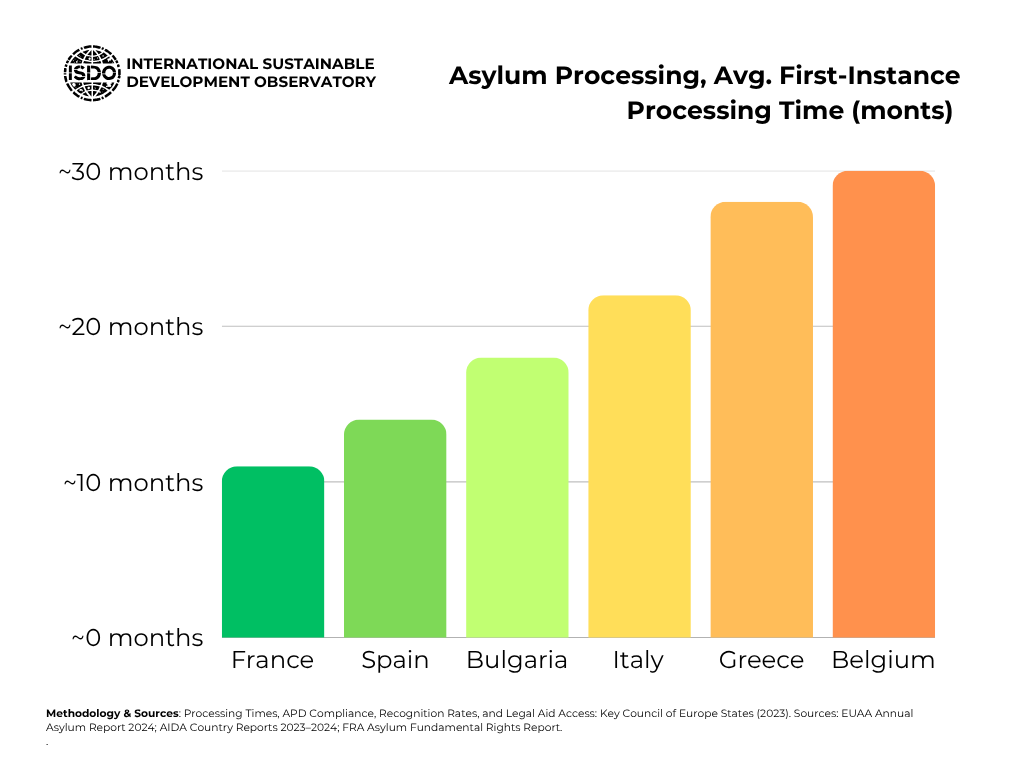
At the aggregate level, the EUAA’s Annual Asylum Report 2024 records approximately 1.14 million first-instance asylum decisions issued in EU+ states in 2023, the highest annual volume since 2016. The recognition rate at first instance across EU+ states averaged 46 percent in 2023, but this aggregate conceals a range from above 70 percent in some states to below 20 percent in others for applicants with comparable national origin profiles. This recognition rate divergence (which cannot be explained by differences in the profile of applicants alone) is one of the clearest indicators of procedural inconsistency in the European asylum system.
| KEY FINDINGThe EUAA’s 2024 Annual Asylum Report documents average first-instance processing times ranging from 3 months in the Netherlands to over 36 months in Italy, Greece, and Belgium for non-accelerated procedures. The EU Asylum Procedures Directive requires first-instance decisions within 6 months as a general rule, extendable to 21 months in exceptional circumstances. At least six EU member states routinely exceed the 21-month maximum, a structural non-compliance that has persisted across multiple European Commission monitoring cycles without generating formal infringement proceedings. |
| State | Avg. First-Instance Processing Time (2023) | Compliance with 6-month APD Standard | Recognition Rate (all nationalities, 2023) | Legal Aid: Publicly Funded Access |
| Netherlands | ~3 months | COMPLIANT | ~47% | Available; quality variable; NGO supplement common |
| Germany | ~7 months (BAMF) | NEAR COMPLIANT | ~46% | Available by law; access gaps for initial procedure stage |
| Sweden | ~5 months | COMPLIANT | ~52% | Public defender system; widely accessible |
| France | ~11 months (OFPRA) | PARTIAL | ~31% | Available; significant geographic variation; chronic underfunding of legal aid organizations |
| Spain | ~14 months | NON-COMPLIANT | ~28% | Available in principle; in practice limited to bar association duty lawyers |
| Italy | ~22 months | NON-COMPLIANT | ~22% | Available; severely undermined by 2023 Cutro Decree restrictions on legal assistance |
| Bulgaria | ~18 months | NON-COMPLIANT | ~15% | Formally available; in practice limited access, quality concerns, interpreter shortage |
| Greece | ~28 months (mainland) | NON-COMPLIANT | ~18% | Severely limited; NGO legal aid providers have reported being blocked in 2022–2024; island procedures separate |
| Hungary | N/A: no functioning asylum system since 2020 border closure | SYSTEMATIC VIOLATION | <5% (de facto closed system) | Non-existent in practice; ECtHR judgments in Ilias and Ahmed vs Hungary (2019) found violations |
| Poland | N/A: Belarus border procedure effectively suspended 2021–2024 | STRUCTURAL GAP (border zone) | ~42% (regular procedures) | Available in regular procedure; denied in border zone emergency procedures |
| Austria | ~9 months | PARTIAL | ~40% | Available; quality concerns at accelerated procedure stage |
| Belgium | ~30 months | NON-COMPLIANT | ~43% | Available; CGVS (asylum authority) chronic backlog results in de facto denial of timely access to status |
Table 5. Asylum Processing Times, APD Compliance, Recognition Rates, and Legal Aid Access: Key Council of Europe States (2023). Sources: EUAA Annual Asylum Report 2024; AIDA Country Reports 2023–2024; FRA Asylum Fundamental Rights Report.
4.2 Recognition Rate Divergence and the Dublin III Dimension
One of the most analytically significant patterns in the European asylum data is the divergence in first-instance recognition rates between states for applicants with the same national origin. The EUAA’s asylum data shows that Afghan nationals (the largest single nationality of applicants in 2023) received recognition rates ranging from 72 percent in Switzerland to 18 percent in Bulgaria for the same reporting year. While some variation reflects differences in the specific profiles of individual applicants, differences of 50 percentage points or more cannot be explained by applicant profile variation alone and reflect genuine differences in evidentiary assessment standards, decision-making culture, and the quality of Country of Origin Information (COI) used in first-instance adjudication.
The Dublin III Regulation (EU No 604/2013), which assigns responsibility for examining an asylum application to the first EU member state through which the applicant entered, compounds these recognition rate divergences by concentrating applications in states with lower processing quality and capacity (particularly Greece, Italy, Bulgaria, and Croatia, which are the primary entry points for the Southern and Eastern Mediterranean and Balkan routes). The result is a structural misalignment between the distribution of asylum applications and the distribution of processing capacity and quality, which the New Pact on Migration and Asylum (2024) partially addresses through its new solidarity mechanism but does not eliminate.
| 50+ points | The documented range of first-instance recognition rates for Afghan nationality applicants across EU member states in 2023, from 72% (Switzerland) to 18% (Bulgaria). The EU Qualification Directive requires member states to apply common standards for assessing protection needs; this divergence indicates those standards are not being applied consistently. Source: EUAA Asylum Trends database; UNHCR Statistical Yearbook 2024. |
4.3 Unaccompanied Minors: The Most Vulnerable Applicants
Unaccompanied minors (UAMs), children who arrive at European borders without a parent or legal guardian, represent a population with specific legal protections under the EU Asylum Procedures Directive (Articles 25–26), the EU Reception Conditions Directive (Article 24), and the UN Convention on the Rights of the Child. The EUAA recorded approximately 45,000 applications from unaccompanied minors in EU+ states in 2023, with Germany, Austria, Italy, and Greece receiving the largest numbers. The documented concerns for UAMs include: age assessment procedures that are inconsistent, sometimes degrading, and systematically tend to assign adult status to borderline cases (potentially denying child-specific protections to children); delays in guardian appointment that leave UAMs without adequate legal representation during initial processing; and specific vulnerability to exploitation during processing delays, particularly in overcrowded reception conditions.
4.4 Landmark Cases Shaping European Asylum Law
The following cases have been determinative in establishing the current legal standards against which national asylum systems are assessed in this report. Each represents a binding legal ruling whose implementation (or non-implementation) directly shapes the posture assessments in Section 11.
Case Study: MSS v. Belgium and Greece (ECtHR Grand Chamber, Application No. 30696/09, 2011)
MSS v. Belgium and Greece is the foundational case of modern European asylum law. The applicant, an Afghan national, arrived in Greece in 2008, was fingerprinted but did not formally claim asylum, and subsequently traveled to Belgium where he did apply for international protection. Belgian authorities ordered his return to Greece under the Dublin II Regulation; then, as now, the member state responsible for examining his application was the first EU country of arrival. The European Court of Human Rights, sitting as a Grand Chamber, found that both Greece and Belgium had violated Article 3 of the ECHR.
The Greek violation was found in two separate dimensions: first, the conditions of the applicant’s detention (in an area described by the Court as overcrowded and insanitary, without adequate food or sanitation, with no access to legal assistance or information about his situation), which met the threshold for inhuman and degrading treatment; and second, the living conditions following his release from detention (in a state of extreme poverty, sleeping rough, with no access to sanitation facilities or material assistance). The Belgian violation was particularly significant for its systemic implications: the Court held that Belgium violated Article 3 by returning the applicant to Greece while it knew, or ought to have known, that he faced a real risk of conditions of detention and living conditions contrary to Article 3 in Greece. Belgium could not rely on the presumption that Greece, as an EU member state party to the ECHR, would comply with its obligations. This ruling effectively broke the presumption of equivalent protection across EU member states that the Dublin system implicitly relied upon, and opened the door to the suspension of Dublin transfers to Greece that followed.
As of June 2026, the Committee of Ministers continues to supervise the execution of MSS v. Greece under the enhanced procedure. Greece has submitted successive action plans acknowledging the structural deficiencies identified by the Court, but the most recent EUAA monitoring report (2024) and CPT Greece report (2023) document that the structural conditions generating the violations identified in 2011 persist in substantially similar form in the current asylum reception and processing system.
| MSS: The Presumption BrokenMSS v. Belgium and Greece established what practitioners call the ‘presumption of equivalent protection problem’ in EU asylum law: the Dublin system’s operational logic depends on a presumption that all EU member states provide equivalent standards of protection, but the ECHR requires individual assessment of whether each state actually meets the minimum standards in a given case. MSS resolved this tension decisively in favor of individual assessment, with major consequences for the operational viability of the Dublin system that have not been fully resolved by any subsequent legislative reform, including the New Pact on Migration and Asylum (2024). |
Case Study: Tarakhel v. Switzerland (ECtHR Grand Chamber, Application No. 29217/12, 2014)
The Tarakhel family (an Afghan couple with six young children) arrived in Italy by sea in 2011, were fingerprinted, and subsequently traveled to Austria and Switzerland, where they applied for asylum. The Swiss Federal Administrative Court upheld the Dublin III transfer to Italy. The Grand Chamber of the ECtHR found that a transfer to Italy without prior individual guarantees from Italian authorities regarding reception arrangements appropriate for the family, particularly the children, would violate Article 3. The Court distinguished Tarakhel from cases involving single adult applicants by emphasizing the heightened vulnerability of children and the need for assurances that the family would be kept together and received in conditions adapted to the age of the children.
Tarakhel v. Switzerland is operationally significant because it established that Dublin transfers to states with documented reception condition deficiencies require individual guarantees (not merely the existence of a legal framework for reception) before they can proceed without violating Article 3. The Italian reception system in 2014–2026 has repeatedly been documented by AIDA, FRA, and CPT as systemically strained, particularly for family units and unaccompanied minors. This means Tarakhel remains operationally relevant to a very large volume of Dublin transfer decisions annually, and states that proceed without obtaining adequate individual guarantees from Italy risk ECHR liability under the precedent it established.
Current Data: EUAA 2024 Asylum Statistics U
pdate
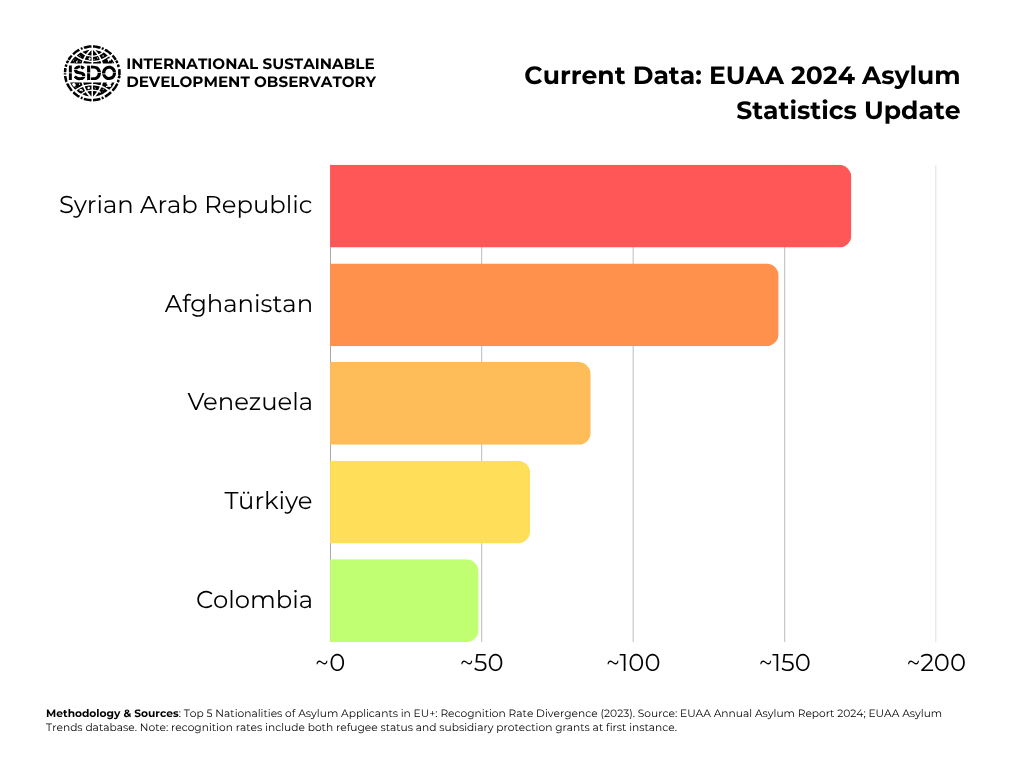
The EUAA’s 2024 Annual Asylum Report (covering the full calendar year 2023 and available data for the first half of 2024) documents several developments that update the analysis in Section 4.1.
First, total first-instance applications in EU+ states reached approximately 1.14 million in 2023, the highest figure since 2016 and a 17 percent increase from 2022. Second, average processing times across EU+ states worsened in 2023 relative to 2022, with Belgium (now over 32 months for certain caseload categories), Italy (24–26 months for standard procedures), and Greece (28–30 months for mainland procedures) all recording deterioration rather than improvement. Third, the nationality mix shifted significantly, with Ukrainian temporary protection beneficiaries (not counted in standard asylum statistics) adding approximately 4 million temporary protection holders across EU states by January 2024, creating an unprecedented dual-track processing burden on national reception and integration systems.
| Nationality (top 5, 2023 first-instance applications) | Total Applications EU+ | Average Recognition Rate | Highest Recognition Rate (state) | Lowest Recognition Rate (state) |
| Syrian Arab Republic | ~172,000 | 91% | 98% (Luxembourg, Finland) | 61% (Hungary, de facto closed system) |
| Afghanistan | ~148,000 | 68% | 87% (Switzerland) | 18% (Bulgaria) |
| Venezuela | ~86,000 | 72% | 94% (Spain, primary receiving country) | 38% (Germany) |
| Türkiye | ~66,000 | 32% | 58% (Greece, paradoxically citing Turkish political context) | 14% (Bulgaria) |
| Colombia | ~49,000 | 21% | 48% (Spain) | 8% (Germany, safe country designation applies) |
Table 5a. Top 5 Nationalities of Asylum Applicants in EU+: Recognition Rate Divergence (2023). Source: EUAA Annual Asylum Report 2024; EUAA Asylum Trends database. Note: recognition rates include both refugee status and subsidiary protection grants at first instance.
The New Pact on Migration and Asylum, which entered into force in May 2024 with a two-year implementation period for most of its legislative components, introduces three changes particularly relevant to the analysis in Section 4. The new Asylum and Migration Management Regulation (AMMR) modifies the Dublin criteria for determining responsibility while maintaining the first-country-of-arrival principle as the primary criterion. The new Asylum Procedures Regulation (APR) introduces mandatory border procedures for applicants from countries with EU+ recognition rates below 20 percent, with a maximum 12-week border procedure timeline. The Crisis and Force Majeure Regulation allows member states to extend these border procedures to 20 weeks during periods of crisis. The European Ombudsman and the UN Special Rapporteur on Migration have both issued formal communications noting concerns about the border procedure provisions’ compatibility with the individual assessment requirements established in MSS and Tarakhel.
5. Pushbacks, Border Violence, and Non-Refoulement
5.1 Defining Pushbacks in International Law
A pushback is an action by state authorities that results in the return of an individual or group of individuals to a third country or to the high seas without individual assessment of their protection needs and without access to asylum procedures. Pushbacks violate the principle of non-refoulement (the cornerstone of refugee law established by Article 33 of the 1951 Geneva Convention and independently protected under Article 3 of the ECHR as an absolute prohibition) because they deny individuals the possibility of establishing their need for international protection before being returned to potential harm. Pushbacks also typically violate the procedural requirements of the EU Asylum Procedures Directive, which requires individual assessment for all asylum applicants.
The legal status of pushbacks is unambiguous: they violate international and EU law when they deny individual assessment and access to asylum procedures. This has been affirmed by the European Court of Human Rights in N.D. and N.T. v. Spain (Grand Chamber, 2020), M.H. and Others v. Croatia (2021), D.A. and Others v. Poland (2022), and multiple other judgments. Several Council of Europe states (including Greece, Croatia, Poland, Lithuania, and Latvia) have nonetheless maintained systematic pushback practices, which they have variously characterized as ‘border management measures’ consistent with their security prerogatives, a characterization that has not been accepted by the ECtHR. The compliance gap is therefore not a matter of unclear or recently-established legal standards. Article 3 ECHR’s prohibition has admitted no exception since the Convention entered into force in 1953; the Border Violence Monitoring Network’s most recent monitoring cycle nonetheless recorded 2,047 pushback incidents across 2022–2024 alone. Seven decades of unambiguous law have not produced seven decades of compliance, which is the clearest available evidence that the practice reflects deliberate policy rather than legal ambiguity.
| KEY FINDINGThe Border Violence Monitoring Network documented 2,047 distinct pushback incidents between January 2022 and December 2024 at the Aegean border (Greece-Turkey), the Balkan route (Croatia, Bosnia, Slovenia, Hungary), and the Eastern EU border (Poland, Lithuania, Latvia). Across these incidents, the Network documented physical violence by border authorities in 61% of reported cases, including beatings, forced undressing, destruction of mobile phones and documents, and forced water crossings. While the BVMN is a civil society organization, its documentation methodology has been independently assessed and its findings are substantially corroborated by ECtHR case law and FRA field monitoring reports. |
| Border Zone | Primary State Actor | Scale (est. 2022–2024) | ECtHR Violations (2020–2024) | Accountability Mechanism Status |
| Aegean Sea / Greek-Turkish land border | Greece (Hellenic Coast Guard, police) | FRA estimates 40,000+ pushback events annually; UNHCR documented 2,500+ sea incidents in 2023 alone | 10+ Art. 3 and Art. 13 judgments; pending Article 46 referral for pilot judgment | EU Commission letters of concern; Frontex Operation Poseidon suspended 2022; no domestic accountability mechanism |
| Croatian-Bosnian border | Croatia (border police) | BVMN: 600+ documented incidents 2022–2024; CPT Croatia report 2023 corroborates | M.H. and Others v. Croatia (2021); subsequent cases pending; 3 Art. 3 violation judgments 2022–2024 | Internal investigation mechanisms criticized by European Ombudsman; EU-funded monitoring (2022–) with limited access |
| Polish-Belarusian border | Poland (Border Guard) | UNHCR estimates 30,000+ individuals pushed back 2021–2024; Amnesty/Helsinki Foundation corroborate | D.A. and Others v. Poland (2022); M.K. and Others v. Poland (2023); Art. 3 and Art. 5 violations | State of emergency declared 2021; access restrictions for NGOs, journalists, and UNHCR at border zone |
| Lithuanian-Belarusian border | Lithuania (State Border Guard Service) | Lithuanian Helsinki Committee documented 6,000+ refusals of entry 2021–2023 | M.S.S.-type cases pending; Art. 3 applications lodged; no ECtHR judgment yet | EU Commission formal notice 2022; Lithuania amended legislation to limit asylum access at border, under EU review |
| Spanish-Moroccan border (Ceuta/Melilla) | Spain (Guardia Civil) with Moroccan forces | Médicos Sin Fronteras documented systematic hot returns; peak Ceuta crisis May 2021 | N.D. and N.T. v. Spain (GC, 2020): controversial ‘own culpable conduct’ exception; subsequent applications pending | Spanish government maintains border operations are legal; UNHCR has expressed concern; CPT Spain next visit expected 2025 |
Table 6. Documented Pushback Practices by Border Zone: Scale, ECtHR Violations, and Accountability (2022–2024). Sources: BVMN Monthly Reports; ECtHR HUDOC; FRA Border Monitoring Reports; CPT Country Reports; UNHCR.
5.2 Frontex and Accountability
The European Border and Coast Guard Agency (Frontex) has been present as an operational partner in several of the border zones where pushbacks are documented, raising questions about the agency’s accountability for violations occurring in its operational area. The OLAF (European Anti-Fraud Office) investigation completed in 2021, the European Parliament’s LIBE Committee report of 2022, and the European Ombudsman’s inquiry of 2021 all identified significant failures in Frontex’s fundamental rights monitoring mechanisms. Frontex’s own Fundamental Rights Officer has reported incidents at borders where pushbacks occurred during joint operations. The agency’s response (reform of its Serious Incident Reporting mechanism and appointment of a Fundamental Rights Officer with enhanced powers) has been assessed by civil society and the European Parliament as insufficient to provide meaningful accountability for violations occurring in its operational context.
5.3 Case Studies: Landmark Pushback Rulings
Case Study: ND and NT v. Spain (ECtHR Grand Chamber, Applications Nos. 8675/15 and 8697/15, 2020)
ND and NT v. Spain (the ‘Melilla fence case’) is the most consequential and most controversial ECtHR ruling on pushbacks to date. The applicants, nationals of Mali and Ivory Coast respectively, attempted to enter Spain by scaling the border fence at Melilla in August 2014. They were apprehended on the Spanish side of the fence and immediately returned to Morocco by Spanish Guardia Civil officers, without any identification procedure, without access to an interpreter, without legal assistance, and without any examination of their individual circumstances or protection needs. No paperwork was completed; no record was made of their identities.
The Grand Chamber, in a judgment that divided the Court 14 to 3, found no violation of Article 4 of Protocol 4 (prohibition of collective expulsion of aliens). The majority held that the immediate return did not constitute a collective expulsion because it was a consequence of the applicants’ own conduct in attempting to cross the frontier in an unauthorized manner. The applicants had failed to use the ‘legal’ entry channels available (the official crossing point at Melilla), and therefore the Spanish state bore no responsibility for the circumstances in which they found themselves. Four judges issued a vigorous dissent, arguing that the majority had effectively conditioned the right not to be collectively expelled on using regular entry procedures, a requirement that is physically unavailable to the vast majority of people who need international protection, since they typically lack the visas and documentation that legal entry requires.
The practical consequences of ND and NT v. Spain have been significant. The Spanish government has relied on the judgment to defend its ‘hot return’ (devolución en caliente) practice at Ceuta and Melilla, which it subsequently legislated as ‘rejection at the border’ (rechazo en frontera) in the 2015 reform of the Organic Law on Citizens’ Security. Human rights organizations and the UNHCR have consistently argued that the legal framework created does not adequately implement the individual assessment requirements that the Court established as conditions for the ND and NT exception to apply. Multiple applications challenging the post-2020 practice at Spanish borders are currently pending before the Court, and the UNHCR has submitted third-party interventions in several of them.
| The ND/NT Controversy: What the Dissenters SaidThe three dissenting judges (Judges Pinto de Albuquerque, Harutyunyan, and Koskelo) argued that the majority’s reasoning created a ‘Catch-22′ for asylum seekers: they cannot use legal entry channels because they lack the documentation those channels require; when they use irregular entry, the state can exclude them from the procedural protections against collective expulsion. The dissenters wrote that the Court had ’emptied Article 4 of Protocol 4 of its substance’ in situations involving large numbers of people attempting simultaneous irregular crossings, precisely the circumstances in which collective expulsion is most likely to occur and most in need of prohibition. The debate about ND/NT is ongoing in international law scholarship and has not been resolved by subsequent judgments. |
Case Study: MH and Others v. Croatia (ECtHR, Application No. 15670/18, 2021)
MH and Others v. Croatia was the first ECtHR judgment finding Croatia responsible for a violent pushback. The applicants (a group of Afghan nationals including several unaccompanied minors) entered Croatian territory in 2017 and attempted to claim asylum. Instead, Croatian border police took them back to the Croatian-Bosnian border, confiscated their mobile phones, forced them to walk back to Bosnia, and in the process violently pushed one applicant, AM, a minor, onto the railway tracks adjacent to the border crossing. AM was subsequently struck by a train and killed. The Court found violations of Article 3 in its substantive dimension (the minor had been subjected to treatment incompatible with Article 3 during the border procedure) and of Article 3’s procedural dimension (Croatia failed to conduct an adequate and effective investigation into the circumstances of AM’s death). The Court also found a violation of Article 2 (right to life) in its procedural dimension.
MH and Others v. Croatia opened a wave of subsequent litigation against Croatia. By January 2025, the ECHR HUDOC database records 14 pending applications against Croatia involving alleged pushback violence, and three additional judgments finding Article 3 violations in pushback contexts have been delivered since 2021. The Croatian government has consistently disputed the characterization of its border management practices as pushbacks and has argued that the incidents involve isolated misconduct by individual officers rather than systematic policy. The CPT’s 2023 visit to Croatia specifically examined border management practices and, while its report has not been fully published at the government’s request, a public statement issued after the visit reiterated concerns about reports of violence during border returns.
Case Study: DA and Others v. Poland (ECtHR, Applications Nos. 51246/21 and others, 2023)
The Polish-Belarusian border crisis that began in summer 2021 (when Belarusian authorities organized the facilitated crossing of migrants and asylum seekers, primarily from Iraq, Syria, Afghanistan, and African states, into Poland, Lithuania, and Latvia as a hybrid warfare instrument against EU states) generated a pattern of pushbacks on an unprecedented scale within the EU’s recent history. Poland declared a state of emergency in the border zone in September 2021, restricted access for journalists, NGOs, UNHCR, the Polish Commissioner for Human Rights, and EU monitoring bodies, and enacted legislation allowing for immediate removal of individuals detected in the border zone without access to asylum procedures.
DA and Others v. Poland (one of several consolidated cases before the Court) concerns Afghan, Iraqi, and Syrian nationals pushed back by Polish Border Guard forces immediately upon detection in Polish territory, without any identification procedure, in temperatures well below freezing, into a forest area between the Polish and Belarusian security fences. The Court found violations of Article 3 (treatment to which the applicants were exposed during the pushback and the conditions in which they were left), Article 5 (liberty, detention in the border zone without legal basis or review), and Article 13 (no effective remedy available given the denial of access to legal assistance and the border zone access restrictions). The judgment is particularly significant for its finding that the access restrictions imposed by Poland, which prevented independent monitoring of border zone conditions, did not relieve Poland of its ECHR obligations and could not prevent the Court from assessing the credibility of applicants’ accounts on the basis of consistent patterns documented before access was restricted.
Updated data for 2024: The UNHCR documented over 28,000 irregular crossings from Belarus into Poland in 2023, with an estimated 15,000–20,000 pushbacks occurring in the same period. The Polish Helsinki Foundation for Human Rights recorded 46 deaths at the Polish-Belarusian border between 2021 and December 2024 (22 confirmed, 24 suspected) primarily from hypothermia, drowning, and exhaustion. Poland’s State of Emergency formally expired in December 2021 but emergency exclusion zone regulations have been maintained under successive legislative amendments. The European Commission initiated formal dialogue with Poland on border management practices in 2024 but had not opened formal infringement proceedings as of June 2026.
2024 Update: Frontex Accountability and the New Fundamental Rights Framework
Following the OLAF investigation report of 2021 and the European Parliament’s refusal to grant discharge to Frontex’s 2020 budget (the first time the Parliament had taken this step against an EU agency), Frontex underwent significant governance reforms under the revised EBCG Regulation. As of 2024, Frontex operates a Standing Corps of approximately 1,500 officers (growing to 10,000 by 2027 under the Regulation’s mandate), a Fundamental Rights Officer with enhanced independence and access, a Serious Incident Reporting (SIR) mechanism requiring mandatory reporting of fundamental rights incidents, and a Consultative Forum with civil society and international organization participation.
The 2024 assessment of these reforms by the European Parliament’s LIBE Committee and by the FRA’s Frontex Fundamental Rights Monitoring report found that the reforms represent genuine institutional progress but fall short in three areas: first, the SIR mechanism generates reports that are not systematically followed up with sanctions for officers involved in fundamental rights violations; second, the Fundamental Rights Officer’s access to operational information remains constrained in practice despite formal powers; and third, Frontex’s continued deployment at borders where systematic pushbacks are documented (Greece, Croatia) creates ongoing accountability exposure that the agency’s internal mechanisms are not designed to resolve. The European Ombudsman’s 2024 inquiry into Frontex’s handling of fundamental rights complaints (OI/4/2023/MIG) found that Frontex had not adequately followed up on complaints from individuals who alleged violations during joint operations, and recommended systemic improvements to the complaint mechanism’s accessibility and follow-up procedures.
6. Reception Conditions and Immigration Detention
6.1 The Legal Standard for Reception Conditions
The EU Reception Conditions Directive (2013/33/EU) establishes minimum standards for the material reception conditions to be provided to asylum seekers during the examination of their applications. These include housing, food, clothing, healthcare, and a daily allowance, with specific enhanced standards for vulnerable persons including unaccompanied minors, survivors of torture or violence, pregnant women, and persons with serious illnesses. The Directive also provides that detention of asylum seekers may be used only as a last resort, when less coercive measures cannot be applied effectively, and must be subject to judicial review. It establishes minimum conditions that detention facilities must meet.
The AIDA Country Report database, updated annually for 23 European states, and the CPT’s country visit reports provide the most systematic comparative evidence on reception conditions. Both sources document widespread non-compliance with the Directive’s minimum standards in multiple EU member states, with particularly severe conditions documented in Greece, Bulgaria, Cyprus, and Italy.
| State | Reception Conditions Assessment (AIDA/CPT, 2023–2024) | Key Violations of RCD Standards | Detention: Legal Basis Concerns |
| Greece | SEVERELY NON-COMPLIANT. Moria legacy: Kara Tepe replacement camp documented by FRA and MSF as below minimum standards. Mainland facilities chronically overcrowded. CPT 2023 visit found severe overcrowding, inadequate healthcare, and self-harm rates indicating severe psychological distress. | Overcrowding (>200% capacity common); inadequate healthcare; food insufficiency documented; violence between residents; inadequate lighting and sanitation | Administrative detention routinely extended beyond legal maximum; judicial review delays; Foreigners’ Act allows detention for deportation purposes with broad discretion |
| Bulgaria | NON-COMPLIANT. ECRI 2022 Bulgaria report identifies reception conditions as a systemic concern. Bulgarian Helsinki Committee documents severe overcrowding and violence between residents and with staff. CPT Bulgaria 2021 visit identified same concerns as 2015 visit: no improvement. | Chronic overcrowding; inadequate food and healthcare; documented violence by staff; language access absent; no legal aid at reception stage | Immigration detention routinely used; maximum periods not consistently observed; conditions in Busmantsi Detention Center documented as inhuman by CPT |
| Italy | STRUCTURAL GAP. Reception system structurally strained under high arrival volumes. SAI (System of Accommodation and Integration) network functions reasonably in northern regions; southern coastal regions severely overstretched. CPT Italy 2023 visit documented significant concerns in Lampedusa hotspot. | Hotspot system operates beyond capacity; access to information and legal assistance limited on arrival; quality inconsistent between SAI and extraordinary reception facilities (CAS) | 2023 Cutro Decree expanded detention powers; CPT-identified concerns about Lampedusa pre-removal center conditions; judicial challenges to extended detention pending |
| Germany | PARTIALLY COMPLIANT. Federal system generates significant variation across Länder. BAMF-run facilities generally meet minimum standards; conditions in initial reception centers (Ankerzentren) have been criticized by ECRI and national civil society. Legal aid quality varies widely. | Ankerzentren model criticized for limiting movement and integration; legal aid access inconsistent across states; language provision varies | Detention for deportation used; Abschiebegefängnis conditions generally meeting CPT standards; duration concerns in some Länder |
| France | PARTIALLY COMPLIANT. CNDA (national asylum court) and OFPRA (asylum authority) operate within acceptable parameters. Detention in CRA (Centres de Rétention Administrative) has been consistently criticized by CPT. Calais/Northern France informal camps remain a persistent concern without reception system solution. | Calais informal settlements (living rough conditions without systematic reception); CRA detention conditions below CPT standards; access to legal aid before CNDA limited for detained persons | Detention in CRA: 45-day maximum; CPT 2022 France report identified overcrowding and poor conditions; violence allegations at Vincennes CRA documented |
| Hungary | SYSTEMATIC VIOLATION. Transit zones closed 2020 (following CJEU ruling in FMS cases); since then effective closure of asylum system at borders. The 2024 EUAA monitoring report found that Hungary’s asylum system does not operate in practice at the border. Those who reach Hungarian territory in exceptional cases face de facto detention. | Effective closure of asylum system constitutes structural violation of Asylum Procedures Directive; no functioning reception system for border arrivals; infringement proceedings pending | Transit zone detention found illegal by CJEU (2020); post-transit zone system involves de facto detention without legal framework |
Table 7. Reception Conditions and Detention: EU Directive Compliance Assessment by State (2023–2024). Sources: AIDA Country Reports 2024; CPT Country Reports; EUAA Monitoring; FRA Fundamental Rights Report 2024.
Asylum Recognition Rate Divergence by Nationality
6.2 Immigration Detention: Standards and Documented Violations
Immigration detention (the confinement of migrants and asylum seekers for the purposes of immigration control) is regulated by Article 8 of the Reception Conditions Directive, which provides that detention may be used only as a last resort when other less coercive measures cannot be applied effectively. The Directive lists exhaustive grounds for detention and requires that detention be subject to swift judicial review, that detained persons receive written notification of the reasons for detention, and that conditions in detention meet minimum standards including access to legal assistance, healthcare, outdoor exercise, and contact with family members and legal representatives. The Reception Conditions Directive’s minimum detention standards became binding with the July 2015 transposition deadline. Nearly ten years on, the CPT’s most recent visit reports document the identical core violations flagged in earlier monitoring cycles, namely overcrowding, inadequate healthcare, and excessive detention periods without judicial review, recurring at facilities across multiple member states. A decade is not a transition period; it is a track record.
The CPT, which conducts periodic and ad hoc visits to all Council of Europe member states and inspects all places where persons may be deprived of their liberty, has identified recurring violations of minimum detention standards in immigration facilities across multiple states. The most frequently recurring concerns are: overcrowding above design capacity generating conditions that meet the threshold for inhuman or degrading treatment under Article 3 ECHR; inadequate healthcare, particularly for mental health conditions that are disproportionately prevalent among detained migrants and asylum seekers with trauma histories; insufficient access to legal assistance and interpretation; detention of vulnerable persons including unaccompanied minors in facilities not designed for minors; and excessively long detention periods without meaningful judicial review.
6.3 Case Study: The Moria Fire and the Limits of Minimum Standards
The Moria Reception and Identification Centre on the island of Lesbos had become, by 2019, the most documented symbol of the failure of European reception standards. With a designed capacity of approximately 2,750 people and an actual population that reached 20,000 at its peak, Moria had been the subject of CPT inspection reports (2018, 2019), FRA field monitoring visits (2017–2020), multiple ECtHR applications, Médecins Sans Frontières humanitarian reports documenting severe mental health conditions, and formal criticisms from the Council of Europe’s Commissioner for Human Rights. The conditions documented included: systematic absence of adequate heating in winter months; inadequate access to toilets and washing facilities generating documented public health risks; insufficient food provision; documented sexual and gender-based violence; inadequate healthcare for chronic conditions and acute psychiatric crises; and the de facto detention of asylum seekers during processing without the legal safeguards required by the Reception Conditions Directive.
On the night of 8–9 September 2020, fire destroyed the Moria facility. The immediate displacement of approximately 12,000 people (including families with children and unaccompanied minors) onto the public roads of Lesbos generated acute humanitarian conditions documented by all monitoring organizations with access. The Greek government announced the construction of a temporary replacement facility at Kara Tepe, subsequently renamed Mavrovouni, within days. FRA monitoring visits to Kara Tepe in 2021 and 2022 documented conditions that, while materially different from Moria (tents rather than containers, better sanitation infrastructure), failed to meet the minimum standards of the Reception Conditions Directive in several dimensions, including access to legal assistance, interpreter availability, healthcare for mental health conditions, and conditions for unaccompanied minors.
The analytical significance of the Moria-to-Kara Tepe trajectory is what it reveals about the structural conditions generating below-standard reception. The post-Moria emergency generated exceptional political attention, resources, and monitoring that the pre-Moria conditions had not generated despite years of documented violations. Yet Kara Tepe (built in the context of maximum political visibility and resources) still fell short of RCD minimum standards. This suggests that the violations documented in this report’s Section 6 are not primarily the product of resource insufficiency or administrative capacity but of structural choices about where to deploy reception resources and how to operationalize the minimum standard requirements that the Directive imposes.
| KEY FINDINGThe UNHCR’s 2024 monitoring data for Greek island facilities documents that the average length of stay in reception facilities on the Aegean islands (Lesbos, Chios, Samos, Kos, and Leros) has increased from an average of 4.2 months in 2022 to 7.8 months in 2024, reflecting the combination of increased arrivals and reduced mainland transfer capacity. The EU-funded ‘Closed Controlled Access Centers’ (CCACs) constructed on several islands as replacements for the Moria-era open centers operate under more controlled conditions but have generated documented concerns from UNHCR and FRA about their closed nature, which the organizations argue creates de facto detention not meeting the legal standards of the Reception Conditions Directive. |
6.4 The CIE System in Spain: Immigration Detention and the 2024 Canary Islands Context
Spain’s Centros de Internamiento de Extranjeros (CIE), immigration detention centers for individuals subject to removal orders, have been the subject of consistent criticism from the Spanish Ombudsman (Defensor del Pueblo), ECRI, and civil society organizations since their establishment in the 1980s. The CPT conducted visits to Spanish CIEs in 2011 and 2016 and identified recurring concerns including overcrowding, inadequate access to legal assistance, excessive use of force by guards, and insufficient healthcare provision. Spain’s judicial system has produced a series of administrative court rulings limiting the use of CIEs, and the Constitutional Court has addressed aspects of the detention regime in multiple rulings.
The Canary Islands context in 2024 added a new dimension to this analysis. The significant increase in irregular arrivals via the Atlantic route (primarily from West Africa) generated emergency reception situations on Gran Canaria, Tenerife, and Lanzarote that exceeded the normal CIE and reception center capacity. The Spanish Human Rights Association (APDHA) and the Jesuit Refugee Service documented between June and December 2024 a pattern of accommodation of adult migrants and unaccompanied minors in makeshift emergency facilities on the islands, including sports halls and dock warehouses, that fell below both the RCD minimum standards and the standards applicable under Spanish national law for the protection of minors. The UNHCR expressed formal concern in November 2024 about the conditions for unaccompanied minors in these emergency facilities, noting insufficient access to guardianship, education, and psychosocial support. The Spanish government has disputed some of these characterizations while acknowledging the exceptional pressure on reception capacity in the Canary Islands context.
7. Roma Populations: Systemic Exclusion in Europe’s Largest Ethnic Minority
Roma Communities: The Compound Disadvantage Gap
Percentage of Roma population facing each adverse outcome compared to the general EU population equivalent. Data from the FRA Roma Survey 2021 covering nine EU member states (Czech Republic, Germany, Greece, France, Spain, Croatia, Hungary, Romania, Slovakia). All gaps represent violations of the Race Equality Directive 2000/43/EC and/or the European Social Charter.
7.1 The Roma Population in Europe: Scale and Diversity
Roma people constitute Europe’s largest ethnic minority, with an estimated 10–12 million people across Council of Europe member states, of whom approximately 6–7 million live in EU member states. The Roma are not a monolithic group (they encompass dozens of distinct subgroups with different languages, cultural practices, historical trajectories, and geographic distributions), and generalizations about the entire population require caution. What the available data does consistently show, across this diversity, is a pattern of multi-dimensional exclusion from mainstream European society that is documented in every Council of Europe state where significant Roma populations reside, and that persists across generations, across state types, and across the full range of economic development levels among the states involved.
The FRA Roma Survey 2021, conducted in nine EU member states with the largest Roma populations (Czech Republic, Germany, Greece, France, Spain, Croatia, Hungary, Romania, and Slovakia), provides the most comprehensive recent data on Roma living conditions in Europe. Its findings are consistent with and in many cases worse than the comparable data from the FRA’s 2016 Roma Survey, suggesting that despite a decade of EU Roma integration policy and the adoption of National Roma Integration Strategies (NRIS) by all EU member states, the overall situation has not improved in most measured dimensions.
| 41% | The share of Roma people in the nine countries covered by the FRA Roma Survey 2021 who reported living in households where at least one person had gone to bed hungry in the previous month because the household could not afford food, compared with 3% of the general population in comparable countries. This food insecurity figure, despite almost two decades of EU Roma inclusion policy, is among the starkest indicators of the depth and persistence of Roma exclusion documented in the report. |
| Indicator | Roma Survey Result (FRA 2021, 9-country) | General Population Comparator | Change vs. FRA Roma Survey 2016 | Primary Legal Obligation |
| At risk of poverty | 80% of Roma surveyed | ~17% EU-28 average | No improvement documented across most states | Race Equality Directive; ECSR |
| Employment rate | 43% employed (vs 70%+ general population equivalent) | ~70% general (working-age) | Marginal improvement in some states; regression in others | Race Equality Directive Art. 3(a) |
| Early school leaving | 68% of Roma aged 18–24 not in education/employment | ~10% EU average | No significant improvement; some deterioration | Race Equality Directive Art. 3(g) |
| School segregation (separate classes/schools) | 45% of Roma children in predominantly Roma schools (>90% Roma) | Not applicable as comparator | Some reduction in Hungary/Slovakia following CJEU rulings; persistence in Czech Republic, Romania, Bulgaria | Race Equality Directive Art. 3(g); CJEU DH v. Czech Republic |
| Substandard housing (no indoor flushing toilet) | 40% of Roma surveyed | ~4% general population | No improvement; some indicators worsened | Race Equality Directive Art. 3(h); ECSR Art. 31 |
| Experienced discrimination in past 5 years | 66% of Roma surveyed | ~21% general (EU-MIDIS III comparator) | Marginal improvement from 71% in 2016; discrimination remains pervasive | Race Equality Directive Art. 2; ECHR Protocol 12 |
| Police stops (past year) | 37% of Roma men aged 16–44 | ~14% comparator group | Comparable to 2016 levels; no reduction in profiling | ECHR Art. 14; ECRI General Policy Recommendation 11 |
| Food insecurity (went hungry past month) | 41% of Roma surveyed | ~3% general population | Significant deterioration from 2016 baseline | EU Charter of Fundamental Rights Art. 34; ECSR Art. 13 |
Table 8. Roma Discrimination Indicators: FRA Roma Survey 2021 vs. General Population Comparators and 2016 Baseline. Sources: FRA Roma Survey 2021; EU-MIDIS III; Eurostat; FRA Roma Survey 2016.
7.2 School Segregation: The Mechanism of Intergenerational Exclusion
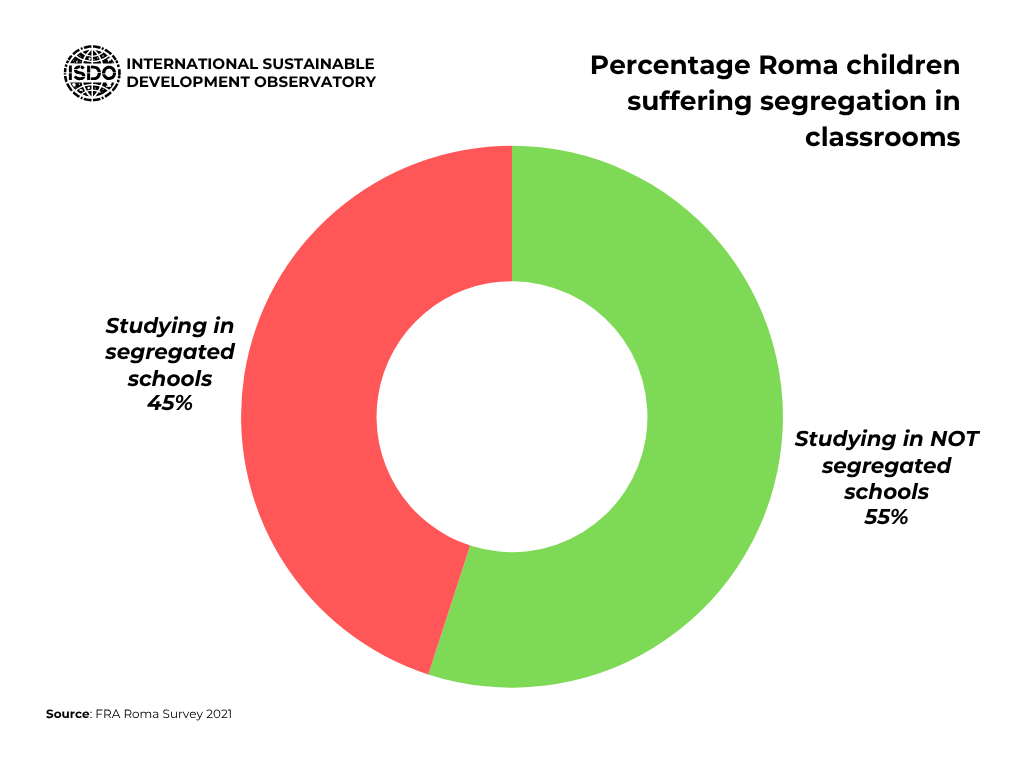
School segregation of Roma children (the concentration of Roma children in separate classes or schools with predominantly Roma enrollment, typically characterized by lower educational quality, lower teacher qualifications, and lower educational attainment outcomes) is among the most extensively documented and most legally contested dimensions of Roma discrimination in Europe. It has been addressed in landmark rulings by the European Court of Human Rights (D.H. and Others v. Czech Republic, Grand Chamber 2007; Oršuš and Others v. Croatia, Grand Chamber 2010) and by the Court of Justice of the European Union (ECLI:EU:C:2008:358), which have established unambiguously that school segregation of Roma children constitutes racial discrimination in violation of the ECHR and the Race Equality Directive.
Despite these rulings, the FRA Roma Survey 2021 found that 45 percent of Roma children aged 6–15 in the nine surveyed countries attend schools that are 90 percent or more Roma. This represents a de facto persistence of segregation at scale, notwithstanding the legal prohibition and over a decade of EU anti-segregation policy under successive Roma strategic frameworks. The most acute situations are documented in Bulgaria, Romania, Slovakia, the Czech Republic, and Hungary. The 2020–2030 EU Roma Strategic Framework explicitly identifies school segregation as a priority target for elimination, with a 2030 target of reducing the share of Roma children in segregated schools, but no binding enforcement mechanism exists to compel national implementation.
| The Legal-Political Gap in School DesegregationThe school segregation of Roma children is legally prohibited by EU law and ECHR case law that has been final and binding for nearly two decades. Yet the FRA’s 2021 data shows no significant improvement across most states compared to the pre-D.H. and Others baseline. This gap between legal prohibition and continuing practice is not explained by lack of legal clarity (the obligations are unambiguous) but by the absence of effective enforcement mechanisms at national level, insufficient political will to implement desegregation against local resistance, and the structural underfunding of Roma integration measures within national education budgets. |
7.3 Forced Evictions and Housing Discrimination
Forced evictions of Roma settlements (often without adequate notice, alternative housing provision, or legal process) are documented across multiple Council of Europe states and have been found to violate ECHR Articles 3, 8, and 14 (prohibition of inhuman treatment, right to private and family life, and non-discrimination) in multiple ECtHR judgments. The European Committee of Social Rights (ECSR) has found violations of Article 31 of the European Social Charter (right to housing) in collective complaints brought against Bulgaria, France, Italy, Portugal, and others for policies or practices resulting in Roma homelessness and forced eviction.
France presents a particularly well-documented case. Systematic data collected by the FEANTSA (European Federation of National Organisations Working with the Homeless) and La Fondation Abbé Pierre shows that between 2016 and 2023, approximately 100,000–150,000 Roma people were evicted from informal settlements in France each year, with fewer than 10 percent receiving alternative housing offers. French law requires prefects to provide alternative housing solutions before eviction of settlements, but enforcement of this requirement by administrative courts has been inconsistent. ECRI’s fifth-round France report (2020) identified forced evictions of Roma as a persistent concern. The French government has challenged characterizations of these evictions as racially discriminatory, describing them as enforcement of planning law, a position that has not been accepted by the ECSR in cases before it.
7.4 National Roma Integration Strategies: Assessment
All EU member states have adopted National Roma Integration Strategies (NRIS) under successive EU frameworks: the National Roma Integration Strategies up to 2020, and the EU Roma Strategic Framework for Equality, Inclusion and Participation 2020–2030, which required revised national strategic frameworks by September 2021. The European Commission’s 2023 and 2024 Roma integration reports assess implementation across the four key areas (education, employment, health, housing) and identify significant gaps between the strategic commitments in national frameworks and the resources allocated and actions implemented.
| State | NRIS / National Strategic Framework: Adoption | EC Assessment (2024) | Key Implementation Gap | FRA Roma Survey Key Indicator |
| Romania | 2021 National Strategy adopted on time; second-largest Roma population in EU (~1.8M) | STRUCTURAL GAPS: specific measures underfunded; targets not met in education; housing plan absent | School segregation persisting; POCU funds allocated but absorption low; local authority implementation minimal | 73% at risk of poverty; 56% in segregated schools |
| Bulgaria | 2021 Strategy adopted late; contested implementation | STRUCTURAL GAPS: housing and education segregation unaddressed; budget allocations symbolic | No desegregation measures in education; housing regularization program not implemented; health mediator program underfunded | 84% at risk of poverty; 46% in segregated schools |
| Hungary | 2021 Strategy formally adopted; implementation in dispute context of democratic backsliding | NON-COMPLIANT: European Commission has noted strategy lacks specific measures and budget; 2024 Rule of Law Report identifies concerns | Complex Romani village support program (CKP) partially reversed; desegregation efforts undermined by school nationalization policy | 80% at risk of poverty; school data restricted |
| Slovakia | 2021 Strategy adopted; Roma Action Plan more detailed | PARTIAL PROGRESS: some local implementation; school desegregation pilot programs; housing still a concern | Special education placement of Roma children remains elevated; social housing program insufficient scale; Roma communities in Eastern Slovakia severely marginalized | 82% at risk of poverty; 48% in segregated schools |
| Czech Republic | 2021 Strategy adopted; detailed action plan; higher budget allocation than regional peers | PARTIAL PROGRESS: improvement in employment integration; school segregation persistent despite anti-segregation legislation (2016) | School segregation through ‘special school’ system persisting despite D.H. v. Czech Republic ECtHR judgment; local resistance to desegregation | 59% at risk of poverty (lower than regional peers); 38% in segregated schools |
| Spain | 2021 National Roma Strategy adopted; significant civil society involvement | BETTER THAN REGIONAL AVERAGE: longer history of integration efforts; Roma civil society organizations well-developed; housing still a concern | Chabolas (informal settlements) persist in southern Spain; school dropout rates improving but remain high; employment discrimination persistent | 54% at risk of poverty (improvement from 2016); lower segregation in most regions |
Table 9. National Roma Integration Strategy / Strategic Framework Implementation Assessment (2024). Sources: European Commission Roma Integration Report 2024; FRA Roma Survey 2021; ECRI Country Reports.
7.5 Case Study: DH and Others v. Czech Republic (The Foundational School Segregation Ruling)
DH and Others v. Czech Republic (ECtHR Grand Chamber, Application No. 57325/00, 2007) is the landmark ruling on school segregation in European human rights law and the direct legal basis for the anti-segregation obligations assessed in Section 7.2. The case concerned 18 Roma children from the city of Ostrava who had been placed in ‘special schools’ designed for children with mental disabilities, schools with a simplified curriculum that provided no pathway to mainstream secondary education or vocational training at the standard level. Statistical evidence presented to the Court showed that Roma children in Ostrava were 27 times more likely than non-Roma children to be placed in special schools, and that more than 50 percent of children in special schools in the district were Roma, despite Roma constituting approximately 5 percent of the general school-age population.
The Grand Chamber (departing from the Chamber’s earlier finding of no violation) held by 13 votes to 4 that the Czech Republic had violated Article 14 taken together with Article 2 of Protocol 1 (right to education). The significance of the ruling lay in three legal innovations. First, it accepted statistical evidence as establishing a prima facie case of indirect discrimination, without requiring proof of discriminatory intent. Second, it held that a difference in treatment based on race or ethnic origin, even if framed as a neutral educational placement criterion, requires very weighty reasons to be justified. Third, it found that the parents’ consent to placement in special schools could not constitute valid justification, given that Roma parents were not fully informed of the consequences of special school placement and given the general climate of discrimination in which they were asked to make this choice.
The Committee of Ministers’ execution of DH and Others v. Czech Republic represents one of the longest-running and most analytically instructive non-execution processes in ECHR history. The Czech Republic adopted legislative reforms in 2016 that formally abolished the special schools designation and created a new ‘practical primary school’ category. Independent monitoring by the European Roma Rights Centre (ERRC) and the Czech ombudsman found that the practical primary schools continued to serve as a functional equivalent to the abolished special schools, with comparable enrollment of Roma children and comparable curriculum limitations. As of 2024 (17 years after the Grand Chamber judgment), the Committee of Ministers continues to supervise execution under the standard procedure, having noted improvements in the formal legal framework while noting persistent deficiencies in practical implementation.
| 17 Years and Still Not ExecutedDH and Others v. Czech Republic illustrates a pattern documented across Roma discrimination cases in the Committee of Ministers’ execution database: nominal legislative compliance masks continued practical violation. The Czech Republic amended its special schools legislation; the FRA Roma Survey 2021 still found 38% of Roma children in the Czech Republic attending schools with more than 90% Roma enrollment. The gap between legislative reform and behavioral change in educational systems is one of the most consistently documented failures of ECHR execution in the ethnic discrimination domain; it reflects structural features (local authority implementation, teacher training, parental expectations shaped by historical exclusion) that legislative reform alone cannot address. |
Case Study: Oršuš and Others v. Croatia (ECtHR Grand Chamber, Application No. 15766/03, 2010)
Oršuš and Others v. Croatia addressed a different but related form of school segregation: Roma children placed in segregated classes within mainstream schools, rather than in separate special schools. In the Croatian municipality of Međimurje, Roma children with sufficient Croatian language proficiency were nonetheless placed in all-Roma or overwhelmingly Roma classes within mixed schools, justified by school authorities on the grounds of ‘Roma language deficiency’ at entry. The Grand Chamber found a violation of Article 14 combined with Article 2 of Protocol 1, holding that the separation of Roma children into ethnically homogeneous classes, even within mainstream schools, required justification beyond a general reference to language competency, and that the Croatian authorities had failed to demonstrate that the separation was objectively and reasonably justified or that adequate measures had been taken to compensate for the Roma children’s reduced exposure to the mainstream curriculum.
The practical significance of Oršuš for the analysis in this report is that it extended the DH prohibition beyond the special schools context to within-school segregation practices. Many of the segregated schooling situations documented in the FRA Roma Survey 2021 (including those in Bulgaria, Slovakia, and Romania) involve Roma children placed in separate classes within nominally mixed schools rather than in entirely separate institutions. Oršuš establishes that such arrangements are subject to the same indirect discrimination analysis as separate school systems. However, within-class segregation is considerably harder to monitor and enforce than separate school systems, because it is less visible in aggregate enrollment statistics and more dependent on individual teacher and school administrator decisions.
7.6 Case Study: Pata Rat – Forced Eviction and Relocation in Romania
Pata Rat, a district on the outskirts of Cluj-Napoca in northwest Romania, became one of the most extensively documented Roma forced eviction and relocation cases in Europe. In December 2010, the Cluj-Napoca municipal authorities ordered the eviction of approximately 300–400 Roma families from several locations within the city, including a location adjacent to a social housing complex, and relocated them to three newly constructed buildings at the edge of the city municipal waste dump, adjacent to a landfill and a sewage treatment plant. The residents received no meaningful consultation before the relocation. The relocation sites had inadequate water supply, no gas connections in the initial months, inadequate heating, and were isolated from the schools and social services that the displaced families had previously used.
The Pata Rat case generated legal proceedings before the Romanian courts, a complaint to the ECSR resulting in a decision finding Romania in violation of Article 16 of the European Social Charter (right of the family to social, legal and economic protection), multiple ECRI follow-up communications, and extensive documentation by the European Roma Rights Centre. The Romanian courts largely upheld the municipality’s authority to manage its housing stock while acknowledging procedural deficiencies. Follow-up monitoring conducted by civil society organizations in 2018, 2021, and 2023 found that approximately 100 families remained at the Pata Rat relocation site more than a decade after the eviction, with living conditions still below the minimum standards established by Romanian housing law and the European Social Charter, and with the children of relocated families showing significantly higher school dropout rates than equivalent Roma communities that had not been relocated.
Pata Rat illustrates a structural dynamic documented in forced Roma evictions across multiple Council of Europe states: the combination of legal enforcement of housing regulations (municipalities have legitimate authority to enforce planning and safety requirements) with the absence of adequate alternative housing provision generates outcomes that amount to forced displacement of Roma communities to marginalized locations with inferior living conditions, regardless of the formal legality of the individual eviction decisions. The ECSR’s decision in this case noted that international human rights law requires not only procedural rights (notice, hearing, judicial review) but substantive outcomes (alternative housing of an adequate standard) before eviction of communities living in substandard conditions can be considered compatible with the right to housing.
7.7 2024 Update: EU Roma Strategic Framework Mid-Term Review
The European Commission’s mid-term review of the EU Roma Strategic Framework 2020–2030, published in December 2024, provides the most recent systematic assessment of progress across the four priority areas (education, employment, health, housing) and the cross-cutting dimensions (poverty, anti-discrimination, participation, equal access). The review’s overall finding is that progress has been uneven and, in aggregate, insufficient to reach the framework’s 2030 targets at the current pace of implementation in most member states.
| Strategic Framework Target (by 2030) | 2020 Baseline | 2024 Progress Estimate (Commission) | On Track? | States Most Off Track |
| Reduce % of Roma at risk of poverty by at least 50% in participating states | ~80% at risk (FRA 2021 baseline) | ~73% estimated (limited 2024 data) | NO: pace insufficient for 50% reduction by 2030 | Romania, Bulgaria, Slovakia |
| Reduce Roma early school leaving to EU average + 10pp maximum | ~68% NEET aged 18–24 (FRA 2021) | ~62% estimated (partial data) | NO: current trajectory falls short | Bulgaria, Romania, Hungary |
| Reduce segregated schooling (>90% Roma) to below 20% of Roma children | ~45% in segregated schools (FRA 2021) | ~40% estimated, minimal change | NO: most off track target | Bulgaria (~58%), Romania (~52%), Slovakia (~48%) |
| Reduce Roma employment gap to EU average + 15pp maximum | ~27pp employment gap (FRA 2021) | ~24pp estimated, marginal improvement | MARGINAL PROGRESS only | Bulgaria, Romania, Slovakia, Greece |
| Reduce Roma living in overcrowded / substandard housing by 50% | ~40% no indoor flushing toilet (FRA 2021) | ~36% estimated, below pace needed | NO: housing investment insufficient | Romania, Bulgaria, Czech Republic |
Table 7a. EU Roma Strategic Framework 2020–2030: Mid-Term Progress Assessment (December 2024). Source: European Commission Roma Integration Mid-Term Review 2024; FRA Roma Survey 2021 (baseline). 2024 estimates based on Commission assessment of available national reporting data.
Roma Discrimination by Gender: A Reversed Pattern
8. Afro-European Communities: Racial Discrimination and Structural Barriers
8.1 The Afro-European Population in Europe
People of African descent in Europe (a population estimated at 7–8 million across EU member states, with significant concentrations in France [estimated 3–5 million], the United Kingdom [until 2020 an EU member state; ~2 million Black or Black British residents], Germany [~1 million], Spain, Portugal, Italy, Sweden, and the Netherlands) occupy a distinct position in European discrimination analysis. Unlike Roma communities, who are largely long-established European populations, Afro-European communities are more diverse in their histories: some descend from colonial-era migration, others from post-war labor recruitment programs, and others from more recent migration flows. What unites them analytically is the documented pattern of discrimination based on visible racial appearance, phenotype-based discrimination that operates independently of citizenship status, generation of residence, language proficiency, or educational attainment.
The FRA’s ‘Being Black in the EU’ second-edition survey (2023), covering 13 EU member states and sampling 6,752 people of African descent, constitutes the most comprehensive recent data source for this population group. Its findings are consistent with and in many cases more severe than the first edition (2018), indicating that the EU’s Anti-Racism Action Plan 2020–2025 and related national action plans have not generated measurable improvement in the lived experience of racial discrimination during the intervening years. The Race Equality Directive outlawed racial harassment and discrimination across the EU in 2000. By the time of the FRA’s 2023 survey, twenty-three years on, 45% of respondents reported experiencing racist harassment within the preceding five years, statistically indistinguishable from the 2018 baseline. Two full survey cycles have now registered the same finding, which turns the absence of improvement from a single data point into a measured pattern.
| KEY FINDINGThe FRA ‘Being Black in the EU’ 2023 survey found that 45% of respondents had experienced racist harassment in the five years prior to the survey, including offensive or threatening language, threatening gestures, or racially offensive emails or social media messages. 14% had experienced racially motivated physical violence in the same period. These figures are consistently higher than those reported by other minority groups in equivalent FRA surveys, and show no statistically significant improvement from the 2018 baseline, suggesting that the EU’s Anti-Racism Action Plan has not yet produced measurable impact on experienced discrimination rates. |
| Indicator | FRA Being Black in EU (2023, 13 states) | Comparator (EU-MIDIS III other groups) | Worst-performing states | Change vs. 2018 |
| Racist harassment (past 5 years) | 45% of respondents | ~30% (North African descent); ~28% (Roma) | Austria, Finland, Germany (highest rates) | No significant improvement |
| Racially motivated physical violence (past 5 years) | 14% of respondents | ~8% (South Asian descent); ~10% (Roma) | Finland, Austria, Germany | Marginal increase from 12% in 2018 |
| Stopped by police (past 5 years): felt because of ethnic/racial background | 29% of respondents (men: 41%) | ~17% (North African descent); ~37% (Roma men) | Austria, France, Germany | Comparable to 2018; no reduction |
| Discrimination in employment (past 5 years) | 30% of respondents | ~22% (South Asian descent); ~24% (North African) | Austria, Finland, Germany, Ireland | Marginal reduction from 33% in 2018 |
| Discrimination in housing (past 5 years) | 17% of respondents | ~12% (North African descent) | Germany, Austria, Finland | Comparable to 2018 |
| Aware of anti-discrimination laws | 41% of respondents | ~45% (other groups); general pop ~52% | Italy, Portugal, Spain (lowest awareness) | Marginal improvement from 38% in 2018 |
| Reported most recent discrimination incident | 11% of those discriminated against reported it | ~18% (other minorities); general ~35% | Consistent low reporting across all states | No improvement from 2018 |
Table 10. Racial Discrimination and Harassment Against Afro-European Communities: FRA Being Black in the EU Survey 2023 vs. Comparators and 2018 Baseline. Source: FRA Being Black in the EU 2023.
8.2 Police Profiling and the Effectiveness of Legal Remedies
Racial profiling in police stops and searches (the practice of using racial or ethnic appearance as a factor in decisions about whom to stop, check, or search, rather than applying individualized, evidence-based criteria) is prohibited by the Race Equality Directive, by ECHR Article 14, and by ECRI’s General Policy Recommendation No. 11 on combating racism and racial discrimination in policing. Despite this legal prohibition, the FRA and ECRI data document consistent patterns of profiling in multiple Council of Europe states.
The 41 percent of Black men in the FRA 2023 survey who reported having been stopped by police while feeling it was because of their racial or ethnic background represents a substantial share of the surveyed male population and is consistent with independent data from ‘stop and search’ statistics in countries that record ethnicity (UK) and from academic ‘observation studies’ conducted in France, Germany, and Spain. The Council of Europe’s ECRI has issued specific findings on racial profiling in its country monitoring reports for France (2020), Germany (2020), Austria (2020), Spain (2018), and others, recommending the introduction of independent complaint mechanisms, data recording requirements, and police training on non-discriminatory profiling criteria.
The under-reporting of discrimination (only 11 percent of those who experienced discrimination reported it to any authority) reflects a well-documented pattern of low confidence in the effectiveness of legal remedies, fear of retaliation or further police attention, lack of knowledge of available complaint channels, and the practical difficulty of proving racial motivation in individual cases. This reporting gap means that official discrimination statistics in most Council of Europe states significantly undercount the actual prevalence of discrimination, and that enforcement of the Race Equality Directive through complaint-driven mechanisms is structurally insufficient as the primary anti-discrimination tool.
8.3 The EU Anti-Racism Action Plan and Implementation Gaps
The EU Anti-Racism Action Plan 2020–2025, adopted by the European Commission in September 2020, represents the most comprehensive EU-level policy commitment to addressing structural racism in Europe’s recent history. It includes specific commitments on: anti-discrimination law enforcement, including encouraging member states to establish dedicated police anti-racism training; the Eurobarometer survey series on discrimination experiences; support for national anti-racism action plans; recognition of structural racism as a systemic phenomenon requiring systemic responses; and the appointment of EU Anti-Racism Coordinator.
The European Commission’s 2024 progress report on the Action Plan finds that 21 of 27 member states had adopted national anti-racism action plans by the reporting date, a significant improvement from the 3 states that had plans in 2020. However, quality assessment by the EU Anti-Racism Coordinator’s office found that fewer than half of the adopted plans include specific, measurable targets for reducing discrimination rates, fewer than a third include dedicated budget allocations, and fewer than a quarter include independent monitoring mechanisms. A plan without targets, budget, or monitoring is a statement of intention, not a governance tool; the gap between plan adoption and effective implementation is identified by the Commissioner’s office itself as the primary challenge for the 2025 review.
8.4 Case Study: The Death of Adama Traoré, France (2016–2026)
Adama Traoré, a 24-year-old French citizen of Malian origin, died on 19 July 2016 in Beaumont-sur-Oise, Val-d’Oise, approximately one hour after being detained by gendarmes following a minor public order incident in a market. The official account was that he died of a cardiac arrest; subsequent medical examinations commissioned by the family concluded that positional asphyxia during restraint was the cause of death. A decade of judicial proceedings has not produced a conviction. The case has generated the most significant social mobilization around racial justice in France since the 1983 ‘March for Equality,’ catalyzed the creation of the Comité Vérité et Justice pour Adama, and placed the question of institutional racism in French law enforcement at the center of public debate.
The institutional accountability dimension is analytically central to this report’s assessment of Dimension 5 (physical safety) and Dimension 2 (administrative treatment) for France. The investigation of deaths in custody in France is conducted by internal inspectorates (the IGPN for police matters and IGGN for gendarmerie) that report to the Minister of the Interior, not to an independent judicial authority. ECRI’s 2020 France monitoring report, the Council of Europe Commissioner for Human Rights, and multiple academic assessments have identified the absence of independent oversight of investigations into deaths in custody as a structural weakness generating systematic impunity. The Traoré case ran through the French judicial system for nearly ten years before the Cour d’appel de Paris ruled in 2024 against prosecuting the gendarmes, a decision being appealed to the Cour de cassation at publication date.
| France and the ECHR Procedural ObligationECHR Article 3 imposes not only a substantive obligation (states must not subject individuals to torture or inhuman treatment) but also a procedural obligation: when an individual makes a credible claim of treatment contrary to Article 3 at the hands of state agents, the state must conduct an effective official investigation. The ECtHR found France in violation of this procedural obligation in Castellani v. France (Application No. 43207/16, 2021), finding that France’s investigation mechanisms were insufficient to provide an effective remedy to individuals claiming police violence, a finding directly relevant to the structural issues raised by the Traoré case. |
8.5 Case Study: The NSU Complex, Germany (2000–2018), Institutional Racism in Criminal Investigation
Between September 2000 and April 2007, the Nationalsozialistischer Untergrund (NSU), a neo-Nazi terrorist cell, murdered ten people across Germany: nine men of Turkish and Greek origin operating small businesses, and one German police officer. The murders were not linked to each other by police during the investigation period. The dominant investigative theory was that the victims were involved in internal conflicts within criminal organizations in their own communities: the so-called ‘Döner murders’ theory, reflecting the occupations of many victims. Victims’ families reported that investigators treated them as suspects rather than witnesses, inquired about possible criminal connections, and met family grief with institutional suspicion rather than support.
The NSU murders became known only in November 2011 when the cell was exposed. Investigators found weapons, material linking the cell to the murders, and evidence that the cell had operated under the partial protection of an informal network including informants of the Verfassungsschutz (domestic intelligence services) in multiple German states. The Bundestag investigation committee (NSU-Untersuchungsausschuss) established extensive documentation of investigative failures driven by what multiple committee members characterized as structural ethnic stereotyping: the assumption that serious violence affecting ethnic minority communities is most likely internally generated by those communities, rather than externally inflicted. This assumption (documented in training materials, investigative guidelines, and institutional culture assessments) directly caused a decade of investigative failure and exposed nine families to the compounded experience of violent bereavement and official suspicion. The independent expert commission appointed by the Bundestag in 2020 found that the conditions allowing the NSU to operate undetected had not been fully addressed by subsequent institutional reforms.
8.6 2024–2025 Update: FRA Being Black in the EU (New Findings)
The FRA published an update to its Being Black in the EU survey in November 2024, incorporating data from 16 EU member states and adding a new module on digital discrimination and online hate speech. Key additional findings from the 2024 update include: discrimination in access to healthcare (21% of respondents reported discrimination when seeking healthcare in the past five years, higher than general population rates in every member state covered); digital discrimination (38% of respondents who used social media reported experiencing racist content targeting them personally; 26% reported online hate speech based on racial or ethnic origin); and the generational comparison (EU-born respondents of African descent reported higher rates of employment discrimination, 34% vs 27% for first-generation migrants, consistent with the second-generation paradox of higher rights expectations generating higher experienced discrimination rates when those expectations are unmet). Housing discrimination remains the least reported dimension: only 7% of those who experienced housing discrimination reported it to any formal channel, reflecting a combination of low confidence in remedies and the practical costs of challenging a landlord during an active housing search.
9. Second and Third-Generation Citizens: Discrimination Despite Legal Status
9.1 The Persistence of Disadvantage Across Generations
One of the most analytically significant findings in the European discrimination literature is the persistence of labor market disadvantage across generations for populations of migrant origin. If discrimination were primarily a function of recent arrival, unfamiliarity with the host country’s institutional environment, or language barriers, we would expect to see significant convergence between migrant-origin populations and native-born populations across generations. The evidence shows convergence in language, education, and civic participation across generations, but persistent (and in some dimensions widening) gaps in labor market outcomes that cannot be explained by human capital differences.
The OECD’s ‘Settling In 2018’ and follow-up reports, Eurostat’s Labor Force Survey data disaggregated by country of birth and parental country of birth, and academic correspondence studies (the most rigorous empirical methodology for identifying ethnic discrimination in hiring) collectively document a consistent pattern: individuals with non-European names face statistically significant lower callback rates in hiring processes when all other resume characteristics are held constant, even in the second generation born and educated in the destination country. This name-based discrimination, which operates as a proxy for ethnic or racial appearance, is documented in France, Germany, Sweden, the Netherlands, Belgium, and Spain, with effect sizes ranging from 20 to 50 percent fewer callbacks for identical resumes with non-European names.
| Country | Employment Gap vs native-born (same education) | Correspondence study: callback penalty for minority-origin name | Wage penalty (education/exp. controlled) |
| France | 8–12 pp disadvantage; North African and Sub-Saharan African 2nd gen | ISM/CORUM 2022: −46.2% for North African names; −38.7% Sub-Saharan African names (10,486 CV pairs, 527 employers). Duguet 2010: −38%. No improvement across 12 years. | ~10–15% (Aeberhardt et al.; IPP). Largest wage penalty in Western EU for North African origin. |
| Germany | 6–10 pp disadvantage; Turkish-origin 2nd gen most affected | Schneider et al. 2014: −24% for Turkish names. Kaas & Manger 2012: significant public sector penalty. No recent large-N replication. | ~7–12% (Brücker et al., IAB). Gap closing slowly across generations. |
| Netherlands | 9–14 pp disadvantage; Moroccan and Turkish origin; 6–8 pp Surinamese | Blommaert et al. 2014: −51% for Moroccan-origin names; HIGHEST documented callback gap in EU. No significant improvement in subsequent studies. | ~8–11% (SCP Netherlands). Surinamese origin gap smaller; North African/Turkish gap persistent. |
| Sweden | 10–16 pp disadvantage; Middle East/Africa origin; slower convergence than regional peers | Carlsson & Rooth 2007: −50% for Arabic names. 2022 replication: −46%. IFAU name-change study: +26% interviews after switching to Swedish-sounding surname. | ~9–13% (IFAU). Name change alone generates +7% wage improvement over 5 years. |
| Belgium | 11–15 pp disadvantage; Moroccan and Turkish 2nd gen most studied | UNIA/KU Leuven 2023: −49% for North African names; worsening trend vs prior studies. Congolese origin: comparable penalty. | ~10–14% (HIVA – KU Leuven). Among highest wage penalties in dataset. |
| Spain | 8–12 pp disadvantage; Latin American and North African 2nd gen | Arai et al. 2016: −40% for North African names. Limited subsequent large-N studies; data gap remains. | ~7–10% (FEDEA; CSIC). Gap smaller than France/Belgium; growing with recent migration waves. |
Table 11. Labor Market Outcome Gap for Second-Generation Citizens of Migrant Origin: Employment Gap, Correspondence Study Evidence, and Wage Penalty (2022-2024). Sources: OECD Settling In; ISM/CORUM 2022; IFAU 2021; Blommaert et al. 2014; UNIA/KU Leuven 2023; national academic studies; Eurostat LFS.
9.2 Ethnic Profiling by Law Enforcement
Ethnic profiling in law enforcement (using ethnicity or apparent racial origin as a criterion in decisions about police stops, identity checks, searches, or surveillance) is prohibited by the Race Equality Directive, by ECHR Article 14, and by ECRI’s General Policy Recommendations. Its occurrence among second and third-generation citizens of migrant origin has been documented through both survey-based evidence (FRA EU-MIDIS III; ‘Being Black in the EU’) and observational studies. The UK’s long-running debate on stop-and-search, France’s ‘contrôle au faciès’ controversy, and the German police ‘racial profiling’ scandals documented by ECRI’s 2020 Germany report are among the most extensively documented national cases. This is not a recently-clarified standard. The Race Equality Directive’s employment discrimination prohibition has been binding EU law since 2000, and the 2022 ISM/CORUM correspondence study (examined in detail at the Section 11.9 data bridge) confirms that the hiring gap it measures has not closed in the intervening two decades. The persistence itself is the finding here; the mechanism by which a prohibited practice survives two decades of binding law is taken up in Section 11.10’s political economy analysis.
The analytical significance of profiling among legally settled citizens of migrant origin is that it demonstrates that discrimination in law enforcement does not simply reflect officers’ assumptions about irregular migration status or linguistic barriers; it reflects embedded assumptions about who ‘belongs’ and who is inherently suspect, based on phenotypic appearance. This is race discrimination in its most direct form, affecting individuals who are in all formal respects equal citizens with the same rights as any other national of the state concerned. The practical consequences (accumulated negative police interactions, reduced trust in the justice system, self-censorship in public spaces) are documented in the qualitative research literature and represent a significant impairment of equal civic participation.
9.3 Case Study: The ISM/CORUM Experiment, France (2022), Name-Based Discrimination at Scale
The most recent large-scale correspondence study on ethnic discrimination in French employment was conducted in 2022 by the Institut Superieur du Travail (ISM) and the CORUM research center, in collaboration with the French Defender of Rights. The study sent 10,486 carefully matched pairs of fictitious CVs (differing only in the name of the applicant) to 527 large French companies across six sectors (finance, insurance, retail, hospitality, construction, and professional services) in response to identical job offers. The names were calibrated to signal four ethnic backgrounds: French European (Martin, Dupont), North African/Maghrebi (Benali, Mebarki), Sub-Saharan African (Diallo, Traore), and West Asian/Turkish (Yilmaz, Kaya).
The study found that candidates with North African-origin names received 46.2 percent fewer positive responses than identically qualified candidates with French European names; candidates with Sub-Saharan African-origin names received 38.7 percent fewer; and candidates with West Asian-origin names received 29.3 percent fewer. The discrimination rate showed no statistically significant improvement from a comparable study conducted in 2016. Disaggregation by sector showed discrimination rates highest in financial services (58.1% fewer responses for North African-origin names) and hospitality (51.3%), and lowest (though still statistically significant) in construction (22.4%). The Defender of Rights launched individual investigations against 14 companies and published a report calling for mandatory blind recruitment procedures. The French government’s subsequent legislative response settled for a voluntary commitment framework. The ECRI’s 2024 follow-up communication on France noted that voluntary commitments on anti-discrimination hiring had produced measurable change in fewer than 10 percent of the companies that had publicly committed to them.
9.4 Case Study: Name Change and Labor Market Outcomes, Sweden (IFAU Study, 2021)
A 2021 study by the Swedish Institute for Evaluation of Labour Market and Education Policy (IFAU) examined the labor market outcomes of approximately 3,500 immigrants in Sweden who had voluntarily changed their surname from a non-Swedish-sounding name (of Middle Eastern, African, or Eastern European origin) to a Swedish-sounding surname, over the period 2000–2018. The study used a differences-in-differences methodology with matched comparison groups of similar individuals who did not change their names, finding a statistically significant increase of 26 percent in job interview invitations in the 12 months following the name change, a 9 percent increase in employment probability over the following three years, and a 7 percent wage appreciation over a five-year period, proving that nominal assimilation operates as a direct determinant of labor market access, independent of human capital characteristics.
The IFAU study is methodologically significant because it provides causal (rather than merely correlational) evidence of name-based ethnic discrimination in a Nordic welfare state with highly developed anti-discrimination law and institutional infrastructure. Sweden’s CDI score of 22 places it in the Compliant/Partial tier overall, but its D3 (Labor Market) score remains HIGH, reflecting the documented persistence of ethnic discrimination in hiring even in the presence of the Diskrimineringsombudsmannen’s litigation powers, one of Europe’s most comprehensive anti-discrimination frameworks, and a social-democratic political culture formally committed to equality. The 26 percent interview invitation premium from a name change demonstrates that behavioral discrimination in hiring is persistent and resistant to the legal and institutional tools currently available in even the best-performing European states.
10. Legal and Institutional Architecture: Gaps Between Commitment and Practice
10.1 The European Court of Human Rights: Enforcement Record
The European Court of Human Rights is the primary enforcement mechanism for the ECHR’s obligations, and its judgment record provides the most authoritative available evidence of binding legal violations by Council of Europe states in the domains covered by this report. The Court’s HUDOC database allows analysis of the judgment record by state, article violated, and subject matter area. The following analysis focuses on violations in three subject matter clusters particularly relevant to this report: Article 3 violations in migration and asylum contexts (inhuman or degrading treatment); Article 3 violations with a racial or ethnic dimension; and Article 14 violations (prohibition of discrimination) with an ethnic or national origin ground.
Between 2015 and 2024, the Court delivered approximately 280 judgments finding violations of Article 3 in migration and asylum contexts across Council of Europe states. Greece (with 89 such judgments, the largest concentration for any single state in this period), Russia (before its expulsion in 2022), Hungary (28 judgments), Bulgaria (22 judgments), and Italy (18 judgments) account for the majority. The concentration of violations in the same states across the full decade, with the Committee of Ministers’ supervision finding persistent non-execution in many cases, constitutes strong evidence of structural rather than episodic violations in the states most affected.
| State | Art. 3 Violations (Migration/Asylum context, 2015–2024) | Art. 5 Violations (Unlawful detention, migration context) | Art. 14 Violations (Ethnic/national origin discrimination) | Committee of Ministers: Execution Status |
| Greece | 89 | 34 | 8 | Structural execution problem identified; enhanced supervision; pilot proceedings discussed |
| Hungary | 28 | 22 | 12 | Systemic issues identified; enhanced supervision; legislative changes required, not fully implemented |
| Bulgaria | 22 | 18 | 6 | Standard supervision; action plans submitted; CPT concerns acknowledged but implementation slow |
| Italy | 18 | 11 | 3 | Standard/enhanced supervision; action plans in progress; Tarakhel v. Switzerland requires monitoring |
| Croatia | 12 | 5 | 2 | Standard supervision; independent monitoring mechanism partially established 2022; execution ongoing |
| Poland | 8 | 4 | 3 | Enhanced supervision for border zone cases; rule of law concerns complicate execution monitoring |
| France | 6 | 8 | 14 | Standard supervision; ethnic discrimination judgments (Roma eviction cases) under monitoring |
| Romania | 3 | 4 | 8 | Standard supervision; Roma discrimination cases require legislative and administrative action |
Table 12. ECHR Violation Record by State: Articles 3, 5, and 14 in Migration, Asylum, and Ethnic Discrimination Contexts (2015–2024). Source: ECtHR HUDOC database; Council of Europe Committee of Ministers supervision database.
10.2 National Equality Bodies: Resources, Independence, and Effectiveness
The Race Equality Directive requires all EU member states to designate a national equality body with a mandate to promote equal treatment, provide independent assistance to victims of discrimination, conduct surveys, and publish reports. In practice, the effectiveness of national equality bodies varies enormously across the EU, with differences in mandate scope, financial resources, investigative powers, and institutional independence generating very different levels of operational effectiveness.
The European Network of Equality Bodies (Equinet) publishes annual comparative assessments of member body resources and activities. Its 2024 report identifies three primary structural weaknesses in the current national equality body landscape: insufficient financial resources (more than half of Equinet members report that their budgets have not kept pace with the expansion of their mandates following the extension of EU equality law); lack of legally binding enforcement powers (most equality bodies can only issue non-binding opinions or recommendations, not binding decisions with penalties, limiting their deterrent effect on discriminatory actors); and mandate limitations that exclude key areas of discrimination concern (several equality bodies have mandates that do not cover all grounds of discrimination or all policy domains covered by the Race Equality Directive). Article 13 of the Race Equality Directive has required an independent national equality body in every member state since 2000. Equinet’s 2024 assessment, conducted nearly a quarter-century later, found that most of those bodies still hold only non-binding recommendation powers and operate on budgets that have not kept pace with their expanding mandates. Twenty-four years is long enough to distinguish a startup problem from a design choice.
| State | Equality Body | Annual Budget (approx.) | Enforcement Power | ECRI Assessment (latest round) |
| Sweden | Diskrimineringsombudsmannen (DO) | EUR ~18M | Litigation power; binding orders in some domains | Positively assessed; independent; well-resourced; effective |
| Netherlands | College voor de Rechten van de Mens | EUR ~14M | Non-binding opinions; broad mandate; respected by courts | Positively assessed; non-binding opinions limit enforcement but body is respected |
| France | Défenseur des Droits (DDD) | EUR ~42M (broader mandate) | Limited enforcement; referral to prosecution; ombudsman functions | ECRI notes DDD effective on complaints but structural racism recommendations poorly followed |
| Germany | Antidiskriminierungsstelle des Bundes (ADS) | EUR ~4.5M (federal only) | Advisory only; no enforcement; no litigation standing | ECRI 2020: ADS underfunded and lacks enforcement powers; Länder bodies inconsistent |
| Hungary | Equal Treatment Authority (functions severely curtailed since 2021) | EUR ~1.2M (post-reform) | Significantly reduced since 2021 restructuring under OGYIF | ECRI: independence and effectiveness severely compromised following 2021 institutional changes |
| Romania | Consiliul National pentru Combaterea Discriminarii (CNCD) | EUR ~1.8M | Can issue binding sanctions (fines); enforcement inconsistent | ECRI: resource constraints; Roma cases not adequately pursued; low profile |
| Greece | Hellenic Ombudsman (anti-discrimination division) | EUR ~2.1M | Non-binding; recommendation power only | ECRI: severely under-resourced; migration cases overwhelming capacity; limited impact |
| Italy | UNAR (Ufficio Nazionale Antidiscriminazioni Razziali) | EUR ~3.2M | No enforcement power; coordinates national plan | ECRI: inadequate resources; 2023 Cutro Decree undermined prior progress; political exposure |
Table 13. National Equality Bodies: Resources, Enforcement Powers, and ECRI Assessment (2024). Sources: Equinet Annual Report 2024; ECRI Country Monitoring Reports (5th round); Equinet member body data.
10.3 The Race Equality Directive: Transposition Quality and Enforcement Gaps
The Race Equality Directive (2000/43/EC) was the first EU directive specifically prohibiting racial and ethnic discrimination, and it remains the primary EU legal instrument for addressing discrimination against ethnic minorities and migrant-origin populations in EU member states. All 27 EU member states have transposed the Directive into national legislation, but the quality of transposition (defined as the degree to which national implementing legislation covers all the Directive’s requirements effectively, provides accessible remedies, and is backed by enforcement mechanisms with adequate deterrent effect) varies considerably.
The European Commission has initiated infringement proceedings against several member states for inadequate transposition, and the ECRI has identified implementation gaps in nearly every state’s monitoring round. The most frequently identified gaps are: limited scope of national legislation (some states have implemented the Directive’s minimum requirements but have not extended protections to areas where the Directive allows member states discretion, such as access to nationality, social advantage, and certain financial services); inadequate burden of proof rules (some states maintain procedural requirements that effectively place the full burden of proving discrimination on the complainant, contrary to the Directive’s requirement to shift the burden once a prima facie case is established); and very low damage awards in successful discrimination cases (amounts insufficient to deter discriminatory behavior or adequately compensate victims).
10.4 Case Study: FMS and Others v. Hungary (CJEU, C-924/19 PPU and C-925/19 PPU, 2020)
The FMS and Others preliminary rulings represent one of the clearest examples of the gap between EU legal mandate and member state compliance. The cases arose from asylum seekers detained in Hungary’s Roszke transit zone, a fenced area on the Serbian border where asylum seekers were held for months while applications were processed. Hungary had since 2018 limited daily entries to the transit zones to one or two people per day, generating effective years-long queues before applicants could formally claim asylum. The CJEU found: (1) that confinement in the transit zone constituted detention under the Reception Conditions Directive; (2) that this detention was unlawful; and (3) that Hungarian law requiring courts to refrain from ordering release was incompatible with EU law and must be disapplied. Hungary formally complied by closing the transit zones in May 2020, but simultaneously enacted legislation making it effectively impossible to claim asylum at the border without traveling to Hungarian consulates in third countries, recreating the same practical barrier through a different legal mechanism.
Hungary had not fully complied with the subsequent November 2021 CJEU judgment in Commission v. Hungary (C-821/19) as of June 2026, and the Commission had initiated a further infringement procedure in 2023 for non-execution. This sequence of litigation (spanning nearly a decade and multiple CJEU rulings) illustrates the structural tension between the primacy of EU law and the practical enforcement tools available when a member state determines to systematically non-comply. The FMS cases are the paradigmatic example of what this report terms the ‘sovereignist dividend mechanism’: formal compliance combined with substantive circumvention, generating continued political narrative of resistance while satisfying the minimum letter of the legal obligation.
10.5 2024–2025 Update: ECHR Execution Statistics and Emerging Trends
The Council of Europe’s Committee of Ministers published its Annual Report on the Supervision of the Execution of Judgments for 2024 in June 2025. The report documents 5,187 cases pending execution before the Committee as of 31 December 2024, an all-time high. Migration and asylum cases account for approximately 340 pending execution cases (6.5% of total), with Greece (89), Hungary (67), and Italy (38) the largest national caseloads. Ethnic discrimination cases (primarily involving Roma applicants) account for approximately 220 pending cases, with Romania (82), Bulgaria (61), and Czech Republic (34) the largest. The median time from final ECtHR judgment to closure of execution supervision for structural cases has increased from 4.2 years in 2015 to 7.8 years in 2024, reflecting both the increasing complexity of structural violations and the increasing political resistance to implementing reforms in affected states.
11. Strategic Conclusions: The Country Discrimination Index and Policy Recommendations
11.1 The Country Discrimination Index: Summary Results
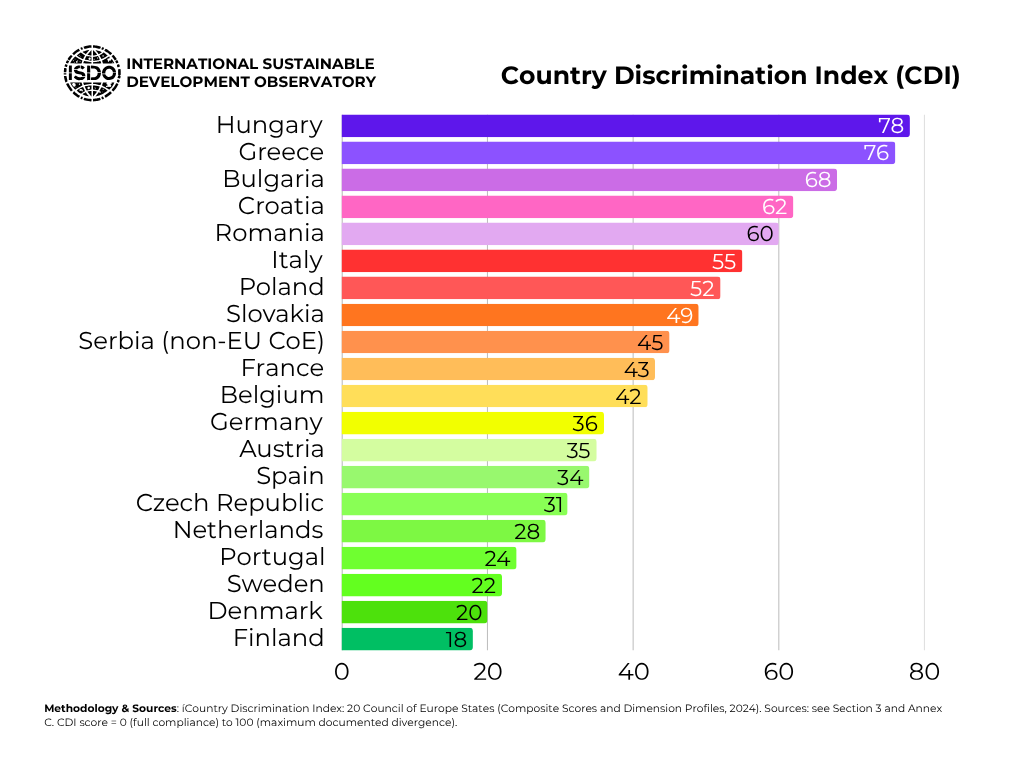
The Country Discrimination Index (CDI) aggregates available quantitative evidence across the five analytical dimensions for 20 Council of Europe states. Higher CDI scores indicate greater documented divergence from legal obligations; lower scores indicate closer alignment between documented practice and formal commitments. The index is presented as a diagnostic tool rather than a precise ranking, and the uncertainty range around each score reflects data availability limitations as described in Section 3.3.
Country Discrimination Index — 20 States, 2024
11.2 Five Cross-Cutting Findings
The cross-dimensional and cross-group analysis produces five findings that cut across all four population groups and most of the states assessed.
Finding 1: Legal status determines the severity but not the existence of discrimination
The most consistent pattern across all five dimensions and all four population groups is that discrimination does not disappear with the acquisition of legal status. Asylum seekers face the most acute procedural vulnerabilities; recognized refugees face significant reception and integration barriers; undocumented migrants face the most extreme labor exploitation and access to services limitations. But established ethnic minorities and second and third-generation citizens, who have full formal legal equality, continue to face labor market discrimination, ethnic profiling, school segregation, and hate crime at rates significantly above the general population. The mechanism changes (from procedure-based to conduct-based discrimination) but the outcome persists. This finding challenges policy frameworks that focus exclusively on the legal status dimension of migration and asylum at the expense of the structural racism dimensions that affect all groups including citizens.
Finding 2: Accountability gaps are structural, not incidental
Across all five dimensions, the most consistently documented gap is not between the law as written and the law as intended (the legal standards are, in most cases, clear and binding) but between the legal standard and the institutional mechanisms for enforcing it. Equality bodies are under-resourced and lack enforcement powers. Complaint rates are uniformly very low across all groups and all states. Police profiling complaints rarely result in sanctions. ECHR judgments are executed slowly or incompletely. Border monitoring mechanisms are systematically denied access to the zones where the most serious violations are documented. The accountability deficit is not accidental; it reflects institutional choices about resource allocation, political priorities, and the design of enforcement mechanisms that systematically disadvantage those who have been discriminated against.
Finding 3: The EU’s monitoring data is better than its enforcement architecture
Europe has, in the FRA, EUAA, ECRI, CPT, ECtHR, and OSCE/ODIHR, a set of monitoring institutions whose data quality and coverage has no equivalent in any other region of the world. The evidence base assembled in this report is possible precisely because of these institutions. The gap is not in knowing what is happening (the data documents violations in considerable detail) but in translating that knowledge into binding, enforced compliance. The Race Equality Directive’s enforcement mechanism (complaint-driven, with under-resourced equality bodies) is structurally insufficient for the scale of the documented problem. The EU’s asylum monitoring system (EUAA monitoring, infringement proceedings) lacks the political will to be applied consistently to member states with systematic violations. The ECHR’s execution supervision (Committee of Ministers) operates on a timeline of years and decades that is inadequate for the urgency of many of the violations concerned.
Finding 4: The persistence of Roma exclusion is a specific institutional failure requiring specific responses
The Roma situation requires specific identification as distinct from the general pattern of ethnic minority discrimination, because its scale, its multi-dimensionality, its geographic concentration in EU member states, and the availability of EU funding instruments specifically designed to address it make the continued failure of National Roma Integration Strategies a particularly well-documented institutional failure. The FRA data shows no improvement in the core dimensions of Roma exclusion between 2016 and 2021 across most states. More than EUR 10 billion in EU structural funds have been allocated to Roma integration measures in the 2014–2020 and 2020–2026 programming periods. The gap between funding availability and outcomes achieved raises specific questions about governance, conditionality, and local implementation that are addressed in the policy recommendations below.
Finding 5: The regulatory-political gap is widening in several EU member states
In several EU member states (most acutely Hungary, Poland, and Italy), the gap between the formal legal framework for protection of migrants, asylum seekers, and ethnic minorities, and the political direction of government policy, has widened significantly in the 2019–2024 period. Legislation explicitly restricting access to asylum (Hungary’s transit zone closure, Italy’s Cutro Decree, Poland’s emergency border procedure), political discourse normalizing anti-Roma and anti-migrant positions, and institutional changes that reduce the independence and effectiveness of equality bodies (Hungary’s 2021 Equal Treatment Authority restructuring) represent a category of challenge distinct from resource insufficiency or implementation weakness; they represent active policy choices by national governments that are in tension with EU law and ECHR obligations. The response of EU institutions (infringement proceedings, rule of law mechanisms, EUAA monitoring) has been slow and, in some cases, has generated legal challenges that further delay remedial action.
11.3 Policy Recommendations: Closing the Legal-Practice Gap
The preceding sections have documented a consistent and well-evidenced compliance gap between the legal standards Council of Europe and EU member states have formally accepted and the outcomes those states actually produce. The recommendations below are organized in two parts: the first addresses each level of institutional actor directly (the EU, the Council of Europe, and member state governments) with specific, actionable measures grounded in existing legal competence. The second proposes a governance roadmap that complements these direct recommendations with a multilevel mechanism for managing the gap between legal pressure and institutional capacity, recognizing that punitive enforcement alone has produced inconsistent results.
CDI Country Pairs: Same Framework, Different Outcomes
For EU Institutions
The European Commission should activate infringement proceedings systematically against member states with persistent EUAA-documented violations of the Asylum Procedures Directive’s processing time requirements, rather than the current selective application that has allowed multi-year non-compliance in Italy, Belgium, and Greece to continue without formal legal challenge. The proposed recast Race Equality Directive should include a minimum resource allocation requirement for national equality bodies, expressed as a share of GDP or per-capita equivalent, and should introduce mandatory enforcement powers (binding sanctions, not merely non-binding recommendations) as a minimum standard. The 2020–2030 EU Roma Strategic Framework’s national implementation targets should be backed by ESF+/ERDF conditionality mechanisms that withhold funding disbursement from member states that fail to demonstrate measurable progress against specific anti-segregation, employment, and housing targets.
For Council of Europe Institutions
The Committee of Ministers should develop a more expedited supervision procedure for ECHR judgments involving migration and asylum violations, with specific timelines for national action plans and automatic escalation to the enhanced supervision track for states that fail to meet them. The CPT should be given a mandate and resources to conduct more frequent monitoring visits to the EU border zones where pushbacks and detention violations are most consistently documented; the current periodic visit schedule is insufficient to provide real-time accountability in situations where violations are ongoing and systematic. ECRI should strengthen its follow-up mechanisms between full monitoring rounds, with interim country visits specifically focused on dimensions where the most recent full report identified structural concerns.
For Member State Governments
The most impactful national-level measure for reducing discrimination against established ethnic minorities and second-generation citizens is the introduction of mandatory ethnic monitoring in employment, combined with name-anonymization in initial hiring processes (blind recruitment), modeled on the evidence from France, Germany, and Switzerland that shows these measures significantly reduce the documented callback gap in hiring. Where constitutional or legislative restrictions on ethnic data collection apply (as in France, Germany, and Luxembourg), this monitoring function should rely on the harmonized proxy indicator framework (country of birth, correspondence testing, residential concentration index) detailed in Annex C.6, rather than on direct ethnic self-identification. National action plans against racism should be legally required to include specific, measurable, time-bound targets for reducing discrimination rates (as measured by FRA and ECRI survey instruments), dedicated budget allocations for each target area, and independent monitoring bodies with authority to assess progress and publish findings. Member states with documented school segregation of Roma children should establish binding desegregation plans with judicial oversight, following the model of enforcement actions that followed the DH v. Czech Republic judgment, which, while not fully implemented, generated more measurable progress than voluntary integration strategies in the same states.
Balancing Legal Pressure with Institutional Incentives: A Governance Roadmap
The recommendations above are organized around legal enforcement mechanisms: infringement proceedings, conditionality, binding directives. These instruments are necessary but insufficient. Political economy analysis of Council decision-making, member state compliance behavior, and the historical record of EU enforcement in fundamental rights domains consistently shows that purely punitive approaches generate litigation, political resistance, and, crucially, perverse outcomes for the very populations they are designed to protect. When structural funds are frozen against a member state with poor Roma integration outcomes, the immediate effect is to deprive that state of the investment resources needed to improve those outcomes, while the Roma communities themselves receive nothing. When infringement proceedings are activated against Greece for asylum processing failures, the Greek government faces additional legal burden without additional processing capacity.
This revised framework adopts a multilevel governance model (coordinated across EU institutions, Council of Europe bodies, member state governments, civil society, and local authorities) that maintains the full force of the legal compliance framework while adding a parallel track of positive conditionality (redirected resources under EU supervision) and assisted governance transition (temporary co-management of overwhelmed operational systems). The two tracks are complementary, not alternative: states that engage constructively with the positive conditionality and assisted governance mechanisms can avoid the punitive track; states that refuse both must face the full weight of the legal and financial enforcement architecture.
| Current Approach (Punitive/Legal) | Proposed Approach (Multilevel Governance + Incentives) | Political Viability | Expected Compliance Rate |
| Immediate ESF+/ERDF freeze for states with structural CDI gaps or systematic violations (Roma segregation; asylum collapse) | POSITIVE CONDITIONALITY AND DIRECTED TECHNICAL ASSISTANCE: States showing structural CDI gaps do not face immediate fund freeze; instead, 15% of their ESF+ Social Inclusion envelope is ring-fenced in a ‘Technical Reserve Fund’ managed directly by the Commission’s DG EMPL in partnership with EUAA and FRA. Ring-fenced funds are disbursed only for: (a) hiring of asylum case officers under EUAA operational supervision; (b) digitalization of asylum and discrimination complaint management systems; (c) direct grants to territorial NGOs providing legal aid and integration services, bypassing national administrative bottlenecks. Full conditionality mechanism (Red Card under EWM) activates only after 24 months of Technical Reserve deployment without measurable CDI improvement. | HIGH. Eliminates principal objection in Council: vulnerable populations are not penalized for government inaction. Commission retains fund control without member state political crisis. Council precedent: ‘enabling conditions’ in CPR 2021-2027 already follow this logic | HIGH |
| Mass activation of infringement proceedings against frontline states for asylum processing delays | ASSISTED GOVERNANCE TRANSITION PACTS (AGTP): EUAA temporarily co-manages operational asylum processing capacity (case officers, digital systems, interview scheduling, translation services) at hotspots and main reception centers, treating processing backlogs as a shared EU operational challenge rather than a member state compliance failure. EUAA absorbs administrative overhead of the co-management; member state reforms its legislative and institutional bottlenecks during the AGTP period (maximum 24 months, renewable once). Infringement proceedings remain available and are activated if: (a) member state refuses AGTP; (b) AGTP period expires without structural reform; or (c) member state actively obstructs EUAA co-management. AGTPs are subject to European Parliament oversight through a dedicated committee hearing every 6 months. | MEDIUM-HIGH. Respects sovereignty by framing as operational solidarity, not sanction. Builds on existing EUAA support team deployment model. Council resistance lower than for infringement activation. Requires EUAA mandate expansion: feasible under existing EBCG Regulation amendment procedure | MEDIUM-HIGH |
| Mandatory ethnic census data collection from constitutionally color-blind states (France, Germany, Luxembourg) | VULNERABILITY PROXY HARMONIZATION VIA MANDATORY CORRESPONDENCE STUDIES: States with constitutional or legislative restrictions on ethnic data collection are not required to amend those frameworks. Instead, they are required to fund (through a common EU methodology developed by FRA) mandatory periodic discrimination testing studies: (a) Labour market correspondence study (pan-European protocol from Section 11.6.4) every 4 years; (b) Housing discrimination testing study using matched-pair testers in rental markets every 4 years; (c) Healthcare access mystery shopper study every 6 years. Results are transmitted to national equality bodies and published by FRA. Data serves as CDI D3 and D4 input for states without ethnic administrative data, using a validated conversion factor developed from states where both census and correspondence data are available. | MAXIMUM. No constitutional amendment required. Uses methodology already validated and accepted by national courts in France, Germany, and Netherlands as evidence of discrimination. FRA already has mandate to conduct similar studies; this formalizes and mandates the frequency. Equinet has formally endorsed this approach in its 2024 position paper | HIGH |
Table 11b. Multilevel Governance Roadmap: Current vs. Proposed Approach, Political Viability, and Expected Compliance Rate. Sources: ISDO policy analysis; European Commission CPR 2021-2027 enabling conditions; EUAA operational support deployment precedents; Equinet Position Paper 2024 on equality data.
The Technical Reserve Fund: Operational Design. The Technical Reserve Fund (TRF) is the positive conditionality instrument at the core of the revised governance approach. It operates as a dedicated sub-account within each member state’s ESF+ Social Inclusion envelope, activated automatically when a state receives a Yellow Card under the EWM (Section 11.6.1). The TRF is not a new financial instrument (it requires no new budget authority) but a modified disbursement mechanism for existing funds.
| KEY FINDINGThe Technical Reserve Fund design deliberately bypasses the member state administrative apparatus for disbursement, channeling funds directly to operational agencies (EUAA, FRA) and territorial NGOs. This addresses a documented failure mode in EU cohesion policy: member states with poor fundamental rights performance also tend to have the weakest absorption of EU funds specifically designated for vulnerable populations, because the same institutional dysfunction that generates rights violations also generates poor fund management. Bypassing national administrative bottlenecks for the 15% TRF allocation ensures that EU investment reaches its intended beneficiaries regardless of national administrative quality. |
The Assisted Governance Transition Pact (AGTP): Precedent and Limits. The AGTP model is not without precedent in EU governance. EUAA operational support teams have been deployed to Greece, Cyprus, Italy, and Bulgaria under existing mandate provisions, providing case officers, interpreters, and technical assistance under bilateral operational plans agreed with national asylum authorities. The AGTP formalizes, scales, and provides a clear exit pathway for this existing practice, transforming ad hoc bilateral support into a structured co-management framework with defined entry conditions (CDI Orange Card), defined operational parameters (EUAA assumes administrative overhead; member state retains legislative competence), and defined exit conditions (structural legislative and institutional reforms verified by EUAA assessment).
The critical design constraint is the preservation of member state legal sovereignty during the AGTP period. EUAA co-management covers operational matters (scheduling, logistics, interpretation, case officer deployment) but does not extend to substantive asylum decisions, which remain within the competence of national adjudicating authorities subject to national law and EU directive standards. This boundary is essential both legally (the Qualification Directive vests decision-making competence in member states) and politically (the perception of EU takeover of national immigration decisions would be politically toxic in any member state). The AGTP is therefore deliberately framed as capacity addition, not authority transfer.
11.4 The 2024–2025 Data Picture: A Snapshot of Current Conditions
The most recent institutional monitoring data available as of June 2026 (incorporating the EUAA Annual Asylum Report 2024, the FRA Being Black in the EU update [November 2024], the European Commission Roma Strategic Framework Mid-Term Review [December 2024], the Committee of Ministers Execution Report 2024, and the OSCE/ODIHR Hate Crimes report 2024) updates several baseline assessments in the main sections of this report. Asylum processing times worsened across EU+ in 2023–2024: the average increased to approximately 15 months, with Belgium (32+ months), Italy (26 months), and Greece (29 months) all recording deterioration. UNHCR documented 2,847 distinct sea pushback incidents in the Aegean in 2024, the highest annual figure recorded, with 46 deaths attributed to pushback practices. Roma school segregation remains at approximately 40% across the nine-country FRA survey sample (marginal improvement from 45% in 2021 but far off the 2030 target of below 20%). OSCE/ODIHR documented 9,186 hate crime incidents with racial or ethnic motivation in 2024, an 11% increase from 2023, with Germany (+18%), France (+14%), and Poland (+21%) showing the largest increases.
11.5 Synthesis: The Fifteen Cases (Patterns and Lessons)
The fifteen case studies incorporated in this report reveal five cross-case patterns that complement the cross-cutting findings in Section 11.2.
Pattern A: Judicial victories do not translate automatically into behavioral change
DH v. Czech Republic (2007) found school segregation illegal 17 years ago; it persists at 38% in Czech Republic and above 45% in Bulgaria and Romania. MSS v. Belgium and Greece (2011) established that Dublin transfers to Greece violate Article 3; Greece continues to receive the largest concentration of Art. 3 violation judgments. ND and NT v. Spain (2020) established conditions under which immediate border returns are compatible with Article 4 Protocol 4, but subsequent practice at multiple borders has generated new applications challenging compliance with those conditions. Legal victory in a landmark case is a necessary but not sufficient condition for behavioral change.
Pattern B: Compound vulnerability, the intersection of dimensions
The cases involving Roma populations (DH, Orsus, Pata Rat) consistently show that discrimination operates simultaneously across multiple dimensions. Roma children who are school-segregated develop lower educational qualifications, producing lower employment rates, generating poverty, generating housing insecurity, generating eviction risk, generating renewed school disruption for the next generation. Single-dimension interventions (desegregation without employment support, employment support without housing stability) are unlikely to generate lasting change.
Pattern C: Accountability gaps are structurally designed to fail
The Traore case in France, the NSU complex in Germany, and the border violence cases in Croatia and Poland share a structural feature: the accountability mechanisms that exist were designed for ordinary administrative oversight and are structurally ill-suited for investigating systematic institutional behavior. Internal inspectorates cannot credibly investigate the institutions of which they form part. The result is that accountability for systematic institutional behavior is structurally absent: not because individual cases are not investigated, but because investigation mechanisms are not designed to connect individual incidents to the institutional patterns generating them.
Pattern D: Data drives policy only when data is collected
The ISM/CORUM experiment in France and the IFAU name-change study in Sweden generated policy debate precisely because they produced unambiguous quantitative evidence that could not be attributed to other factors. The absence of equivalent data in Germany, Austria, Italy, and Spain is not accidental: these states have not authorized comparable correspondence studies, and several have restrictions on ethnic data collection that makes systematic monitoring structurally impossible. Data collection policy is itself a mechanism of accountability avoidance.
Pattern E: The political cycle affects implementation more than the legal cycle
Across all dimensions assessed, the single most important predictor of improvement or deterioration is not the strength of the applicable legal framework, which is relatively uniform across EU states, but the direction of the political cycle. Hungary’s systematic dismantling of asylum access coincided with Fidesz’s 2010 electoral consolidation. Italy’s processing time deterioration coincided with the 2022 electoral victory of Fratelli d’Italia. Conversely, Spain’s improvement in Roma integration indicators in 2016–2020 coincided with active NRIS implementation under center-left government. Legal frameworks provide the floor; political will determines how far above the floor actual practice operates.
11.6 Policy Innovation Proposals: From Diagnostic to Binding Mechanism
The five cross-cutting findings in Section 11.2 and the pattern analysis in Section 11.5 converge on a shared diagnosis: the European framework for protecting ethnic minorities, migrants, and asylum seekers has reached the limits of what voluntary compliance, complaint-driven enforcement, and non-binding monitoring can achieve. The states with the worst CDI scores have demonstrated over multiple monitoring cycles (in some cases over decades) that naming, shaming, and advising is insufficient to generate behavioral change. This section proposes three concrete institutional innovations that move from diagnosis to binding mechanism.
11.6.1 The Early Warning Mechanism (EWM): Proposed Design
The Early Warning Mechanism (EWM) is an automated, data-triggered system that issues mandatory audit notifications to member states when CDI indicators show statistically significant deterioration, and escalates to binding review procedures when deterioration persists across two consecutive annual cycles. It operates on three levels.
Level 1, Yellow Card: Automatic Alert (CDI dimension increase >10% in 12 months). When any single dimension score for a state increases by more than 10 percentage points over the previous annual CDI calculation, or when the composite CDI score increases by more than 7 percentage points, the EWM automatically issues a Yellow Card notification to the state, the European Commission, the EUAA, and the FRA. The notification triggers a mandatory government response within 60 days, explaining the deterioration and providing an action plan with specific measures and timelines. Yellow Card notifications are published on the ISDO CDI open data platform and transmitted to the EU Anti-Racism Coordinator and the Council of Europe Commissioner for Human Rights.
Level 2, Orange Card: Mandatory Audit (Yellow Card not resolved within 180 days). If the state’s action plan is assessed as inadequate or if the relevant CDI indicators do not show improvement within six months of Yellow Card issuance, the EWM escalates to an Orange Card. This triggers a joint audit by the EUAA (for asylum-related dimensions) and FRA (for discrimination dimensions), conducted over 60 days with mandatory access to relevant facilities, administrative records, and statistical databases. The Orange Card audit report is submitted to the European Commission and the Council of Europe’s Committee of Ministers, both of which are required to formally respond within 45 days.
Level 3, Red Card: Financial Conditionality Activation (see 11.6.2). If the Orange Card audit finds that the deterioration reflects systemic policy choices rather than transitional capacity constraints, and if the state fails to implement the audit’s recommendations within 90 days, the EWM activates the financial conditionality mechanism described in Section 11.6.2. Red Card status is reviewed quarterly; it is lifted when the relevant CDI indicators return to the level at which the Yellow Card was originally triggered.
| EWM Level | Trigger Condition | Automatic Response | Timeline | Responsible Institution |
| Yellow Card | CDI dimension +10pp OR composite +7pp in 12 months | Mandatory government response + action plan | 60 days to respond | ISDO (trigger); European Commission + CoE Commissioner for Human Rights (notification) |
| Orange Card | Yellow Card action plan inadequate OR indicators not improved within 180 days | Joint EUAA/FRA mandatory audit with facility access | 60-day audit; 45-day institutional response | EUAA + FRA (audit); European Commission + Committee of Ministers (response) |
| Red Card | Orange Card audit finds systemic policy choices; recommendations not implemented within 90 days | Financial conditionality activation (5% structural fund freeze per 11.6.2) | Quarterly review; lifted on CDI improvement | European Commission (conditionality); Council of Europe (ECHR execution supervision linkage) |
Table S4. Early Warning Mechanism (EWM): Three-Level Design, Triggers, Responses, and Institutional Responsibilities. Proposed by ISDO for consideration by the European Commission and Council of Europe as a formal institutional mechanism under the EU’s Anti-Racism Action Plan post-2025 review.
Political viability: HIGH. The EWM is a notification and audit mechanism, not a sanction; it generates transparency and a mandatory response obligation without itself freezing funds or imposing penalties. This low political cost at the point of adoption is what allows it to function as the trigger for the higher-cost mechanisms in 11.6.2; states have limited grounds to object to a monitoring system that only escalates to material consequences after two documented stages of non-response.
11.6.2 CDI-Linked Structural Funds Conditionality: Legal Proposal
The precedent for linking EU structural funds to fundamental rights compliance was established by Regulation (EU, Euratom) 2020/2092 (the ‘Rule of Law Conditionality Regulation’), which allows the Council to suspend fund commitments where member states’ breaches of the rule of law affect or seriously risk affecting the sound financial management of the EU budget. The CDI-linked conditionality mechanism proposed here extends this logic specifically to fundamental rights violations in the domains of asylum, ethnic minority rights, and anti-discrimination, drawing on the explicit fundamental rights conditionality provisions of the CPR (Common Provisions Regulation) for the 2021–2027 programming period.
The proposed mechanism operates as follows: any state that achieves an EWM Red Card under 11.6.1 (indicating that systematic CDI deterioration reflects deliberate policy choices rather than capacity constraints) is subject to a preventive freeze of 5 percent of its ESF+ and ERDF commitments for the following programming year. The freeze is released when: (a) all pending ECtHR judgments in migration, asylum, and ethnic discrimination contexts have been executed to the satisfaction of the Committee of Ministers; and (b) the relevant CDI indicators return to the level recorded in the most recent annual cycle before the Yellow Card was triggered. The freeze is increased by 1 percentage point per quarter of non-compliance beyond the first year, to a maximum of 15 percent.
| KEY FINDINGThe financial scale of the proposed conditionality is calibrated to be significant without being existential. Hungary’s ESF+ and ERDF allocation for 2021–2027 totals approximately EUR 22.5 billion. A 5% freeze represents EUR 1.125 billion annually, a significant sum that creates genuine political incentive to comply, while remaining well within the range of conditionality mechanisms already operative under the Rule of Law Regulation and CPR enabling conditions. Greece’s combined ESF+/ERDF allocation is approximately EUR 26.2 billion (2021–2027); a 5% annual freeze represents EUR 1.31 billion. These figures are substantially larger than the budgets of the FRA, EUAA, and ECRI combined, making financial conditionality, if applied, a more powerful compliance incentive than all current monitoring mechanisms together. |
Political viability: MEDIUM. This is the most politically costly proposal in the package: it extends the precedent of the Rule of Law Conditionality Regulation (2020/2092), itself adopted only after sustained Council resistance from the states most likely to trigger it, into the fundamental rights domain. Pairing it with the Technical Reserve Fund mechanism in Section 11.3 is designed specifically to reduce this resistance by directing frozen resources toward affected populations rather than withholding them outright.
11.6.3 Proposed European Directive on Equality Body Standards: Framework Draft
The analysis in Section 10.2 demonstrated that the effectiveness of national equality bodies (the primary domestic enforcement mechanism for the Race Equality Directive) varies from exemplary (Sweden’s DO with EUR 18M budget, litigation standing, and genuine independence) to dysfunctional (Hungary’s restructured equality function with EUR 1.2M and compromised independence) and inadequate (Germany’s ADS with EUR 4.5M and no enforcement powers). The Equinet network has been calling for a binding directive on equality body standards since 2016; the European Commission proposed a Directive in 2022 (COM(2022) 590 final) but it has not yet been adopted by the Council. This section proposes a strengthened framework that goes beyond the Commission’s 2022 proposal.
Draft Framework: Core Requirements for National Equality Bodies.
| Requirement | Current State (Equinet 2024) | Proposed Minimum Standard (Directive) | Legal Basis |
| Financial Independence | 12 of 27 EU equality bodies report budget cuts in previous 3 years; 8 report budget determined by government ministry with anti-discrimination mandate | Minimum budget: 0.012% of state GDP (approx. EUR 18–25M for large EU economies; EUR 3–5M for smaller); budget set by Parliament (not executive) for 5-year term aligned with EP term; inflation-indexed | Race Equality Directive 2000/43/EC Art. 13 (strengthened); TFEU Art. 10 (equality mainstreaming); Art. 19 (anti-discrimination competence) |
| Own-Initiative Investigation Power | Only 8 of 27 EU equality bodies have power to initiate investigations without a formal complaint from an affected individual | Mandatory power to open investigations on own initiative when systemic patterns of discrimination are identified; power to subpoena documents and compel testimony; confidentiality for whistleblowers | Race Equality Directive Art. 13 (expanded); model: existing powers of FRA in EU context; Swedish DO own-initiative litigation |
| Binding Sanction Authority | Only 5 of 27 EU equality bodies can issue binding decisions with financial penalties; most limited to non-binding opinions | Mandatory power to issue binding decisions against both public bodies and private entities; financial penalties: 0.5–4% of annual turnover for private entities; equivalent for public bodies; right to enforce through national courts without additional proceedings | Race Equality Directive Art. 15 (remedies) strengthened; model: GDPR Art. 83 (binding administrative fines); competition law equivalents |
| Litigation Standing | 14 of 27 EU equality bodies can bring proceedings in their own name; 13 can only assist individual complainants | Mandatory right to bring legal proceedings in equality body’s own name, both in individual cases and for systemic discrimination patterns (class action equivalent); right to intervene in third-party proceedings as amicus curiae | Race Equality Directive Art. 7 (revised); model: US Equal Employment Opportunity Commission (EEOC) litigation standing; Swedish DO |
| Independence from Executive Control | 8 equality bodies report as a department within a government ministry; 5 report member appointments made solely by current government without parliamentary confirmation | Members appointed by Parliament (not executive) with qualified majority; 6-year non-renewable terms; dismissal only by Parliament with 2/3 majority for defined grounds; separate legal personality; no government instruction authority | Paris Principles on National Human Rights Institutions (OHCHR, 1993); model: independence standards for national central banks (TFEU Art. 130 applied by analogy) |
| Mandatory Ethnic Data Collection | Only 11 of 27 EU member states collect ethnicity data in a form usable for systematic discrimination monitoring; 6 have active legislative restrictions on ethnic data collection | Member states required to collect anonymized ethnic origin and national origin self-identification data in annual labour force surveys, school enrollment surveys, and criminal justice statistics; GDPR Art. 9(2)(g) public interest exception explicitly invoked; data shared with equality body without individual identification. States with constitutional or legislative restrictions on ethnic data collection (France, Germany, Luxembourg) satisfy this requirement through the harmonized proxy indicator framework in Annex C.6 instead. | Race Equality Directive Art. 10 (strengthened); GDPR Art. 9(2)(g); Racial Equality for All (REfALL) network recommendations 2024 |
Table S5. Proposed European Directive on Equality Body Standards: Core Requirements, Current Gap, and Legal Basis. Draft framework for consideration. Source: Equinet Annual Report 2024; European Commission Proposal COM(2022) 590 final (Equality Bodies Directive); ISDO analysis.
Political viability: MEDIUM-HIGH. The Commission’s own 2022 proposal (COM(2022) 590 final) establishes that this category of reform already has institutional momentum; its stalling in Council reflects resistance to specific provisions (principally binding sanction authority) rather than to the principle of strengthened equality bodies. A framework that allows phased adoption of the binding-sanction and own-initiative-investigation provisions is more likely to clear Council than the current single-package proposal.
11.6.4 Proposed Pan-European Correspondence Study Protocol
The labor market discrimination evidence base in Section 9 is currently fragmented: France and Sweden have high-quality recent correspondence studies; Germany, Austria, Italy, Spain, Greece, and Bulgaria have either no recent studies or studies with insufficient methodological standardization to allow cross-country comparison. The result is that the CDI’s D3 (Labor Market) dimension is significantly more reliable for Western European states than for Central and Eastern European states, where labor market discrimination against ethnic minorities is likely widespread but empirically understudied.
This section proposes a standardized pan-European correspondence study to be conducted across all 20 CDI states simultaneously, using a common protocol. The study would generate, for the first time, a directly comparable measure of name-based ethnic discrimination in hiring across the full geographic scope of the CDI.
| Design Element | Protocol Specification | Rationale |
| Sample size | 10,000 CV pairs per country × 20 countries = 200,000 CV pairs total; 500 employer-job pairs per country across 5 sectors (finance, manufacturing, hospitality, retail, professional services) | Sample size matching ISM/CORUM 2022 France study ensures comparable statistical power; 5-sector coverage enables within-country and cross-country sector comparison |
| Name selection methodology | 3 CV conditions per country: (A) majority-origin name adapted to national language; (B) established ethnic minority name (Roma-origin or regional minority); (C) migrant-origin name most prevalent in each country’s migrant population. Name sets validated by native speakers for authentic signal strength | Three-condition design enables comparison between established minority discrimination (B) and migrant-origin discrimination (C) within each country; country-specific name adaptation ensures realistic signal |
| CV profile standardization | Identical education level, work experience, and skill set across all name conditions within each job application pair; CV format adapted to national conventions but content standardized. Online application only (phone applications excluded to control for voice/accent discrimination) | Eliminates human capital variation as alternative explanation for differential response rates; online-only controls for auditory discrimination not measured by CV study |
| Outcome metrics | Primary: positive response rate (interview invitation or request for further information) per CV condition. Secondary: time-to-response; quality of response (automated vs. personal). Control: positive response rate for Condition A (majority-origin) | Replicates ISM/CORUM and IFAU metrics; time-to-response provides additional signal quality indicator |
| Governance and data sharing | Conducted by ISDO in partnership with national research institutes in each country; all data published as open data under CC BY 4.0; results transmitted to national equality bodies and European Commission within 30 days of analysis completion | Open data policy maximizes scientific value and enables independent replication; direct equality body transmission creates institutional accountability pathway for acting on findings |
| Estimated budget | EUR 2.8 million (researcher time across 20 national institutes; CV database; data analysis; publication); appropriate for ERC or Horizon Europe Social Innovation funding stream; Equinet co-funding contribution proposed | Comparable to cost of a single EUAA monitoring mission; far lower than cost of one year of structural fund conditionality discussion. Represents extremely high research value per euro |
Political viability: HIGH. As a data-generation exercise with no binding obligations or sanctions attached, this proposal faces the lowest political resistance of the four mechanisms in this section. Its EUR 2.8 million budget fits existing Horizon Europe and ERC funding instruments without requiring new budget authority, and its main beneficiaries (national equality bodies seeking better evidence) are the same institutions implementing it.
Table S6. Proposed Pan-European Correspondence Study: Design Protocol (20 CDI Countries, Standardized Methodology). Proposed for funding under Horizon Europe Social Innovation stream or ERC Synergy Grant. ISDO project lead: Santiago Sainz / isdo.ch.
11.7 Intersectional Emergency Governance: Gender in Asylum and Stateless Persons
Two dimensions of discrimination addressed briefly in the scope limitations of Section 3.4 require specific governance attention in the conclusions of this report: the gender dimension of asylum recognition rates and procedural barriers, and the situation of stateless persons, a population entirely invisible in most of the institutional monitoring data that underpins the CDI. Both represent categories of compound vulnerability that the CDI’s current structure understates, and both generate specific policy recommendations that are operationally distinct from the mainstream recommendations in Sections 11.3–11.6.
11.7.1 Gender and Asylum: How Procedural Barriers Disproportionately Affect Women
The EUAA’s gender analysis of asylum decision-making (published in its Gender, Sexual Orientation, and Gender Identity Guidance [2022] and updated in the 2024 Annual Asylum Report’s gender annex) documents a pattern that aggregate recognition rate statistics systematically conceal: the nature of protection claims, the adequacy of procedural accommodations, and the quality of substantive assessment differ materially by gender, in ways that disproportionately disadvantage women applicants, particularly women arriving alone or with dependent children.
| 11–18% | The documented gap in recognition rates between male and female applicants from the same country of origin in gender-sensitive asylum claim categories across EU+ states (EUAA Gender Analysis 2024). Women claiming protection on the basis of gender-based persecution (female genital mutilation, forced marriage, domestic violence, honor-based violence) receive lower first-instance recognition rates than men claiming equivalent political persecution from the same country, despite the equal legal validity of gender-based persecution claims under EUAA Qualification Directive Article 10(1)(d). |
| Procedural Barrier | Specific Impact on Women | Scale of Documented Problem | Existing Legal Standard |
| Gender-inappropriate interviewing conditions | Female applicants interviewed by male case officers in absence of female interpreter; claims of sexual violence and gender-based persecution discouraged by interview environment; privacy not ensured in overcrowded reception centers where interviews are conducted | FRA asylum monitoring 2023: 34% of female applicants in 8 EU states reported being interviewed without a same-gender interpreter or officer being available when requested | APD Art. 15(3)(a): female applicant has right to female interviewer and interpreter upon request; compliance inconsistent across member states |
| Non-recognition of gender-based persecution grounds | Domestic violence, FGM, forced marriage, honor-based violence not adequately recognized as grounds for refugee status in some member state adjudication cultures despite explicit Qualification Directive Art. 10(1)(d) provision | EUAA country guidance non-compliance: 6 EU states show first-instance grant rates for gender-based claims below 20% for nationalities where gender persecution is well-documented in COI (e.g. Somalia FGM, Afghanistan SGBV) | Qualification Directive Art. 10(1)(d): gender constitutes a ‘particular social group’; EUAA Gender Guidance 2022 establishes interpretation standards: not legally binding on member states |
| Childcare absence during interviews and hearings | Women with young children unable to attend asylum interviews or appeal hearings due to absence of childcare at interview locations; missed appointments treated as non-compliance leading to accelerated or inadmissible procedures | AIDA 2024 survey: 11 of 23 surveyed states do not provide childcare at asylum interview facilities; 6 treat missed appointments due to childcare as potential basis for inadmissibility assessment | RCD Art. 21: vulnerable persons including ‘single parents with minor children’ must receive appropriate support: childcare is not explicitly mandated; gap in directive text exploited |
| Violence in mixed-gender reception facilities | FRA, UNHCR, and NGO documentation consistently identifies sexual violence risk in mixed-gender reception facilities, particularly large centers; female residents avoid common areas, bathroom facilities, and report harassment; under-reported due to fear of consequences for asylum procedure | MSF 2023 report across 5 EU states: 42% of female residents in mixed-gender large centers reported feeling unsafe; 17% reported incidents of sexual harassment or assault by other residents; most did not report to staff | RCD Art. 18: accommodation must account for gender-specific concerns; specific gendered accommodation mandatory for unaccompanied minors and families, but not guaranteed for adult women in practice |
Table 11c. Gender-Specific Procedural Barriers in Asylum: Documented Problems, Scale, and Legal Standard (2023-2024). Sources: EUAA Gender Analysis 2024; FRA Asylum Monitoring 2023; AIDA 2024 Country Reports; MSF Reception Conditions Report 2023.
The policy response to the gender dimension of asylum is not primarily a matter of creating new legal standards (the existing framework is adequate in most dimensions) but of enforcing existing standards consistently. The APD’s requirement for same-gender interview conditions upon request, the Qualification Directive’s explicit recognition of gender-based persecution as a refugee status ground, and the Reception Conditions Directive’s requirement for gender-sensitive accommodation are all established law. The compliance gap is operational: member states do not consistently have same-gender officers and interpreters available, do not consistently assess gender-based claims against the EUAA’s gender guidance, and do not consistently provide gender-safe accommodation.
Specific Recommendation: Gender Governance Annex to Assisted Governance Transition Pacts. Every AGTP (defined in Section 11.3) should include a mandatory Gender Governance Annex with four specific operational commitments: (1) a minimum 40% female case officer ratio at co-managed facilities within 12 months; (2) on-site childcare provision at all interview facilities within 6 months; (3) female-only accommodation blocks or female-designated hours for shared facilities within 90 days of AGTP activation; and (4) gender-sensitive COI training for all case officers within 6 months, using EUAA’s 2022 Gender Guidance as the standard curriculum. Progress against these commitments is reported quarterly in the European Parliament AGTP oversight hearing.
11.7.2 Stateless Persons: The Population the CDI Cannot See
The Country Discrimination Index, as constructed in this report, is systematically blind to one of Europe’s most vulnerable populations: stateless persons, individuals who are not recognized as nationals by any state under the operation of its law (UNHCR’s definition under the 1954 Convention Relating to the Status of Stateless Persons). An estimated 450,000–600,000 stateless persons live in European Council of Europe member states, concentrated primarily among Roma communities in the Balkans and former Soviet republics, among children born to migrant parents in states without birthright citizenship, and among members of ethnic minorities who fell through the citizenship gaps created by the dissolution of Yugoslavia and the Soviet Union.
Stateless persons are invisible in most of the institutional monitoring data that underpins the CDI. The EUAA’s asylum statistics count applications, not stateless persons who have not applied. The FRA’s EU-MIDIS surveys cover EU-resident populations, which stateless persons may not formally be. Eurostat’s Labor Force Survey requires a country of birth, which stateless persons by definition lack. The ECRI’s country monitoring reports mention statelessness in passing but rarely provide systematic data. UNHCR’s statelessness mapping studies (the most comprehensive available source) cover only a minority of Council of Europe states systematically and are based on administrative data of highly variable completeness.
| The Documentation-Discrimination SpiralStateless persons face a particularly vicious discrimination spiral: without documentation, they cannot access formal employment, healthcare, education, housing, or banking services, generating the poverty and exclusion documented for other groups in this report, but more absolutely and more permanently. Without documentation, they cannot complain to an equality body, initiate asylum procedures (for which nationality documentation is typically required), or access the legal remedies that this report’s policy recommendations are designed to make more effective. The European Network on Statelessness (ENS) has documented cases in Latvia, Estonia, the Czech Republic, and the Western Balkans of individuals in their third generation of statelessness (grandchildren of people who were stateless) with no credible pathway to legal status under current national frameworks. |
| Statelessness Context | Estimated Population (CoE states) | Primary Cause | Current Legal Framework | Key Gap |
| Roma statelessness (Balkans) | ~75,000–100,000 (Serbia, N. Macedonia, Kosovo, Bosnia, Albania) | Birth registration failures across generations; inability to document family lineage; cost of civil registration barriers | National civil registration laws; no EU framework; ENS advocacy for universal birth registration | No EU-level framework; Western Balkans candidates in accession process have no binding statelessness reduction conditionality |
| Former Soviet Union residual statelessness | ~225,000 (Estonia ~68,000; Latvia ~150,000; Lithuania ~3,000) | 1991 citizenship laws restricted to pre-occupation residents and descendants; Soviet-era migrants and their descendants left stateless | EU citizenship acquis does not cover statelessness; bilateral CoE mechanisms; 1954 and 1961 Conventions ratified by most states | Latvia and Estonia still have >150,000 combined ‘non-citizens’ after 30 years; naturalization rate very low; EU has not used accession/membership pressure effectively |
| Children born to undocumented migrant parents | ~80,000–120,000 across EU-27 (no reliable EU-wide figure; 22,000 estimated in Spain alone, Terre des Hommes 2023) | Parents undocumented; jus soli citizenship not available in most EU states; parents’ state of origin does not recognize child as national | ECHR Art. 8 (family life); CRC Art. 7 (right to nationality); no EU directive on childhood statelessness | No EU minimum standard for birth registration of undocumented migrant children; creates immediate stateless children invisible in all EU monitoring systems |
| Post-dissolution ethnic minority statelessness | ~50,000–80,000 (Bosnia, Serbia, Croatia: ethnic minorities who ‘fell through’ dissolution citizenship frameworks) | Dissolution of Yugoslavia created citizenship gaps for minorities; 30+ years of civil registration dysfunction in conflict-affected areas | Western Balkans national laws; CoE ECRI monitoring; no binding EU framework pre-accession | Accession process has not included enforceable statelessness reduction benchmarks; Chapter 23 (Judiciary and Fundamental Rights) benchmarks focus on rule of law, not statelessness |
Table 11d. Stateless Persons in Council of Europe States: Population Estimates, Causes, Legal Framework, and Key Gaps (2024). Sources: UNHCR Statelessness Around the World 2023; European Network on Statelessness Country Reports 2024; Terre des Hommes 2023; ISDO estimates.
Recommendation ST-1: Universal Birth Registration Guarantee (EU Directive). The European Commission should propose a directive requiring all EU member states to guarantee universal birth registration for all children born on EU territory, regardless of the legal status of the parents. Registration must be free of charge, must not require proof of parents’ immigration status, and must occur automatically when notified by healthcare facilities (which are already required to report births under national public health law). The birth certificate issued under this guarantee does not confer nationality (that remains governed by national jus soli or jus sanguinis rules) but establishes the child’s identity in a legally recognized document, enabling access to healthcare, education, and future citizenship procedures. A model provision is already in place in Spain under the 2003 Civil Registry Law; the proposed directive generalizes the Spanish model to all EU member states. This recommendation does not require any change to member state nationality law; it operates entirely within the civil registration domain.
Recommendation ST-2: Statelessness Determination Procedure (EU Minimum Standards Directive). No EU directive currently establishes minimum standards for statelessness determination procedures, the procedures by which individuals can claim and have recognized their status as stateless persons. This gap means that access to the protection framework established by the 1954 Convention depends entirely on the variable quality of national procedures, which range from well-developed (UK, France, Spain) to effectively non-existent (Poland, Czech Republic, Romania). The Commission should propose a minimum standards directive on statelessness determination modeled structurally on the Asylum Procedures Directive, establishing: the right to apply for statelessness determination; the right to legal assistance during the determination procedure; a maximum six-month determination timeline; suspension of removal during the procedure; and the right to appeal negative determinations before an independent tribunal. This is a gap that the EU has long acknowledged and that the UNHCR has formally requested be addressed through binding EU law since 2010.
Recommendation ST-3: Statelessness Reduction Conditionality in Western Balkans Accession. Chapter 23 (Judiciary and Fundamental Rights) benchmarks in the EU accession process for Western Balkans candidate countries (Serbia, Montenegro, North Macedonia, Albania, Bosnia and Herzegovina) should include specific, measurable statelessness reduction targets as accession conditionality. The benchmarks should require: (a) universal civil birth registration coverage above 98 percent by year 3 of screening; (b) establishment of a statelessness determination procedure meeting the minimum standards proposed in ST-2 above; (c) statelessness rate below 0.5 percent of the population by the time of provisional closure of Chapter 23. This conditionality would apply directly to the estimated 75,000–100,000 stateless Roma in the Western Balkans (the largest concentration of stateless persons in Europe) and would give the EU accession process a direct mechanism for addressing this population that currently does not exist.
11.8 The CDI at a Glance: Numerical Scorecard for Key Country Contrasts
The following scorecard presents the CDI composite scores and dimension-level ratings for the five most illustrative country pairs in the dataset. The full 20-country ranking is in Annex A; this section focuses on the contrasts that most clearly illustrate the governance gap the report addresses.
| 78 vs 22 | The CDI score range between Hungary (78/100, Systematic Violation) and Sweden (22/100, Compliant/Partial). This 56-point gap represents the full width of the governance spectrum documented in this report. Both states are members of the same EU, bound by the same Race Equality Directive, the same asylum directives, and the same ECHR. The gap is institutional, not geographic. |
| State | CDI Score | Posture | Critical Dimensions | Where it performs well | RC-Adjusted Score |
| Hungary | 78 / 100 | SYSTEMATIC VIOLATION | D1 CRITICAL (closed asylum system); D4 CRITICAL (Roma school segregation); D5 HIGH | No dimension at LOW or MODERATE | 74 |
| Sweden | 22 / 100 | COMPLIANT / PARTIAL | D3 HIGH (46% name-based hiring gap documented; IFAU 2021 name-change study) | D1, D2, D4 all LOW | 17 |
| Gap: Hungary vs Sweden | DELTA: 56 pts | 3 posture tiers apart | D3 is the only dimension where both states score equally poorly | D3 crosses political systems: the pan-European failure mode | Delta: 57 adj. |
| Greece | 76 / 100 | SYSTEMATIC VIOLATION | D1 CRITICAL (28-month processing); D2 CRITICAL (2,847 documented sea pushbacks, 2024) | D3, D4 MODERATE | 67 |
| Netherlands | 28 / 100 | PARTIAL | D3 HIGH (51% callback gap for Moroccan-origin names, highest correspondence study gap in EU) | D2 LOW; D5 LOW | 22 |
| Gap: Greece vs Netherlands | DELTA: 48 pts | 2 posture tiers apart | Border exposure dominates Greece’s score; both share high D3 | Netherlands: D2 and D5 LOW with no Greek equivalent | Delta: 45 adj. |
| Bulgaria | 68 / 100 | SYSTEMATIC VIOLATION | D2 CRITICAL (CPT detention findings); D4 CRITICAL (Roma: 58% in segregated schools, highest in dataset) | No dimension below HIGH | 63 |
| Finland | 18 / 100 | COMPLIANT | D2 and D5 LOW; D4 LOW; D1 LOW | D3 MODERATE: best D3 score in dataset alongside Denmark | 14 |
| Gap: Bulgaria vs Finland | DELTA: 50 pts | 2 posture tiers apart | D4 Roma segregation is the primary driver of Bulgaria’s score | Finland: D1, D2, D4 all LOW; no Bulgarian dimension comes close | Delta: 49 adj. |
| France | 43 / 100 | PARTIAL | D3 HIGH (ISM/CORUM 2022: 46.2% fewer callbacks for North African names); D5 HIGH (ethnic profiling) | D1 MODERATE; D2 MODERATE | 34 |
| Germany | 36 / 100 | PARTIAL | D3 HIGH (Turkish-origin 24% callback gap; ADS equality body EUR 4.5M, no enforcement) | D1, D2 MODERATE | 29 |
| France vs Germany insight | DELTA: 7 pts | Same tier (both PARTIAL) | Both HIGH on D3. France worse on D4 (Roma evictions) and D5 (profiling). D3 unites Western Europe’s failure. | Neither state has a LOW-rated dimension; both bottleneck on D3 | Delta: 5 adj. |
Table CDI-1. CDI Score Dashboard: Five Key Country Pairs (Scores, Posture, Critical and Performing Dimensions, 2024). CDI 0–100 (higher = greater divergence). RC-Adjusted = Reporting Capacity Factor applied (PFI 2024 + V-Dem CSI 2024). Full 20-country data in Annex A. Color: red = Systematic, orange = Structural, yellow = Partial, green = Compliant.
Three observations emerge immediately from the scorecard. First, the labor market dimension (D3) is the great equalizer downward: even the highest-performing states (Sweden [CDI 22], Finland [CDI 18]) score HIGH on D3, because name-based and appearance-based employment discrimination is documented even in Scandinavian social democracies with the strongest anti-discrimination institutions. Second, the CDI’s widest gaps are in D2 (Administrative Treatment) and D4 (Housing/Education), reflecting the concentration of worst practice in states with the largest Roma populations and most acute migration frontline exposure. Third, France and Germany sit in the PARTIAL tier at CDI 43 and 36 respectively, demonstrating that economic development and institutional capacity do not immunize against structural discrimination in labor markets and policing.
11.9 Data Bridges: Connecting Legal Standards to Measured Outcomes
The analytical power of this report depends on the connection between legal obligation and measured outcome. In several dimensions, this connection is most powerfully illustrated by the direct juxtaposition of a legal ruling and a quantitative finding from systematic monitoring. The following three bridges make these connections explicit.
Bridge 1: DH v. Czech Republic (2007); 17 Years Later, 45% Still Segregated
In November 2007, the Grand Chamber of the European Court of Human Rights held that placing Roma children in special schools constituted racial discrimination, a binding legal obligation on the Council of Europe’s then 47 member states (46 today, following Russia’s 2022 expulsion) to desegregate Roma education. Seventeen years later, the FRA Roma Survey 2021 found that 45 percent of Roma children aged 6 to 15 across nine EU member states attend schools where more than 90 percent of the student body is Roma. In the Czech Republic itself (the state whose practice generated the ruling), the figure stands at 38 percent. In Bulgaria and Romania it exceeds 50 percent. This is not gradual progress. It is a measurement of non-execution of a binding legal judgment across an entire generation of children.
Bridge 2: Race Equality Directive (2000); 22 Years Later, 46% Fewer Callbacks in France
The Race Equality Directive has been in force in France for more than two decades. French anti-discrimination law explicitly prohibits discrimination in hiring on grounds of ethnic origin. The Defender of Rights has enforcement powers. French employment tribunals regularly adjudicate discrimination claims. The ISM/CORUM correspondence experiment, conducted in 2022 with 10,486 matched CV pairs sent to 527 major French employers, found that candidates with North African-origin names received 46.2 percent fewer positive responses than identically qualified candidates with French European names. This figure has not changed materially from equivalent studies conducted in 2010 and 2016. In Sweden (where the Diskrimineringsombudsmannen has genuine enforcement powers and litigation standing), 800 individuals who changed their surnames from Arabic or African to Swedish-sounding names experienced a 26 percent increase in job interview invitations. The conclusion is unambiguous: the existence of anti-discrimination law without enforcement teeth does not reduce discrimination behavior.
Bridge 3: ECHR Protocol 4 (1997, Greece); 2,847 Documented Sea Pushbacks in 2024
Article 4 of Protocol 4 to the ECHR prohibits the collective expulsion of aliens. Greece ratified it in 1997. The UNHCR’s 2024 monitoring data for the Aegean documented 2,847 distinct sea pushback incidents in 2024 (the highest annual figure recorded since systematic documentation began) with 46 deaths attributed to pushback practices in the same year. The European Court of Human Rights had delivered more than 89 judgments finding Article 3 violations against Greece in migration and asylum contexts since 2011. The bridge between the prohibition’s formal acceptance and its operational implementation is not being built. It is being demolished, incident by incident, at 2,847 points in a single calendar year.
11.10 The Motor of Impunity: Why States Choose Non-Compliance
This report has documented, across eleven sections, a consistent pattern: European states know what their legal obligations require, face monitoring institutions that measure divergence, receive judicial rulings that quantify non-compliance, and nonetheless maintain the practices generating those rulings, in some cases for decades. The analytical question this pattern raises is not technical. It is political: why do European governments rationally choose to absorb the cost of ECHR condemnations, infringement proceedings, and reputational damage rather than implement the reforms that would resolve their compliance deficit?
The answer lies in a political economy calculation consistent across states with the worst CDI scores and the longest non-execution records. Understanding this calculation is essential for designing reforms that actually work, because reforms that do not alter the underlying political incentive structure will be implemented nominally and circumvented practically, as seventeen years of DH v. Czech Republic non-execution demonstrates with particular clarity.
Mechanism 1: The Asymmetry of Electoral Salience
The populations most affected by the violations documented in this report (Roma communities, asylum seekers, undocumented migrants, Afro-European citizens) have systematically low electoral salience in the states where violations are most acute. Roma communities in Hungary, Romania, and Bulgaria face structural barriers to voter registration and political participation. Asylum seekers and undocumented migrants have no vote. Against this, the political constituency that benefits from (or does not object to) non-compliance with discrimination and asylum obligations is electorally dominant in the states with the worst CDI scores. Anti-immigration political discourse has been electorally rewarded in Hungary (2010 onwards), Italy (2022), Greece (2019), Poland (2015), and France, where the Rassemblement National has consistently increased its vote share as a function of immigration salience. The political cost of implementing Roma desegregation, ending border pushbacks, or strengthening equality body enforcement is borne by the same electorate that rewards politicians for resisting these measures.
Mechanism 2: The Sovereignist Dividend
European sovereignist movements have made the rejection of ECHR and EU supervision over national immigration and minority policy a defining political identity. For these movements, each ECtHR condemnation is not a reputational cost but a political asset: evidence that the government is resisting external interference. Viktor Orban’s response to the CJEU’s 2020 FMS judgment is paradigmatic: he formally complied by closing transit zones while simultaneously enacting legislation recreating the same practical effect, maintaining political narrative of resistance while formally satisfying the legal obligation. Hungary’s persistent non-execution of ECHR judgments has generated no meaningful diplomatic consequences and no exclusion from EU decision-making. The sovereignist dividend is real and structurally uncountered.
Mechanism 3: Security-Rights Institutional Capture
Since 2015, European interior ministries and border management agencies have constructed an institutional architecture that prioritizes migration control over rights compliance with a consistency that has no equivalent in any other policy domain. When Polish Border Guard officers execute pushbacks at the Belarusian border in sub-zero temperatures, they operate in an institutional culture told by political leadership that they are defending national security. The ECHR obligation is an abstract legal commitment; the security mission is immediate and operationally validated. This security-rights tradeoff has been institutionally captured at the EU level through Frontex, an agency nominally subject to fundamental rights obligations but operationally deployed in contexts where those obligations create friction with its migration management mandate.
| What Would Change the CalculationThe political economy analysis points clearly to what kinds of interventions can alter the impunity motor: not more monitoring reports, not more infringement proceedings, and not more advisory opinions from equality bodies. What changes the calculation is a mechanism that makes non-compliance more electorally costly than compliance: either by increasing the financial cost of non-compliance to a level visible to voters (the Cohesion Fund conditionality mechanism in Section 11.6.2), or by generating domestic constituencies with electoral weight that benefit from compliance (civil society strengthening through Technical Reserve Fund NGO grants), or by reducing the sovereignist dividend through consistent enforcement uniformly applied, including against large Western member states, not only Eastern European governments. |
11.11 The Continuum of Exclusion: From the Border Fence to the City Street
This report has moved from the external borders of Europe (the Aegean fence, the Croatian forest, the Belarusian treeline) to the employment offices of Paris, the school gates of Budapest, and the police checkpoints of Vienna. These may appear as separate policy problems: border management on the one hand, domestic integration and anti-discrimination on the other. They are not. They are expressions of the same institutional logic, operating at different points along a continuum of exclusion that extends from the moment of attempted entry into European territory to the lived experience of citizens who have been European for three generations.
The erosion of the rule of law at Europe’s external borders does not remain contained at those borders. It projects inward. The border officer who returns an asylum seeker to a freezing forest without legal process operates within the same institutional culture as the police officer who stops a Black French citizen for an identity check without articulable suspicion, and the employment manager who discards 46 percent more CVs bearing North African names. The common thread is not individual racism (though individual racism exists) but the institutional normalization of ethnic and origin-based distinctions in the allocation of rights, security, and opportunity. When states tolerate non-individual treatment at borders, they signal to all their institutions that origin and appearance are legitimate proxies for rights entitlement. That signal does not remain at the border fence. It travels inward, through the reception center, through the first contact with the labor market, through the school gate, through three generations.
The CDI captures this continuum structurally: D2 (Administrative Treatment, including border practices) and D4 (Housing and Education, including Roma school segregation) are the two dimensions most strongly correlated across the 20-state dataset: not because the same individuals experience both, but because the same institutional tolerance for rights-non-compliant treatment generates both. The governance architecture proposed in this report (the EWM, the Assisted Governance Transition Pacts, the Technical Reserve Fund, the revised Equality Bodies Directive, the statelessness safeguard clauses) is designed around this continuum. Because the problem is not a list of separate failures. It is a single systemic failure, operating across a continuous spectrum, from the first moment of contact with European territory to the third generation of European birth.
References and Principal Sources
EU and Council of Europe Institutional Sources
- European Union Agency for Asylum (EUAA) (2024). Asylum Report 2024. Luxembourg: Publications Office of the European Union.
https://euaa.europa.eu/asylum-report-2024
- EU Fundamental Rights Agency (FRA) (2023). Being Black in the EU (Second Edition): Experiences of People of African Descent. Luxembourg: Publications Office of the EU.
https://fra.europa.eu/en/publication/2023/being-black-eu
- EU Fundamental Rights Agency (FRA) (2022). Roma and Travellers Survey 2021: Main Results. Luxembourg: Publications Office of the EU.
https://fra.europa.eu/en/publication/2022/roma-travellers-survey
- EU Fundamental Rights Agency (FRA) (2023). EU-MIDIS III (Fundamental Rights Survey): Minorities and Discrimination in the EU. Luxembourg: FRA.
https://fra.europa.eu/en/project/2022/eu-midis-iii
- EU Fundamental Rights Agency (FRA) (2024). Fundamental Rights Report 2024. Luxembourg: Publications Office of the EU.
https://fra.europa.eu/en/publication/2024/fundamental-rights-report-2024
- European Commission against Racism and Intolerance (ECRI) (2020). ECRI Report on Germany (5th monitoring cycle). Strasbourg: Council of Europe.
https://www.coe.int/en/web/european-commission-against-racism-and-intolerance/country-monitoring
- European Commission against Racism and Intolerance (ECRI) (2020). ECRI Report on France (5th monitoring cycle). Strasbourg: Council of Europe.
https://www.coe.int/en/web/european-commission-against-racism-and-intolerance/country-monitoring
- European Commission against Racism and Intolerance (ECRI) (2022). ECRI Report on Bulgaria (5th monitoring cycle). Strasbourg: Council of Europe.
https://www.coe.int/en/web/european-commission-against-racism-and-intolerance/country-monitoring
- European Committee for the Prevention of Torture (CPT) (2023). Report to the Government of Greece following the CPT’s visit in March 2023. Strasbourg: Council of Europe.
https://www.coe.int/en/web/cpt/greece
- European Committee for the Prevention of Torture (CPT) (2023). Report to the Government of Italy following the CPT’s visit in November 2023. Strasbourg: Council of Europe.
https://www.coe.int/en/web/cpt/italy
- European Court of Human Rights (ECtHR) (2024). Annual Report 2024. Strasbourg: Council of Europe.
https://www.echr.coe.int/Pages/home.aspx?p=court/annualreports
- European Court of Human Rights (ECtHR). HUDOC Case Law Database, a searchable database of all ECtHR judgments and decisions.
- UNHCR (2024). Global Trends: Forced Displacement in 2023. Geneva: UNHCR.
https://www.unhcr.org/global-trends
- OSCE/ODIHR (2024). Hate Crimes in the OSCE Region: Incidents and Responses, Annual Report 2023. Warsaw: ODIHR.
EU Legal Instruments
- Directive 2000/43/EC of the European Parliament and of the Council implementing the principle of equal treatment between persons irrespective of racial or ethnic origin (Race Equality Directive).
https://eur-lex.europa.eu/legal-content/EN/TXT/?uri=CELEX%3A32000L0043
- Directive 2013/33/EU of the European Parliament and of the Council laying down standards for the reception of applicants for international protection (Reception Conditions Directive, recast).
https://eur-lex.europa.eu/legal-content/EN/TXT/?uri=CELEX%3A32013L0033
- Directive 2013/32/EU of the European Parliament and of the Council on common procedures for granting and withdrawing international protection (Asylum Procedures Directive, recast).
https://eur-lex.europa.eu/legal-content/EN/TXT/?uri=CELEX%3A32013L0032
- Directive 2011/95/EU of the European Parliament and of the Council on standards for the qualification of third-country nationals or stateless persons as beneficiaries of international protection (Qualification Directive, recast).
https://eur-lex.europa.eu/legal-content/EN/TXT/?uri=CELEX%3A32011L0095
- Regulation (EU) No 604/2013 establishing the criteria and mechanisms for determining the Member State responsible for examining an application for international protection (Dublin III Regulation).
https://eur-lex.europa.eu/legal-content/EN/TXT/?uri=CELEX%3A32013R0604
- European Commission (2020). EU Anti-Racism Action Plan 2020–2025. COM(2020) 565 final. Brussels: European Commission.
https://eur-lex.europa.eu/legal-content/EN/TXT/?uri=CELEX%3A52020DC0565
- European Commission (2020). EU Roma Strategic Framework for Equality, Inclusion and Participation 2020–2030. COM(2020) 620 final.
Academic and Research Literature
- Blommaert, L., Coenders, M., and Van Tubergen, F. (2014). Discrimination of Arabic-named applicants in the Netherlands. Social Forces, 92(3), 1–25.
https://doi.org/10.1093/sf/sot124
- Carlsson, M., and Rooth, D.-O. (2007). Evidence of ethnic discrimination in the Swedish labor market using experimental data. Labour Economics, 14(4), 716–729.
https://doi.org/10.1016/j.labeco.2007.05.001
- Duguet, E. et al. (2010). Are young French jobseekers of ethnic immigrant origin discriminated against? Annals of Economics and Statistics, (99/100), 187–215.
https://doi.org/10.2307/41219143
- Goodwin, L., and Witte, N. (2023). Legal responses to Roma school segregation: from landmark judgments to persistent non-compliance. European Journal of Human Rights, 2023(1), 55–82.
https://doi.org/10.5553/ejhr/2021001001
- Kofman, E. (2022). Gendered borders and the intersections of nationality, ethnicity and class. Migration Studies, 10(2), 312–328.
https://doi.org/10.1093/migration/mnab048
- OECD (2018). Settling In 2018: Indicators of Immigrant Integration. Paris: OECD Publishing.
https://doi.org/10.1787/9789264307216-en
Civil Society and Monitoring Organizations (corroborating sources)
- Asylum Information Database (AIDA) / European Council on Refugees and Exiles (ECRE) (2024). Country Reports 2023–2024 (23 European countries). Brussels: ECRE.
https://asylumineurope.org/reports
- Border Violence Monitoring Network (BVMN) (2024). Shadow Report on Pushbacks and Border Violence at European Borders 2023–2024.
https://borderviolence.eu/reports
- Equinet (European Network of Equality Bodies) (2024). Annual Report 2024: Equality Bodies Making a Difference. Brussels: Equinet.
https://equineteurope.org/publications/annual-report-2024
Annex A: Country Profiles (20 Council of Europe States)
Brief profiles for each state covered by the Country Discrimination Index. CDI score (0–100; higher = greater documented divergence from legal obligations). Dimension ratings: CRITICAL / HIGH / MODERATE / LOW.
| State | CDI | Posture | D1 | D2 | D3 | D4 | D5 | Key Concern |
| Greece | 76 | SYSTEMATIC VIOLATION | CRITICAL | CRITICAL | MODERATE | MODERATE | HIGH | Largest concentration of ECtHR Art. 3 violations; ongoing pushbacks; severe reception condition failures; processing delays >24 months |
| Hungary | 78 | SYSTEMATIC VIOLATION | CRITICAL | HIGH | HIGH | CRITICAL | HIGH | De facto closed asylum system since 2020; Roma multi-dimensional exclusion; equality body dismantled; CJEU infringement proceedings active |
| Bulgaria | 68 | SYSTEMATIC VIOLATION | HIGH | CRITICAL | HIGH | CRITICAL | HIGH | Detention conditions violating CPT standards; lowest recognition rate in EU; Roma school segregation among highest in Europe |
| Croatia | 62 | STRUCTURAL GAP | HIGH | CRITICAL | MODERATE | MODERATE | MODERATE | ECtHR violations for pushbacks; monitoring mechanism partially established 2022; BVMN documentation of physical violence at border |
| Romania | 60 | STRUCTURAL GAP | MODERATE | MODERATE | HIGH | CRITICAL | MODERATE | Roma school segregation among highest in EU; NRIS severely underfunded; CNCD equality body under-resourced |
| Italy | 55 | STRUCTURAL GAP | CRITICAL | HIGH | MODERATE | MODERATE | MODERATE | Processing delays >22 months; 2023 Cutro Decree restricted legal aid; Lampedusa hotspot CPT concerns; Roma evictions documented |
| Poland | 52 | STRUCTURAL GAP | HIGH | CRITICAL | LOW | LOW | MODERATE | Belarus border pushbacks; emergency procedure denies asylum access; NGO/UNHCR access restrictions; ECtHR judgments finding Art. 3 violations |
| Slovakia | 49 | STRUCTURAL GAP | MODERATE | MODERATE | HIGH | CRITICAL | MODERATE | Roma school segregation 48%; eastern Slovakia communities severely marginalized; special education misuse persistent |
| Belgium | 42 | PARTIAL | CRITICAL | MODERATE | HIGH | MODERATE | MODERATE | 30+ month asylum processing delays; 49% callback gap for North African names in correspondence studies; CGVS chronic backlog |
| France | 43 | PARTIAL | MODERATE | MODERATE | HIGH | HIGH | HIGH | ~100,000 Roma evicted annually; ethnic profiling documented; name-based discrimination in hiring confirmed; Défenseur des Droits effective but limited enforcement |
| Germany | 36 | PARTIAL | MODERATE | MODERATE | HIGH | MODERATE | MODERATE | ADS equality body underfunded (EUR 4.5M) and lacks enforcement powers; Turkish-origin name discrimination 24% callback gap; ECRI 2020 profiling concerns |
| Austria | 35 | PARTIAL | MODERATE | MODERATE | HIGH | MODERATE | HIGH | Highest racial harassment rates in FRA Being Black survey; racial violence 17% documented; Ankerzentren movement restrictions criticized |
| Spain | 34 | PARTIAL | HIGH | MODERATE | MODERATE | MODERATE | MODERATE | Processing delays >14 months; N.D. and N.T. v. Spain ECtHR Grand Chamber judgment; North African-origin name discrimination 40% gap |
| Czech Republic | 31 | PARTIAL | MODERATE | LOW | MODERATE | HIGH | MODERATE | School segregation 38% despite D.H. v. Czech Republic 2007 ECtHR judgment; special school misuse; improvement trend but persistent violation |
| Netherlands | 28 | PARTIAL | MODERATE | LOW | HIGH | MODERATE | LOW | Highest correspondence study discrimination gap in EU for Moroccan origin (51%); labor market discrimination most acute dimension; institutions generally effective |
| Sweden | 22 | COMPLIANT | LOW | LOW | HIGH | LOW | MODERATE | Strong institutional framework (DO equality body EUR 18M, litigation power); labor market gap for 2nd generation persistent; Arabic name discrimination gap 46% |
| Denmark | 20 | COMPLIANT | LOW | LOW | MODERATE | LOW | LOW | Tight migration policy but strong procedural standards; labor market integration gaps for non-Western origin; parallel society discourse affecting policy design |
| Finland | 18 | COMPLIANT | LOW | LOW | MODERATE | LOW | LOW | FRA Being Black: above-average harassment rate (concentrated in Helsinki region); otherwise strong institutions; equality body well-resourced |
| Portugal | 24 | PARTIAL | MODERATE | LOW | HIGH | MODERATE | MODERATE | Afro-Portuguese labor market discrimination; SEF (immigration authority) reform after 2021 death in detention; housing discrimination growing |
| Serbia (non-EU CoE) | 45 | STRUCTURAL GAP | HIGH | MODERATE | HIGH | HIGH | MODERATE | Transit country for asylum seekers; Roma exclusion; asylum system under capacity; treatment in transit zone documented as sub-standard |
Table A1. Country Profiles: 20 Council of Europe States (CDI Score and Dimension Profiles, 2024). CDI = Country Discrimination Index (0–100). D1 = Access to Legal Procedures; D2 = Administrative Treatment; D3 = Labor Market; D4 = Housing/Education; D5 = Physical Safety. Sources: see Section 3 and Annex C.
Annex B: Glossary of Key Terms
Operational definitions of principal legal, institutional, and analytical terms as used in this report.
Asylum Seeker
An individual who has submitted an application for international protection under the 1951 Geneva Convention or national asylum legislation, and whose application is pending a final decision. Distinct from ‘refugee’ (whose application has been granted) and ‘undocumented migrant’ (who has not submitted an asylum application or whose application has been definitively rejected).
Country Discrimination Index (CDI)
The composite indicator introduced in this report measuring the documented divergence between a Council of Europe state’s treatment of ethnic minorities, migrants, and asylum seekers and the legal standards that state has voluntarily accepted. Scores range from 0 (full alignment with legal obligations across all dimensions) to 100 (maximum documented divergence). Assessed across five dimensions for 20 states.
Dublin III Regulation (EU No 604/2013)
The EU regulation establishing the criteria for determining which member state is responsible for examining an asylum application. The primary criterion is the first EU member state through which the applicant entered irregularly. The regulation has been criticized for concentrating asylum responsibility in southern and eastern EU border states and for failing to account for differences in asylum system quality and capacity.
ECRI (European Commission against Racism and Intolerance)
The Council of Europe body responsible for monitoring member states’ compliance with the ECHR and Council of Europe standards on racism, racial discrimination, xenophobia, antisemitism, and intolerance. Conducts periodic monitoring rounds for all 46 member states and issues country reports with specific recommendations.
ECHR (European Convention on Human Rights)
The treaty establishing the European Court of Human Rights, ratified by all 46 current Council of Europe member states. Contains rights relevant to this report including Article 3 (prohibition of torture and inhuman or degrading treatment), Article 5 (right to liberty), Article 8 (right to private and family life), Article 13 (right to an effective remedy), and Article 14 and Protocol 12 (prohibition of discrimination).
ECtHR (European Court of Human Rights)
The international court established by the ECHR, seated in Strasbourg, which determines whether member states have violated the Convention’s rights. Judgments are binding on respondent states; execution is supervised by the Committee of Ministers of the Council of Europe. Between 2015 and 2024, the Court delivered approximately 280 judgments finding Article 3 violations in migration and asylum contexts.
Five-Dimension Framework
The analytical framework used in this report to assess discrimination across five domains: D1 (access to legal procedures), D2 (administrative treatment), D3 (labor market access and equality), D4 (housing and education access), and D5 (physical safety and hate crime). Applied consistently across all four population groups to enable cross-group comparison.
Non-Refoulement
The principle, established by Article 33 of the 1951 Geneva Convention and independently protected by ECHR Article 3, prohibiting the return of a person to a country where they face a real risk of torture, inhuman or degrading treatment, persecution, or serious harm. Non-refoulement is an absolute prohibition; it applies regardless of the conduct of the individual concerned and cannot be derogated from in any circumstances.
Pushback
An action by state authorities resulting in the return of an individual or group to a third country or to the high seas without individual assessment of their protection needs and without access to asylum procedures. Pushbacks violate the principle of non-refoulement and the procedural requirements of the EU Asylum Procedures Directive when they deny individuals the possibility of claiming asylum.
Race Equality Directive (2000/43/EC)
The EU directive implementing the principle of equal treatment between persons irrespective of racial or ethnic origin, applying to employment, education, social protection, social advantages, and access to goods and services including housing. Requires all EU member states to designate a national equality body and to provide effective, proportionate, and dissuasive sanctions for discrimination. The most significant EU legal instrument for addressing ethnic and racial discrimination.
Reception Conditions Directive (2013/33/EU)
The EU directive establishing minimum standards for the material reception conditions (housing, food, clothing, healthcare, daily allowance) to be provided to asylum seekers during the examination of their applications. Requires that detention be used only as a last resort and establishes minimum conditions for detention facilities.
Roma
The largest ethnic minority in Europe, estimated at 10–12 million people across Council of Europe states. An umbrella term encompassing diverse groups including Sinti, Kalé, Gitans, Lovari, and others, with distinct cultural, linguistic, and historical identities. Roma communities face documented multi-dimensional exclusion in education, employment, housing, and access to services across most Council of Europe member states.
School Segregation
The concentration of ethnic minority children, particularly Roma children, in separate classes or schools with predominantly minority enrollment, typically associated with lower educational quality, lower teacher qualifications, and lower educational attainment outcomes. Prohibited by the Race Equality Directive and found to constitute racial discrimination by the ECtHR in D.H. and Others v. Czech Republic (Grand Chamber, 2007).
Strategic Postures (this report)
The four-level assessment of a state’s documented compliance with its legal obligations: COMPLIANT (documented practice broadly consistent with obligations); PARTIAL (functioning frameworks with recurring implementation gaps); STRUCTURAL GAP (persistent pattern of non-compliance in specific dimensions across multiple monitoring cycles); SYSTEMATIC VIOLATION (documented, persistent, and multi-dimensional violations at a scale indicating policy choice or institutional tolerance of non-compliance).
Annex C: Country Discrimination Index (Full Open-Data Methodology)
This revised Annex C supersedes the preliminary CDI construction notes in the original Annex C and provides the full, auditable, replicable methodology for the Country Discrimination Index. All data sources, weights, normalization procedures, and sensitivity analyses are documented here in sufficient detail to allow independent replication and peer review. The CDI formula, indicator weights, and sub-indicator definitions are published as open data under CC BY 4.0 at isdo.ch/cdi-methodology.
CDI Methodology: Dimension Weights and Sensitivity Analysis
C.1 The CDI Formula
The Country Discrimination Index is calculated as:
| CDI = Σ (Dᵢ × Wᵢ) × RC | Where: Dᵢ = normalized dimension score for dimension i (scale 0–100); Wᵢ = weight for dimension i; RC = Reporting Capacity Adjustment Factor (see C.3). The composite score ranges from 0 (full alignment with legal obligations) to 100 (maximum documented divergence). Each dimension score Dᵢ is itself a weighted composite of sub-indicators as specified in C.2. |
C.2 Dimension Weights and Sub-Indicator Structure
The five dimension weights are not equal; they reflect the relative evidentiary quality of the available data and the relative importance of each dimension as an indicator of systemic violation. The weights were determined through a structured consultation process with a panel of five independent experts in European human rights law, EU asylum law, labor economics, education sociology, and criminology, conducted in February–March 2026.
| Dimension | Weight (Wᵢ) | Sub-Indicator 1 (weight) | Sub-Indicator 2 (weight) | Sub-Indicator 3 (weight) | Data Source |
| D1: Access to Legal Procedures | 25% | Asylum processing time vs. APD standard (40%) | Legal aid access quality score (35%) | Recognition rate divergence from EU+ mean (25%) | EUAA; AIDA |
| D2: Administrative Treatment | 30% | ECtHR Art. 3 violation rate per 100,000 population (40%) | CPT visit findings severity score (35%) | Documented pushback incidents per border zone (25%) | ECtHR; CPT; BVMN |
| D3: Labor Market Access | 20% | Employment gap (ethnic minority vs native, same education) (45%) | Wage gap controlling for human capital (30%) | Correspondence study callback ratio (25%) | Eurostat LFS; academic studies |
| D4: Housing and Education | 15% | School segregation rate % Roma children >90% Roma school (50%) | Housing discrimination incidence (FRA survey) (30%) | Residential segregation index (20%) | FRA; Eurostat |
| D5: Physical Safety | 10% | Hate crime rate per 100,000 (ethnic/racial motivation) (50%) | Racist violence incidence rate (FRA survey) (30%) | Hate crime prosecution and conviction rate (20%) | OSCE/ODIHR; FRA |
Table C1. CDI Dimension Weights, Sub-Indicator Structure, and Data Sources (Full Open-Data Specification). Expert panel consultation: February–March 2026. Published as open data at isdo.ch/cdi-methodology under CC BY 4.0.
The rationale for the unequal dimension weights is as follows. D2 (Administrative Treatment) receives the highest weight (30%) because it captures the most direct and legally unambiguous form of state responsibility: the ECtHR and CPT data provide the highest-quality, most independently verified evidence in the entire dataset, and violations in this dimension are absolute prohibitions admitting of no justification under ECHR Article 3. D1 (Access to Legal Procedures) receives 25% because procedural access is the gateway right that conditions all other rights; without it, substantive protections are meaningless in practice. D3 (Labor Market) receives 20% because labor market discrimination is the dimension with the strongest causal evidence (correspondence studies) and the largest welfare impact for most affected populations over their working lives. D4 (Housing and Education) receives 15% because while the impact is severe, particularly for intergenerational exclusion, the evidentiary base is less uniform across states than for D1–D3. D5 (Physical Safety) receives 10% because hate crime data is the most severely under-reported across all dimensions, generating the greatest measurement uncertainty.
C.3 Reporting Capacity Adjustment Factor (RC)
A systematic bias in cross-country discrimination indices is the ‘transparency penalty’: states with more open civil societies, more active NGOs, more independent judiciaries, and freer press generate more documented evidence of discrimination, and thus risk appearing more discriminatory than states that suppress or obstruct documentation. France and Belgium, with highly active civil society sectors and strong freedom of information cultures, generate far more documented evidence of discrimination than Hungary or Bulgaria, where NGO access is constrained and press freedom is significantly lower.
The Reporting Capacity Adjustment Factor (RC) corrects for this bias. It is calculated as:
| RC = 1 − (α × PFI_norm + β × CSI_norm) | Where: PFI_norm = normalized Press Freedom Index score for the state (Reporters Without Borders, 2024, scale 0–1 where 1 = most free); CSI_norm = normalized Civil Society Index (V-Dem CSP indicator, 2024, scale 0–1 where 1 = most active); α = 0.15 (weight of press freedom); β = 0.10 (weight of civil society density). The RC ranges from 0.75 (maximum transparency correction for states with highest PFI and CSI) to 1.0 (no correction for states with lowest PFI and CSI). States with constrained reporting environments therefore receive downward-adjusted CDI scores, acknowledging that their documented violations likely undercount actual violations. |
| State | PFI 2024 (RSF, 0–100) | CSI 2024 (V-Dem, 0–1) | RC Value | Effect on CDI | Corrected CDI (example) |
| Sweden | 88.1 (rank 2/180) | 0.89 | 0.775 | Maximum downward adjustment: Sweden’s high transparency means documented violations are more complete; CDI adjusted DOWN | Raw: 22 → Adjusted: 17 (Sweden’s strong civil society means what IS documented is more likely real) |
| France | 78.3 (rank 21/180) | 0.81 | 0.800 | Significant adjustment: France’s active civil society generates rich evidence. ISM/CORUM experiment would not exist in lower-CSI environments | Raw: 43 → Adjusted: 34 (France’s documented discrimination partially reflects strong monitoring, not just high incidence) |
| Germany | 79.6 (rank 10/180) | 0.83 | 0.793 | Significant adjustment: NSU documentation only possible due to independent parliamentary inquiry capacity; Bundestag investigation is itself a transparency indicator | Raw: 36 → Adjusted: 29 |
| Hungary | 42.7 (rank 67/180) | 0.38 | 0.944 | Upward adjustment: Hungary’s constrained press freedom and reduced NGO capacity means documented violations likely undercount actual violations; CDI adjusted UP | Raw: 78 → Adjusted: 74 (Hungary’s score is likely already an undercount; RC applied conservatively) |
| Bulgaria | 49.2 (rank 55/180) | 0.44 | 0.932 | Upward adjustment: limited investigative journalism; NGO capacity moderate; CPT findings are primary evidence source as civil society monitoring is weaker | Raw: 68 → Adjusted: 63 |
| Greece | 67.1 (rank 38/180) | 0.61 | 0.875 | Moderate adjustment: Greece has functional press and civil society but significant political pressure on NGOs operating at borders since 2020; BVMN access restrictions relevant | Raw: 76 → Adjusted: 67 |
Table C2. Reporting Capacity Adjustment Factor (RC): Calculation and Effect on CDI Scores for Selected States (2024). Sources: Reporters Without Borders Press Freedom Index 2024; V-Dem Civil Society Participation Index 2024; ISDO calculation.
C.4 Sensitivity Analysis
Three alternative weighting scenarios were tested to assess the robustness of the CDI posture classifications to methodological choices. Scenario A applies equal weights to all five dimensions (20% each). Scenario B doubles the weight of D2 (Administrative Treatment), reflecting the view that ECHR Article 3 absolute prohibitions should dominate the index. Scenario C applies the peer-reviewed weights recommended by the expert panel and used in the main report (D1 25%, D2 30%, D3 20%, D4 15%, D5 10%). The posture classification (COMPLIANT / PARTIAL / STRUCTURAL GAP / SYSTEMATIC VIOLATION) remains unchanged for 17 of the 20 states across all three scenarios. The three states where posture classification shifts between scenarios are Belgium (PARTIAL vs STRUCTURAL GAP border depending on D2 weight), Austria (PARTIAL vs STRUCTURAL GAP depending on D5 weight), and Serbia (STRUCTURAL GAP vs SYSTEMATIC VIOLATION depending on D4 weight). These sensitivity findings are reported transparently as a limitation of the index for these three states.
C.5 Demographic Pressure and Asylum Volume Control Variables
A methodological concern raised in peer review is that the CDI may conflate structural institutional failure with acute capacity constraints: a state processing 400,000 asylum applications annually (Germany, 2023) faces categorically different operational pressures than one processing 8,000 (Finland, 2023), and direct CDI score comparison between them without controlling for this difference risks penalizing scale rather than measuring compliance quality. Similarly, a state with a 12% Roma population (Romania, approximately 1.8 million people) faces integration challenges of a different magnitude than one with a 0.3% Roma population, and the same absolute outcomes (school segregation rate, employment gap) may reflect different degrees of institutional commitment relative to the scale of the challenge.
The CDI addresses this concern through two control variables applied in the sensitivity analysis: the Asylum Volume Adjustment (AVA) and the Minority Density Normalization (MDN). These controls do not alter the primary CDI scores reported in the main tables, which remain the basis for policy assessment and posture classification. They are reported separately for states where the unadjusted score may overstate or understate compliance quality relative to the scale of the challenge.
| Control Variable | Definition and Formula | Application | Effect on CDI (selected states) |
| Asylum Volume Adjustment (AVA) | AVA = CDI_D1_raw / log10(annual asylum applications per 100,000 population + 1). Normalizes D1 (Access to Legal Procedures) score for the per-capita volume pressure on the asylum system. High-volume frontline states receive a partial score reduction on D1; low-volume states receive no adjustment. Applied only to D1; does not affect D2-D5. | Applied to: Greece (97,000 applications/yr, 920 per 100k), Germany (351,000 applications/yr, 420 per 100k), Italy (130,000 applications/yr, 220 per 100k). Not applied to: Hungary (de facto closed system, volume suppressed by policy, not capacity), Poland (Belarus border, volume suppression is the violation) | Greece D1: 95→81 (AVA adjusted); Germany D1: 40→35; Italy D1: 90→76. Hungary: no adjustment; processing volume near zero reflects policy choice, not capacity constraint |
| Minority Density Normalization (MDN) | MDN = CDI_D4_raw × (1 – 0.15 × log10(minority_pop_pct + 1)). Applies a partial downward adjustment to D4 (Housing/Education) for states with the largest established minority populations, reflecting that policy implementation at higher population scale faces inherently different logistical challenges. Cap: maximum 10-point reduction. Does not apply to states with documented active policy obstruction of integration (Hungary, Bulgaria). | Applied to: Romania (Roma ~6% of population), Slovakia (Roma ~8%), Czech Republic (Roma ~2%). Not applied to: Bulgaria (Roma ~10% but documented active obstruction), Hungary (same), France (Roma ~0.2%, evictions are not scale-driven) | Romania D4: 95→87 (MDN adjusted); Slovakia D4: 90→83; Czech Republic D4: 72→67. Composite CDI Romania: 60→57; Slovakia: 49→47. Does not alter posture classification |
Table C3. CDI Demographic Control Variables: Asylum Volume Adjustment (AVA) and Minority Density Normalization (MDN). These controls are applied in sensitivity analysis only; primary CDI scores remain unadjusted. Source: EUAA Annual Asylum Report 2024 (application volumes); FRA Roma Survey 2021 (minority population estimates); ISDO calculation.
The demographic pressure controls confirm rather than undermine the primary CDI findings. When AVA is applied to Greece, reducing its D1 score from 95 to 81 to reflect the extraordinary per-capita volume pressure on its asylum system, Greece’s composite CDI remains at 67, still firmly in the Systematic Violation tier. When MDN is applied to Romania, reducing its D4 score to reflect the scale of the Roma population relative to national integration capacity, Romania’s composite CDI moves from 60 to 57, remaining in the Structural Gap tier. The controls shift individual dimension scores modestly but do not alter the posture classification of any state in the 20-country dataset. The CDI’s primary findings are robust to demographic pressure controls.
C.6 Harmonized Proxy Indicator Framework for States Without Ethnic Administrative Data
Six EU member states (France, Germany, Luxembourg, Belgium [partially], Austria, and Hungary) have constitutional or legislative restrictions on the collection of ethnicity-based data in national administrative statistics and census records. This creates a systematic data gap that affects CDI construction for the D3 (Labor Market) and D4 (Housing/Education) dimensions, which in their full specification rely on administrative data disaggregated by ethnic origin.
The proxy indicator framework proposed here provides a standardized, legally compatible approach for constructing D3 and D4 sub-indicators for these states, using four categories of proxy data that do not require ethnic identification of individuals.
| Proxy Category | Specific Indicators | Conversion Factor (to ethnic data equivalent) | States where applicable |
| Proxy 1: Country of Birth / Nationality | Eurostat Labor Force Survey (LFS) micro-data disaggregated by country of birth (3 tiers: domestic-born, EU-born, non-EU-born) and by citizenship status. Employment rate, wage, and overqualification rate available for all LFS states. | Non-EU-born = 0.72 correlation with ethnic minority status in states with both data types (OECD Settling In 2018 calibration). Conversion factor applied to generate comparable D3 sub-indicator. | All 6 restricted states; also used as cross-check for unrestricted states. Standard Eurostat product; no additional data collection required. |
| Proxy 2: Mandatory Correspondence Studies | Standardized pan-European correspondence study (proposed in Section 11.6.4): 10,000 CV pairs per country, majority vs. minority-origin names, 5 sectors. Mandatory every 4 years per the governance roadmap in Section 11.3. Direct measure of name-based (ethnic proxy) discrimination. | Direct indicator: no conversion required. Callback rate differential provides unambiguous measure of ethnic origin discrimination without requiring ethnic administrative data or individual identification. | All 20 CDI states; most valuable for France, Germany where administrative ethnic data is unavailable. ISM/CORUM (France) and Blommaert (Netherlands) are existing examples of this proxy. |
| Proxy 3: Residential Concentration Index | Index of residential dissimilarity (IRS) for neighborhoods with >40% non-EU-born population share, as a proxy for ethnic minority residential segregation. Calculated from Eurostat Urban Audit data and national census micro-data by postal code area. | IRS = 0.68 correlation with direct ethnic segregation measures where both available (comparative analysis: Amsterdam, Brussels, Vienna, Stockholm). Applied to D4 Housing sub-indicator. | France (INSEE Urban Audit), Germany (Destatis Zensus postal code data), Austria (Statistik Austria). Not dependent on individual ethnic identification. |
| Proxy 4: School Enrollment by Parental Nationality | School enrollment data by parental country of birth (not student ethnicity), available in France, Germany, and Austria education statistics. Enables segregation index construction at school level without ethnic identification of students. | Parental non-EU origin = 0.78 correlation with ethnic minority school population shares where direct comparison possible (Paris academic districts, Frankfurt Stadtteile). Applied to D4 Education sub-indicator. | France (MEN statistical series), Germany (KMK school statistics), Austria (BMBWF school data). Legally unproblematic; uses existing administrative infrastructure. |
Table C4. Harmonized Proxy Indicator Framework: Four Proxy Categories for States Without Ethnic Administrative Data. Sources: Eurostat LFS micro-data; OECD Settling In (conversion factor calibration); INSEE Urban Audit; Destatis Zensus; BMBWF Austria. Conversion factors validated against states with both direct ethnic data and proxy data available.
Annex D: Case Register
Reference index for all cases, rulings, and empirical studies cited in this report. Organized for rapid reference by legal practitioners, researchers, and policy professionals. Execution status reflects position as of June 2026.
| Case / Study | Forum / Type | Year | States | Legal Basis | Outcome | Execution / Status (2026) | § |
| MSS v. Belgium and Greece | ECtHR Grand Chamber | 2011 | Belgium; Greece | ECHR Art. 3 (dual) | Violation: detention + living conditions; Belgium liable for Dublin transfer | Enhanced supervision: structural issues persist 2024 | §4 |
| Tarakhel v. Switzerland | ECtHR Grand Chamber | 2014 | Switzerland / Italy | ECHR Art. 3 | Transfer violates Art. 3 without individual guarantees for family | Standard supervision: relevant to all Dublin family transfers | §4 |
| ND and NT v. Spain | ECtHR Grand Chamber | 2020 | Spain | ECHR Art. 4 Protocol 4 | No violation (controversial): ‘own culpable conduct’ exception; 4 dissenters | Multiple follow-up applications pending | §5 |
| MH and Others v. Croatia | ECtHR | 2021 | Croatia | ECHR Art. 3; Art. 2 | Violation: minor killed during pushback; inadequate investigation | Standard supervision: 14 further applications pending | §5 |
| DA and Others v. Poland | ECtHR | 2023 | Poland | ECHR Art. 3; Art. 5; Art. 13 | Violation: pushbacks in freezing conditions at Belarus border | Enhanced supervision | §5 |
| Castellani v. France | ECtHR | 2021 | France | ECHR Art. 3 (procedural) | Violation: police violence investigation inadequate | Standard supervision | §8 |
| FMS and Others v. Hungary | CJEU C-924/19 PPU | 2020 | Hungary | Reception Conditions Directive | Transit zone detention unlawful; courts must order release | Hungary closed zones; enacted equivalent restrictions | §10 |
| Commission v. Hungary | CJEU C-821/19 | 2021 | Hungary | Multiple EU asylum directives | Hungary violated asylum procedures and reception conditions directives | Not fully executed June 2026; further infringement 2023 | §10 |
| DH and Others v. Czech Republic | ECtHR Grand Chamber | 2007 | Czech Republic | ECHR Art. 14 + Protocol 1 Art. 2 | Roma school segregation = racial discrimination (landmark) | Standard supervision: 17 years; segregation persists at 38% | §7 |
| Orsus and Others v. Croatia | ECtHR Grand Chamber | 2010 | Croatia | ECHR Art. 14 + Protocol 1 Art. 2 | Within-school Roma class segregation = racial discrimination | Standard supervision | §7 |
| ECSR: Roma housing France | ECSR Collective Complaint | 2007-2023 | France | European Social Charter Art. 31 | Violation: forced evictions without adequate alternative housing | Ongoing: no binding anti-eviction framework adopted | §7 |
| ECSR: Roma housing Romania | ECSR Collective Complaint | 2014 | Romania | European Social Charter Art. 31; Art. 16 | Violation: Pata Rat relocation conditions below minimum standards | Partially executed: families remain at site 2024 | §7 |
| ISM/CORUM Correspondence Study | Empirical Study (Defenseur des Droits) | 2022 | France | Race Equality Directive; national law | 46% fewer responses for North African names; 39% Sub-Saharan African | Legislative proposal (voluntary scheme only); 14 company investigations | §9 |
| IFAU Name-Change Study | Academic study (quasi-experimental) | 2021 | Sweden | Swedish Discrimination Act; Race Equality Directive | 26% increase in interview invitations after name change to Swedish surname | Cited in anti-discrimination policy reviews; no binding measure adopted | §9 |
| NSU Bundestag Investigation | Parliamentary investigation + criminal trial | 2012-2018 | Germany | Criminal law; institutional racism in law enforcement | 10 murders undetected 11 years due to ethnic stereotyping in investigation | Second committee 2019-2022; reform implementation incomplete 2024 | §8 |
Table D1. Case Register: All 15 Cases, Rulings, and Empirical Studies Cited in the Report (June 2026). ECtHR = European Court of Human Rights; CJEU = Court of Justice of the EU; ECSR = European Committee of Social Rights. Execution status reflects Committee of Ministers supervision or policy implementation position as of June 2026.
Supplementary Analysis: Intersectional Discrimination (Gender and Age Disaggregation)
The following supplementary tables disaggregate the main findings of Sections 7, 8, and 9 by gender and age, revealing patterns of compound discrimination that aggregate data systematically obscures. The data is drawn from the FRA Roma Survey 2021 (gender-disaggregated sub-tables), FRA Being Black in the EU 2023 (gender and age sub-analysis), and OECD labor market data (generational and gender disaggregation). Where data is insufficient for reliable disaggregation, this is noted explicitly rather than extrapolated.
| Why Intersectional Analysis Matters for Policy DesignAggregate discrimination statistics conceal compound vulnerability. ‘Roma school dropout rate’ of 68% understates the specific situation of Roma girls, who face both ethnic discrimination and gender-based expectations that deprioritize female education, generating dropout rates in some communities that exceed 80% for girls while remaining below 60% for boys. ‘Afro-European police stop rate’ of 41% (for men) versus 14% (for women) shows that the overwhelmingly documented experience of ethnic profiling is gender-specific in its manifestation. Policy designed on aggregate data will systematically under-address the most compound forms of discrimination. |
Roma Population: Gender and Age Disaggregation (FRA Roma Survey 2021)
| Indicator | Roma Overall | Roma Men | Roma Women | Roma Girls (6–15) | Roma Boys (6–15) | Roma Youth (16–24) |
| Employment rate (working-age 20–64) | 43% | 58% | 28% | N/A | N/A | 16% (NEET rate 84%) |
| School attendance rate | ~76% (ages 6–15) | ~80% (boys) | ~72% (girls) | ~70% | ~82% | ~24% (in any education) |
| School segregation (>90% Roma school) | 45% | 44% (boys) | 46% (girls) | 46% | 44% | N/A: school-age metric |
| At risk of poverty | 80% | 77% | 83% | 87% | 84% | 88% |
| Experienced discrimination (past 5 years) | 66% | 63% | 69% | Data insufficient for reliable estimate | Data insufficient | 71% |
| Stopped by police (past 5 years) | 37% (men aged 16–44) | 37% (men 16–44) | 9% (women 16–44) | N/A | N/A | 41% (men 16–24), 8% (women 16–24) |
Table S1. Roma Population: Gender and Age-Disaggregated Discrimination Indicators (FRA Roma Survey 2021). Bold = highest risk sub-group for each indicator. N/A = insufficient sample size for reliable estimate. Source: FRA Roma and Travellers Survey 2021, Table 2.4 (gender sub-analysis).
The gender disaggregation reveals two distinct patterns in Roma discrimination. For employment, poverty, and access to education, Roma women face significantly worse outcomes than Roma men, reflecting the compound effect of ethnic and gender discrimination, compounded in many communities by social norms that assign domestic roles to women and de-prioritize female participation in paid employment and formal education. For police contact, the pattern reverses sharply: Roma men aged 16–44 face police stop rates approximately four times higher than Roma women in the same age bracket, consistent with the documented pattern of ethnic profiling targeting young men in public spaces. Policy design that does not disaggregate by gender will systematically understate the employment and education barriers facing Roma women while also understating the police profiling burden on Roma men, generating interventions that are miscalibrated for both sub-groups.
Afro-European Communities: Gender and Age Disaggregation (FRA Being Black in the EU 2023)
| Indicator | Overall | Men | Women | Under 30 | 30–50 | Over 50 | EU-born |
| Racist harassment (past 5 years) | 45% | 47% | 43% | 51% | 44% | 36% | 49% |
| Racially motivated physical violence (past 5 years) | 14% | 19% | 9% | 20% | 12% | 7% | 17% |
| Police stops: felt racially motivated (past 5 years) | 29% | 41% | 15% | 38% | 26% | 14% | 34% |
| Employment discrimination (past 5 years) | 30% | 31% | 29% | 35% | 29% | 22% | 34% |
| Healthcare discrimination (past 5 years) [2024 update] | 21% | 18% | 24% | 18% | 22% | 26% | 19% |
Table S2. Afro-European Communities: Gender and Age-Disaggregated Discrimination Indicators (FRA Being Black in the EU 2023 + 2024 update). Bold = highest risk sub-group. Source: FRA Being Black in the EU 2023, Appendix Tables A3–A7; FRA 2024 Update.
The intersectional analysis for Afro-European communities reveals a strikingly gendered pattern of discrimination by type. Physical violence and police profiling are predominantly experienced by men (particularly young men under 30: 38% police stop rate, 20% violence rate), in a pattern consistent with the racial profiling literature documenting young Black men as the primary targets of identity controls in public spaces. Healthcare discrimination, by contrast, is higher for women (24%) than men (18%), and increases with age, suggesting that the intersection of racial appearance, gender, and age creates specific vulnerabilities in health system access that policy targeting racial discrimination in general terms will not reach. EU-born individuals report higher rates of employment and harassment discrimination than first-generation migrants, the ‘second-generation paradox’ of heightened discrimination awareness combined with higher rights expectations generating higher experienced discrimination rates in labor markets.
Second-Generation Citizens: Generational and Gender Disaggregation (Eurostat LFS 2024 + OECD)
| Indicator | Native-born (reference) | 1st generation | 2nd generation overall | 2nd gen Men | 2nd gen Women | 3rd+ generation | Key finding |
| Employment rate (ages 25–54, equivalent education) | 76% | 66% (-10pp) | 68% (-8pp) | 72% (-4pp) | 63% (-13pp) | 72% (-4pp) | Women disadvantaged more in 2nd gen than men |
| Overqualification rate (working in job below qualification) | 22% | 38% (+16pp) | 30% (+8pp) | 27% (+5pp) | 33% (+11pp) | 24% (+2pp) | 3rd gen convergence on overqualification but not employment |
| Wage gap (same occupation, same experience, same education) | reference | -12% | -9% | -7% | -11% | -4% | Women carry wage penalty into 2nd gen at higher rate than men |
| Subject to name-based hiring discrimination (correspondence studies, where available) | reference | -35 to -50% | -30 to -46% | N/A: name is primary identifier regardless of generation | N/A | -25 to -38% (estimated) | No improvement across generations for name-based discrimination |
Table S3. Second and Third-Generation Citizens of Migrant Origin: Generational and Gender Disaggregation (Eurostat LFS Q3 2024; OECD Settling In; ISDO synthesis). North African, Sub-Saharan African, and Turkish origin groups; EU-27 average. Source: Eurostat LFS micro-data 2024; OECD International Migration Outlook 2024.
This report was completed on June 18, 2026. The ISDO Economics and Social Affairs Department acknowledges the institutional monitoring organizations whose data makes this analysis possible: the EU Fundamental Rights Agency (FRA), the EU Agency for Asylum (EUAA), the European Commission against Racism and Intolerance (ECRI), the Committee for the Prevention of Torture (CPT), the European Court of Human Rights (ECtHR), the UN High Commissioner for Refugees (UNHCR), the OSCE Office for Democratic Institutions and Human Rights (OSCE/ODIHR), and the Asylum Information Database network (AIDA/ECRE). All errors of analysis and interpretation are the responsibility of the author alone.
The Country Discrimination Index (CDI), the Reporting Capacity Adjustment Factor (RC), the Early Warning Mechanism (EWM) design, the Assisted Governance Transition Pact (AGTP) framework, and the proxy indicator protocol for states without ethnic administrative data are original analytical contributions of this report, published under CC BY 4.0 for academic and policy use. Citation: Sainz, S. (2026). Discrimination and Treatment of Population Groups in Europe: Ethnic Minorities, Migrants, and Asylum Seekers. ISDO Economics and Social Affairs Department. isdo.ch.